
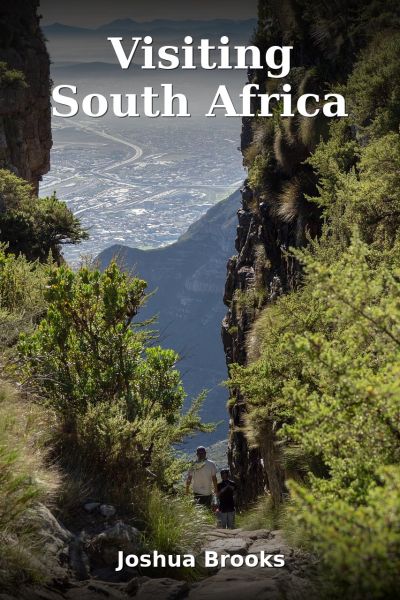
Most travel guides tell you where to go; this one tells you how to actually get there, stay safe, and travel without leaving a mess behind. Joshua Brooks's Visiting South Africa: A Guide for Tourists treats the country's complexity as a feature, not a footnote, weaving practical logistics through every chapter so that the adventure survives contact with reality.
What the book is about
The book runs twenty-five chapters, moving chronologically from pre-trip decisions — when to visit, visa rules, flights, internal transport — through regional deep-dives (Western Cape, Gauteng, Kruger, KwaZulu-Natal, Eastern Cape, and the four less-visited provinces) into thematic sections on wildlife, adventure, culture, food and wine, and the nitty-gritty of money, health, language, electricity, connectivity, and responsible tourism. It's written for independent travellers who want to self-drive, use public transport, or mix both, and it assumes no prior familiarity with South African systems. The tone is instructional but not sterile: Brooks explains why a rule exists (e.g., the two-blank-page passport requirement) and what happens if you ignore it, which makes the advice stick.
The visa and passport gauntlet is real — and specific
Chapter Two devotes more space to entry requirements than many guides give to an entire region. Brooks stresses that "immigration regulations are not static; they can, and often do, change with little advance warning" and walks through the two-blank-consecutive-visa-page rule, the thirty-day-post-departure validity minimum, and the layered documentation needed for minors — unabridged birth certificates, parental consent affidavits, custody orders. He notes that airlines enforce these rules at check-in because they bear the cost of returning inadmissible passengers. The chapter reads less like a checklist and more like a risk-management briefing, which is exactly what a first-time visitor needs.
Load shedding as a planning constraint, not a surprise
Chapter Twenty treats scheduled power cuts as a design parameter for your trip. Brooks explains the stage system (Stage 1 through 4+), the difference between Eskom-direct and municipal schedules, and the practical fallout: traffic lights ("robots") become four-way stops, ATMs and card machines go dark, and accommodation backup varies wildly. He recommends the app EskomSePush, high-capacity power banks, a standalone torch, and proactive charging habits. The advice is calm: "Don't let the prospect of load shedding deter you from visiting. It is a manageable inconvenience rather than an insurmountable barrier."
Wildlife ethics get a dedicated, unsparing framework
Chapter Twenty-Three separates ethical encounters from exploitative ones with a clear test: "the animal's welfare, natural behaviour, and conservation status must always take precedence over human entertainment, convenience, or profit." Brooks dismantles cub-petting and predator-walking operations, tracing the pipeline from breeding facilities to canned hunting, and applies the same scrutiny to elephant riding ("phajaan" training, spinal damage) and primate contact (disease transmission, stress). He gives readers a rubric for evaluating sanctuaries — non-profit status, hands-off policies, transparency about sourcing — and urges reporting concerns to the NSPCA. It's the most consequential chapter for anyone who wants their wildlife spending to align with their values.
Regional climate logic replaces a single "best time"
Chapter One refuses to name one ideal month. Instead, it maps the country's opposing seasonal patterns: dry winter (May–September) for Kruger and northern safaris versus wet summer (November–March) for Cape Town's beaches and vineyards. The Mediterranean Western Cape peaks in summer; subtropical KwaZulu-Natal is most comfortable in its dry winter. Brooks identifies September as a rare sweet spot — spring blooms and whale watching in the Cape, lingering dry-season game viewing in Kruger, mild temperatures in Gauteng and KZN — but insists the choice depends on "your primary interests." This regional honesty prevents the common mistake of booking a single itinerary that guarantees bad weather somewhere.
Community involvement means follows the money
Chapter Twenty-Four moves beyond feel-good rhetoric to economic mechanics. Brooks advocates for locally owned guesthouses over chains, community-run craft cooperatives over imported curios, and Community-Based Tourism Enterprises (CBTEs) where "the economic benefits of tourism flow directly back into the community." He warns against short-term voluntourism that can displace local labour, and against handing cash or sweets to children, which "can discourage school attendance and foster a culture of begging." The chapter treats respect as a set of concrete behaviors — ask before photographing, dress modestly in rural areas, use registered guides for township visits — rather than an abstract virtue.
Who should read this
Travellers planning a first or complex multi-region trip to South Africa — especially those intending to self-drive, combine safari with city and coast, or travel with children — will find the book indispensable for its systems-level view. Readers who only want a curated list of top lodges and photo spots will find it dense; the detail on RICA registration for SIM cards, toll-road payment mechanics, and VAT refund procedures is there for a reason. For anyone who prefers to arrive prepared rather than improvise, Brooks delivers a reference that earns its shelf space.
Read “Visiting South Africa” on MixCache.com →
Please log in or create an account to leave a comment.
No comments yet. Be the first to say something.