
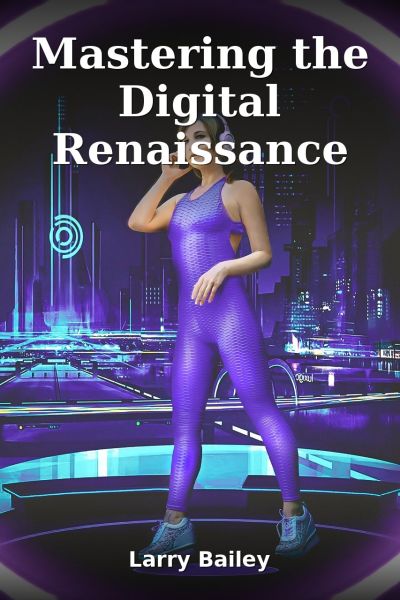
The Digital Renaissance isn't a distant horizon — it's the hum of servers and the glow of screens surrounding us right now. Larry Bailey's Mastering the Digital Renaissance treats this era with the gravity it deserves, framing today's technological convergence as a cultural shift on par with the historical Renaissance, but with algorithms and connected devices replacing paintbrushes and chisels. The result is a sprawling, 25-chapter framework that moves fluently from technical foundations to societal implications without losing sight of the human element.
What the book is about
The book unfolds in five interconnected parts. Chapters 1–5 establish the technological bedrock: the historical arc from punch cards to smartphones, then deep dives into artificial intelligence, machine learning, blockchain, and the Internet of Things. Chapters 6–10 examine how these technologies reshape finance, healthcare, manufacturing, and the power dynamics between tech giants and startups. Chapters 11–15 explore the creative economy — digital art, music, storytelling, and design thinking. Chapters 16–19 tackle work, education, and social structures in a connected world. The final six chapters pivot to ethics, lifelong learning, digital literacy, creativity, and a closing toolkit of strategies for individuals and organizations. Bailey writes for a broad audience — professionals navigating career shifts, leaders making technology decisions, and curious readers who want a structured map of the landscape — assuming no specialized technical background but rewarding careful attention.
The convergence that changes everything
Bailey's central insight is that AI, machine learning, blockchain, and IoT aren't parallel tracks; they amplify each other. Chapter 2 describes AI as "the engine of transformation across industries," while Chapter 3 clarifies that machine learning — "teaching a computer to learn from examples" — is the fuel. Chapter 4 moves blockchain beyond cryptocurrency, calling it "a foundational technology with far-reaching implications" for supply chains, healthcare records, and voting systems. Chapter 5 shows IoT turning everyday objects into "intelligent partners that anticipate our needs." The synthesis appears in the Introduction: "These technologies are not operating in isolation; they are interacting and amplifying each other, creating a synergistic effect that is accelerating the pace of change to an unprecedented degree." This systems view distinguishes the book from single-technology primers.
Industries rewritten from the inside
Rather than generic disruption rhetoric, Bailey walks through specific sectors. Chapter 8 on fintech details how "online lending platforms use algorithms and data analytics to assess creditworthiness, automating the loan application process and reducing the need for human underwriters," while central bank digital currencies and DeFi protocols "recreate traditional financial services in a decentralized and permissionless way." Chapter 9's healthcare revolution centers on personalized medicine: "Genomics... is playing a central role... Pharmacogenomics studies how genes affect an individual's response to drugs." Chapter 10's Manufacturing 4.0 introduces digital twins — "a dynamic, up-to-date model that mirrors the physical world" — and additive manufacturing that enables "mass customization" over mass production. Each chapter balances opportunity with friction: regulatory uncertainty, legacy infrastructure, workforce gaps.
Creativity as core competency, not luxury
The creative economy section reframes artistic practice as economic infrastructure. Chapter 11 notes that "ideas, innovation, and artistic expression are the key commodities, and technology has become the primary enabler." Chapter 12 surveys digital art from generative algorithms to NFTs, acknowledging the environmental debate: "The energy consumption associated with blockchain technology... can be significant." Chapter 13 traces music's journey from MP3s to AI composition tools and virtual concerts in gaming platforms. Chapter 14 introduces transmedia storytelling — "a technique where a story is told across multiple platforms and formats" — citing the Marvel Cinematic Universe as a prime example. Chapter 15 positions design thinking as "a problem-solving approach that prioritizes user needs and iterative development," applicable far beyond product design. Together these chapters argue that creative fluency is now a survival skill across roles.
Work, workplace, and the human factor
Chapters 16 and 17 form a paired analysis of labor's transformation. Chapter 16 documents the shift to remote collaboration and the gig economy, noting that "the lack of face-to-face interaction can lead to feelings of isolation, loneliness, and disconnection" while acknowledging "reduced overhead costs" and "greater diversity and inclusion" for employers. Chapter 17 complicates the automation narrative: "While some jobs will undoubtedly be eliminated, automation also creates new jobs, often requiring different skills." The concept of "augmented work" — "humans and machines work collaboratively, leveraging their respective strengths" — replaces simple replacement fears. Bailey emphasizes "soft skills" like communication and adaptability alongside technical literacy, and flags algorithmic bias in hiring tools as an urgent ethical frontier.
Ethics, literacy, and the lifelong curriculum
The final third of the book operates as a practical philosophy. Chapter 20 frames privacy, security, and bias as design requirements: "Privacy by design... emphasizes proactive measures to protect privacy, rather than treating it as an afterthought." Chapter 21 declares lifelong learning mandatory: "The 'half-life' of knowledge... is shrinking dramatically." Chapter 22 defines digital literacy expansively — "not a static skillset; it's a constantly evolving set of competencies" spanning information evaluation, algorithmic awareness, and digital citizenship. Chapter 23 offers concrete creativity practices: "creative constraints... can force us to think more creatively and find innovative solutions." Chapter 24 advocates "value-sensitive design" and ethical impact assessments. Chapter 25 distills a personal toolkit: growth mindset, digital literacy, entrepreneurial thinking, portfolio careers, and "fail fast, learn fast" experimentation. The through-line is agency — readers are urged to "actively participate in shaping a future where technology serves humanity's best interests."
Who should read this
Professionals in transition — mid-career managers, educators, healthcare administrators, creatives — will find the industry-specific chapters immediately applicable. Leaders responsible for technology strategy or workforce planning get a cohesive vocabulary for cross-functional conversations. General readers seeking a single volume that connects technical concepts to daily life will appreciate the accessible prose and real-world examples. Readers wanting deep technical tutorials, coding guides, or narrow policy analyses should look elsewhere; this is a map, not a manual. For anyone sensing the ground shifting beneath their feet and wanting a structured way to orient themselves, Mastering the Digital Renaissance delivers exactly that — a compass calibrated for continuous change.
Read “Mastering the Digital Renaissance” on MixCache.com →
Please log in or create an account to leave a comment.
No comments yet. Be the first to say something.