
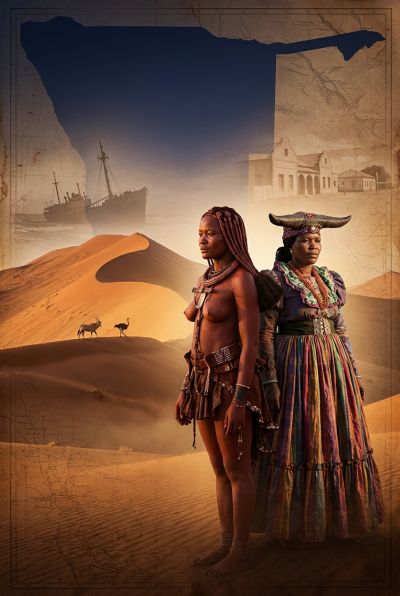
To understand Namibia is to understand a land shaped by extremes: the world's oldest desert meeting a nutrient-rich ocean current, vast mineral wealth coexisting with deep poverty, and a liberation movement that became a governing party still wrestling with the promises of 1990. David Briggs's A History of Namibia does not merely chronicle events; it maps how geography, colonial violence, and international diplomacy forged a nation that remains, in many ways, a work in progress.
What the book covers and how it's built
The book unfolds in twenty-five chapters, moving chronologically from the 25,000-year-old rock art at Twyfelfontein to the 2024 election of Netumbo Nandi-Ndaitwah, Namibia's first female president. Briggs structures the narrative around three major ruptures: the establishment of German South West Africa and the 1904–1908 Herero and Namaqua genocide; the South African mandate that entrenched apartheid; and the armed struggle led by SWAPO that culminated in UN-supervised elections and independence on March 21, 1990. The final chapters examine the presidencies of Sam Nujoma, Hifikepunye Pohamba, and Hage Geingob, the stubborn persistence of land inequality, and the looming double boom of offshore oil and green hydrogen. The prose is measured and evidence-driven, drawing on colonial archives, UN records, oral histories, and recent investigative journalism. It assumes no prior knowledge but rewards readers who want structural explanations, not just a timeline.
The land as a historical actor
Briggs opens with a proposition that recurs throughout: Namibia's environment is not backdrop but protagonist. The Namib Desert, the Skeleton Coast, the Benguela Current, and the veterinary "Red Line" fence each shape political possibilities. The desert shielded the interior from European penetration for centuries; the cold current created one of Earth's richest fisheries; the Red Line, originally a disease barrier, hardened into an economic border that confined the black majority to overcrowded communal lands. In the introduction, Briggs writes that the country is "a place of paradox" where "breathtaking natural wealth coexists with deep poverty and a legacy of violence." This environmental determinism is not reductive — it explains why colonial powers wanted the coast but ignored the interior, why the contract labor system depended on migrant men from the north, and why today's green hydrogen projects cluster near Lüderitz. The land, in Briggs's telling, sets the constraints within which human agency operates.
The genocide that structured a century
Chapter Four, "A Brutal Reign," is the moral and analytical center of the book. Briggs details how Governor Theodor Leutwein's "Leutwein System" of divide-and-rule gave way to Lothar von Trotha's Vernichtungsbefehl — the extermination order that declared, "Any Herero found inside the German frontier, with or without a gun, with or without cattle, will be shot. I will no longer accept women and children, I will drive them back to their people or I will have them shot at." The subsequent concentration camps, notably Shark Island, killed an estimated 80 percent of the Herero and 50 percent of the Nama. Briggs connects this directly to later history: the land confiscations that followed created the white commercial farms that still dominate the best agricultural soil; the pass laws and labor compounds pioneered by Germans were adopted and expanded by South Africa; and the trauma informs the still-unresolved reparations talks with Germany. The 2021 joint declaration, which avoided the word "reparations" and was rejected by many Herero and Nama traditional leaders, shows how the genocide's legal and moral weight persists.
International law as a weapon of the weak
One of the book's most distinctive threads is the decades-long diplomatic campaign at the United Nations. Chapter Ten traces how Ethiopia and Liberia brought a case against South Africa at the International Court of Justice in 1960, only to lose on a procedural technicality in 1966 — a defeat that Briggs notes "was the final nail in the coffin of non-violent resistance" and preceded the first PLAN attack at Omugulugwombashe by a month. The UN's response was unprecedented: Resolution 2145 terminated the mandate, Resolution 2372 renamed the territory Namibia, and the 1971 ICJ advisory opinion declared South Africa's presence illegal, obligating all member states to withhold recognition. Briggs shows how SWAPO leveraged these rulings to gain "sole and authentic representative" status, turning legal isolation into material support from the Eastern Bloc and frontline states. The diplomacy was not abstract; it dictated the terms of the 1988 New York Accords that linked Cuban withdrawal from Angola to Namibian independence under Resolution 435.
The uneasy architecture of reconciliation
Independence did not bring a clean break. Chapter Sixteen describes how Nujoma's government integrated PLAN guerrillas and SWATF soldiers into a single Namibian Defence Force under British supervision — "an extraordinary feat of reconciliation" that prevented a white exodus but left the economy's racial geography intact. The constitution, drafted in eighty days by a Constituent Assembly where SWAPO fell short of a two-thirds majority, entrenched property protections (Article 16) that still constrain land reform. Briggs is candid about the compromises: the "willing buyer, willing seller" policy, the 1998 constitutional amendment allowing Nujoma a third term, the Caprivi secession crisis and its brutal crackdown, the DRC intervention, and the Fishrot corruption scandal that saw two cabinet ministers arrested. The "Namibian House" metaphor of Geingob's presidency aimed to include everyone, but the 2019 election — where Geingob's vote share dropped from 87 percent to 56 percent and an independent candidate took nearly 30 percent — suggests the house's foundations are shifting.
Two energy futures, one climate reality
The final chapter juxtaposes two transformative prospects. The Venus and Graff oil discoveries, with first production targeted for 2029, could triple GDP; the ten-billion-dollar Hyphen green hydrogen project near Lüderitz aims to export millions of tonnes of green ammonia to Europe. Briggs notes the government has created the Welwitschia Sovereign Wealth Fund, modeled on Norway's, to avoid the resource curse. Yet both projects demand massive water in the driest country in sub-Saharan Africa. Windhoek already recycles wastewater for drinking; a second large desalination plant is planned. Climate change, Briggs argues, is not a future threat but a present constraint: droughts are more frequent, the Benguela Current is warming, and the social contract — already strained by 37 percent youth unemployment and sprawling informal settlements — will be tested by how the new wealth is distributed. The book closes with the observation that "the story of Namibia's future is yet to be written, but its opening chapters promise to be every bit as dramatic as its past."
Who should read this
Readers wanting a single-volume political history that connects rock art to green hydrogen will find this indispensable. Scholars of African decolonization, international law, or resource governance will appreciate the detailed treatment of the UN/ICJ campaign and the post-independence political economy. General readers interested in how a liberation movement governs — and where it struggles — will get a clear-eyed account without hagiography or condemnation. Those looking for cultural history, oral testimony, or deep dives into pre-colonial societies may find the scope necessarily compressed; Briggs prioritizes the colonial and post-colonial state. The book is long but not dense, and its chapter structure makes it easy to read in segments. If you want to understand why Namibia's borders, inequality, and future energy bets look the way they do, this is the place to start.
Read “A History of Namibia” on MixCache.com →
Please log in or create an account to leave a comment.
No comments yet. Be the first to say something.