
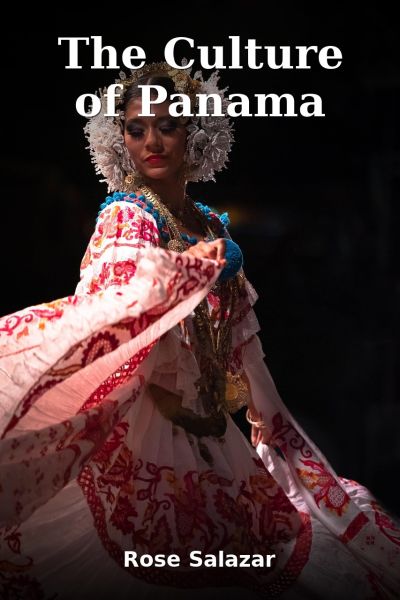
Panama tends to arrive in the global imagination as a shortcut — a 51-mile waterway that reshaped maritime trade. But as Rose Salazar makes clear from the opening pages of The Culture of Panama: An Introduction for Beginners, the country's true significance lies in its role as a cultural land bridge where continents, oceans, and peoples have converged for millennia. This book unpacks that convergence with the thoroughness of a reference work and the warmth of a travelogue.
What the book is about
Structured across 25 chapters, the book moves chronologically and thematically from geology to globalization. It begins with the physical isthmus — its volcanic spine, twin coastlines, and the Darién Gap — then traces human settlement from pre-Columbian Indigenous societies through Spanish colonization, the African diaspora, the Canal-era immigration boom, and into contemporary urban life. Chapters 12–16 dive into expressive culture: textile arts (especially Guna molas), music from tamborito to reggaeton, dance traditions like Congo and cumbia, and a cuisine built on rice, beans, plantains, and coconut milk. Later chapters examine daily etiquette, religious syncretism, festivals such as Carnaval and Fiestas Patrias, and the tension between preserving heritage and embracing modernity. The intended reader is explicitly broad: students, travelers, or "simply curious" people seeking a comprehensive but accessible overview.
Geography as cultural destiny
Salazar argues that Panama's serpentine east-west orientation — unique among nations — has actively shaped every layer of its culture. The central mountain spine creates microclimates that fostered distinct coastal cultures: the wetter, more isolated Caribbean side nurtured Afro-Panamanian communities with maritime traditions, while the Pacific side became the corridor for Spanish colonial expansion and later the capital. The Darién Gap, "one of the most biodiverse regions on Earth," functioned as both barrier and sanctuary, allowing Indigenous groups to maintain autonomy. Even the Canal, often treated as pure engineering, is framed as "a symbol of Panama's strategic importance and its enduring connection to the wider world." This geographical determinism isn't reductive; it's the organizing logic for understanding why Panama became a demographic magnet.
A mosaic built on three foundations, then layered
The book's demographic narrative rests on what Salazar calls "the bedrock of Panama's mestizo population": Indigenous peoples, Spanish colonizers, and enslaved Africans. Chapter 3 details seven distinct Indigenous groups — Guna, Ngäbe-Buglé, Emberá, Wounaan, Naso, Bribri, and Bokota — each with their own comarcas, languages, and artistic traditions. Chapter 4 shows how Spanish institutions (language, Catholicism, legal codes, the hacienda system) overlaid but never erased that foundation. Chapter 5 reveals the African contribution as "profound and undeniable," from the cimarrones who founded free palenques to the drum patterns that drive tamborito and Congo. The Canal era (Chapter 6) then added Afro-Antilleans from Barbados and Jamaica, Chinese railroad workers, European engineers, and American administrators — creating the "Gold Roll/Silver Roll" segregation that "fostered resentment" but also forced daily interaction across difference. Later waves — Jewish, Arab, Venezuelan — deepened the mix. The result is a national identity "not monolithic but rather a dynamic synthesis."
Expressive culture as living history
Salazar devotes four full chapters to arts that double as historical archives. The Guna mola — reverse-appliqué panels originally worn on women's blouses — encodes "geometric patterns, animals, plants, and scenes from Guna mythology and daily life." Emberá and Wounaan basketry and tagua carvings map rainforest cosmologies. The sombrero pintado's black-and-white weave (not paint) signals regional pride. Musically, the tamborito's three-drum ensemble (caja, repicador, pujador) and call-and-response vocals trace directly to African forms, while the accordion-driven típico genre blends European instruments with rural storytelling. Dance operates similarly: Congo performances in Portobelo "re-enact the history of slavery, rebellion, and the quest for freedom" through costumed characters like the reina and diablo. These aren't fossilized traditions; they appear at Carnaval, fiestas patronales, and school competitions, adapting while retaining core symbolism.
Everyday life: family, time, and negotiation
Chapters 8–11 and 17 translate macro-history into micro-interactions. Panamanian Spanish absorbs Indigenous, African, and English loanwords; "hora panameña" reflects a relational rather than clock-driven punctuality; greetings require cheek kisses or handshakes before any business. The extended family — including compadres (godparents) — functions as "a robust support system from birth through old age." Women navigate a society where "machismo, while gradually diminishing, still presents challenges" yet Guna matriarchy and Afro-Panamanian female leadership offer counter-models. Urban Panama City resembles Miami or Dubai with its skyscrapers and bilingual professionals, while "el interior" maintains agricultural rhythms, pollera pageantry, and stronger Catholic observance. The book resists romanticizing either pole, noting rural outmigration and urban inequality alike.
Preservation as active negotiation
The final chapter frames cultural survival not as nostalgia but as strategy. Bilingual education in comarcas, fair-trade mola cooperatives, festival funding, and culinary tourism are presented as deliberate choices. Salazar notes that "protecting their natural heritage is synonymous with protecting their cultural soul" for many Indigenous communities. Even sports — baseball's MLB pipeline (Rod Carew, Mariano Rivera) and soccer's 2018 World Cup run ("La Marea Roja") — become "powerful unifying forces" that "transcend regional differences." The book closes with a pragmatic optimism: Panama's identity "is not about creating a stagnant, unchanging culture" but "a continuous, conscious effort to value, celebrate, and adapt its rich heritage in meaningful ways."
Who should read this
Travelers wanting context beyond guidebook highlights will find the etiquette, festival calendar, and regional breakdowns immediately useful. Students of Latin American studies or diaspora cultures get a well-structured case study in creolization. General readers curious about how geography drives demographics will appreciate the clear causal chains. The book's breadth means specialists in any single topic — say, Guna textiles or Canal Zone labor history — will want deeper monographs, but as a first synthesis it succeeds admirably. If you've only known Panama as a canal, this is the correction you need.
Read “The Culture of Panama” on MixCache.com →
Please log in or create an account to leave a comment.
No comments yet. Be the first to say something.