
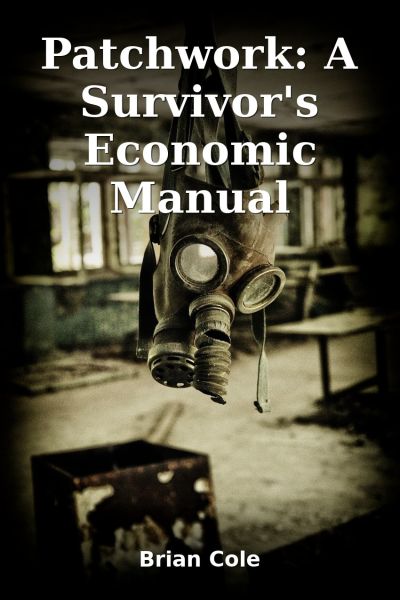
When the dollar dies, what takes its place? Brian Cole's Patchwork: A Survivor's Economic Manual answers that question not with theory but with a novella that watches a train-depot community stumble, argue, and eventually systematize its way from desperate barter to a regional monetary union. The result is a rare hybrid: a page-turning survival story that doubles as a master class in microeconomics, showing how supply curves, credit markets, and public-goods provision re-emerge when the state is gone but scarcity remains.
What the book is about
The book follows a former economics professor who becomes the unofficial chronicler of a survivor enclave at an old rail depot. Across twenty-five chapters, the narrative tracks the community's economic evolution: the first chaotic market days where a can of sardines trades for toilet paper (Chapter 1), the invention of a chalk-ledger to cut search costs (Chapter 3), the baking of iron-flecked "marks" that become commodity money backed by a chicken standard (Chapters 4–5), the creation of a protection levy and a labor lottery to fund defense and share dangerous work (Chapters 6, 19), and the eventual formation of a multi-settlement "Salt Standard" and a joint governance framework called the Accord (Chapters 20, 22–23). Each chapter isolates a core concept — adverse selection, moral hazard, comparative advantage, the winner's curse — and lets the characters rediscover it through trial, error, and the occasional bite mark. The intended reader is anyone who likes their economics grounded in human choice rather than abstract curves; no prior training is required, but professionals will appreciate the fidelity with which the models play out in mud and firelight.
Money emerges as a "truce," not a thing
Cole's central insight, voiced in the Introduction and proven repeatedly, is that "a good currency is a truce between what we have and what we hope to make." The depot's first medium of exchange isn't gold or paper but Marta's cigarettes, which work because they're "compact, portable, and desired by more than one person" (Chapter 2). When cigarettes prove too consumable and variable, the community mints "marks" — dense, iron-dusted hardtack stamped with a cross and verified by a lodestone (Chapter 4). Later, Tomás's live chickens become the reserve asset: "a measure of wealth that walked, clucked, and laid its own interest" (Chapter 5). Each iteration teaches the same lesson: money is memory and trust made tangible. As the narrator reflects, "The point is coordination — of hands, hopes, and hazards — so that tomorrow's work has somewhere safe to sleep."
Public goods force the invention of taxation
The community's first real fiscal crisis arrives not from hunger but from bandits. Security is a textbook public good — non-excludable and non-rivalrous — and the depot learns the hard way that voluntary contributions fail. After a probing attack kills a guard, the council institutes a "Protection Levy" on shelters and market stalls, collected in marks and enforced by reputation marks on the ledger (Chapter 6). The levy funds a standing guard force, signal mirrors, and eventually a network of shared waystations. Later, when routine infrastructure — water mains, granaries, canal locks — demands steady funding, the ad hoc levies coalesce into a formal "Community Revenue Assessment" with progressive brackets and a hard cap of five marks per month (Chapter 22). The chapter titled "The Day We Taxed Ourselves" captures the psychological shift: "The levy was protection money, paid grudgingly to keep the wolves at bay. The tax is a membership fee, paid willingly to belong to something worth belonging to."
Information asymmetry gets solved by reputation, not regulation
Early trades founder on the "lemon problem": sealed bottles of water can't be verified without opening them, destroying their trade value. The breakthrough comes from Reyes, an ex-convict who scratches a verification mark on glass after tasting the contents, turning his personal credibility into a portable brand (Chapter 4). The system scales into a verification co-op: distinct notches for water, preserved food, medicines — each backed by the verifier's reputation, which collapses if a single mark proves false. Later, a Rumor Board on the ledger logs every scrap of intelligence with a source and a verification status, turning gossip into a public good (Chapter 15). The pattern repeats: when asymmetric information threatens a market, the community builds a transparent ledger and lets social exclusion do the enforcement work that courts once did.
Specialization appears as survival strategy, not luxury
The depot's productivity leap comes when people stop being generalists. Priya takes over water systems full-time and doubles collection efficiency; Maria turns mending into a repair shop with a published price list; Dario concentrates on engines and stops trying to farm (Chapter 9). The narrator explicitly names comparative advantage when Margot the baker realizes that an hour splitting wood costs her six loaves of bread, while Silas can split twice the wood in the same time (Chapter 10). "Better for each to do what they did best and trade," the text notes. The gains are measurable: total output roughly doubles in a month. But specialization creates fragility — when Priya falls ill, only she understands the filtration valves — so the community adopts a "rule of two": every critical system must have at least two competent operators (Chapter 9).
Governance reduces to exit, voice, and a gate that swings both ways
The Accord, hammered out after a dispute over a pair of scissors (Chapter 14), establishes property rights, a rotating council, and the right to leave without penalty. That last article becomes decisive when Dario, the depot's best mechanic, walks out over spending priorities he couldn't change (Chapter 23). His departure triggers a wave of dissent that forces the council to commission an independent review of the Protection Levy and put the result to a community vote — the levy is cut by thirty percent. The episode illustrates Albert Hirschman's exit-voice framework in real time: "The threat of departure kept the system honest. The act of voice kept it responsive." Later, when a militaristic settlement called Fort Carmichael appears on the southern flank, the network chooses invitation over embargo, offering membership on the same terms as everyone else — a bet that connection is a stronger currency than coercion (Chapter 25).
Who should read this
Readers who enjoy economic history, post-apocalyptic fiction, or institutional economics will find Patchwork unusually rewarding. It works as a novel — characters have distinct voices, the stakes feel visceral, and the auction scenes crackle with tension — but it also functions as a case-study library for concepts usually taught in sterile abstraction. Skip it if you want pure escapism or a traditional zombie thriller; the undead are background pressure, not foreground spectacle. For everyone else, it's a reminder that the most durable currency has always been "a community's belief in its own tomorrow."
Read “Patchwork: A Survivor's Economic Manual” on MixCache.com →
Please log in or create an account to leave a comment.
No comments yet. Be the first to say something.