
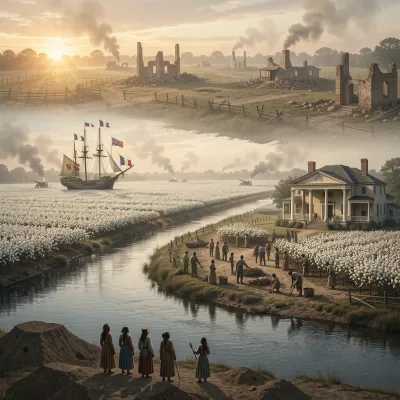
Mississippi has always been a study in extremes: the richest soil and the poorest people, the birthplace of American music and the stronghold of Jim Crow, a land of literary genius and persistent illiteracy. Mark Montague's A History of Mississippi does not flatten these contradictions. Instead, it follows them across 25 chapters and 12,000 years, showing how each era's choices — about land, labor, race, and power — echo into the next.
What the book is about
The book moves chronologically from the Paleo-Indians who hunted mastodons near the retreating ice sheets through the 2020 retirement of the Confederate-emblazoned state flag. Its 25 chapters are grouped into clear eras: the pre-contact Mississippian cultures and the Choctaw, Chickasaw, and Natchez nations (Chapter 1); European exploration and colonial rivalry among France, Britain, and Spain (Chapter 2); territorial formation and the road to statehood in 1817 (Chapters 3–4); the explosive rise of King Cotton and the planter class (Chapter 5); the daily reality of slavery (Chapter 6); secession, Civil War, and the siege of Vicksburg (Chapters 7–8); Reconstruction's brief biracial democracy and its violent overthrow (Chapter 9); the construction of Jim Crow through the 1890 constitution (Chapter 10); the Populist revolt and its defeat by racial demagoguery (Chapter 11); the Progressive era's whites-only reforms (Chapter 12); the Great Migration and the 1927 flood (Chapter 13); the Depression and the New Deal's double-edged relief (Chapters 14–15); World War II's transformation of the economy and society (Chapter 16); the post-war Sunbelt boom, mechanization of cotton, and the Dixiecrat revolt (Chapter 17); the Civil Rights Movement, Freedom Summer, and the MFDP challenge (Chapters 18–19); the realignment of modern politics (Chapter 20); economic diversification into catfish, auto plants, and casinos (Chapter 21); the Delta blues and its global legacy (Chapter 22); the Southern Renaissance of Faulkner, Welty, and Wright (Chapter 23); Hurricane Katrina's devastation and uneven recovery (Chapter 24); and the 21st-century struggles over symbols, infrastructure, and identity (Chapter 25). The intended reader is anyone who wants a single-volume narrative that refuses to treat Mississippi as a sideshow to American history, showing instead how the state's particular struggles illuminate national ones.
The land before Mississippi: 12,000 years of indigenous engineering
Long before Hernando de Soto's brutal entrada, the region hosted sophisticated societies whose achievements challenge the "wilderness" myth. Chapter 1 details the Poverty Point culture (1730–1350 BCE), whose hunter-gatherers built massive earthen ridges and mounds without agriculture, trading copper from the Great Lakes and stone from the Appalachians. By 1000 CE, the Mississippian Period brought maize-based chiefdoms with flat-topped platform mounds — temples and elite residences — at centers like Emerald Mound, the second-largest pre-Columbian earthwork in the U.S. The Natchez, encountered by the French at the Grand Village, maintained a theocratic caste system with the "Great Sun" as divine ruler. Montague emphasizes: "This was not an empty land awaiting discovery, but an ancient and populated homeland, rich with the history, traditions, and lives of its first peoples." The forced removals of the 1830s (Treaties of Dancing Rabbit Creek and Pontotoc Creek) erased this presence to make way for cotton, a theft the book traces to its demographic and moral consequences.
King Cotton's double helix: wealth built on bondage
Chapters 5 and 6 form the book's economic and moral core. The cotton gin, the fertile Delta and Bluff Hills, and the domestic slave trade created a "Cotton Kingdom" where, by 1860, Mississippi produced 20 percent of the world's cotton and enslaved people outnumbered whites. Montague describes the "Flush Times" (1833–1837) as a speculative frenzy: "Towns sprang up overnight. Aspiring planters, land speculators, and merchants flooded into the newly opened Choctaw and Chickasaw cessions. Credit was easy to come by… Land prices soared, and fortunes were seemingly made in an instant." But the planter elite — fewer than 3 percent of whites — consolidated power while yeomen and poor whites were bound to the system by white supremacy. Chapter 6's portrait of slavery is unsparing: the Forks of the Road market at Natchez, the gang system's sunrise-to-sunset labor, the "understanding clause" that gave registrars discretion to deny Black voters, and the "invisible church" where spirituals encoded resistance. The Slave Code forbade teaching enslaved people to read; the penalty was "thirty-nine lashes with a whip." This system, Montague shows, was not a static backdrop but a dynamic, brutal machine that shaped every institution.
Vicksburg and the war that split the state
Chapter 8 renders the Vicksburg campaign with tactical clarity and human texture. Grant's audacious April 1863 river run past the batteries, the 47-day siege, civilians digging caves in loess clay, the diet of "peas, cornmeal, and mule meat" — these details ground the strategic turning point. The surrender on July 4, 1863, came one day after Gettysburg; Lincoln wrote, "The Father of Waters again goes unvexed to the sea." But Montague doesn't stop at the battlefield. He follows the war home: Sherman's Meridian raid (a preview of the March to the Sea), Nathan Bedford Forrest's cavalry raids, the collapse of slavery as thousands fled to contraband camps and enlisted in USCT regiments, and the state's utter ruin by 1865 — "its government in disarray, its economy in ruins, and its landscape scarred." The chapter makes clear that the war did not merely interrupt the Cotton Kingdom; it shattered the labor system and the political order that sustained it.
Reconstruction's promise and the 1890 counter-revolution
Chapter 9 and 10 form a devastating diptych. The 1868 constitution — drafted by a convention with 16 Black delegates — established universal male suffrage, public schools, and property rights for married women. Hiram Revels and Blanche K. Bruce reached the U.S. Senate. But the "Mississippi Plan" of 1875 used "rifle clubs" and "Red Shirts" to terrorize Black voters; Governor Ames pleaded for federal troops, and Grant refused. By 1890, a new constitution codified disenfranchisement through a poll tax and the infamous "understanding clause," which let white registrars pass illiterate whites while failing Black college professors. The result: "In 1890, there were an estimated 147,000 voting-age Black men in Mississippi. By 1892… fewer than 9,000 were registered to vote." Jim Crow laws followed, mandating separate Bibles in courtrooms, separate waiting rooms, and a disparity in school funding that was "vast and intentional." Lynching became "the brutal capstone of the Jim Crow system." Montague connects each legal mechanism to the political will that engineered it, showing how the 1890 constitution became a template for the South.
Freedom Summer, the MFDP, and the long political realignment
Chapters 18 and 19 bring the civil rights struggle into intimate focus. Medgar Evers' assassination, the Jackson Woolworth's sit-in (where Anne Moody and others were "covered in ketchup, mustard, and sugar"), and the 1964 disappearance of Chaney, Goodman, and Schwerner in Neshoba County are narrated with precision. The Freedom Schools' radical curriculum — Black history, the Haitian Revolution, the Declaration of Independence — aimed to "empower the students, to help them overcome the internalized sense of inferiority." The Mississippi Freedom Democratic Party's challenge at the 1964 Democratic Convention produced Fannie Lou Hamer's televised testimony: "Is this America… where we have to sleep with our telephones off the hook because our lives be threatened daily because we want to live as decent human beings?" The national party's compromise — two at-large seats — was rejected: "We didn't come all this way for no two seats." Chapter 20 traces the aftermath: the Voting Rights Act's immediate impact (Black registration from 6.7% to nearly 60% by 1968), the first Black legislator since Reconstruction (Robert Clark, 1967), Charles Evers' mayoral win in Fayette (1969), and the slow, racially polarized shift from Democratic to Republican dominance — completed when Kirk Fordice won the governorship in 1991. The realignment, Montague argues, was not inevitable but forged through federal intervention, Black activism, and white resistance.
Culture as witness: the blues and the literary renaissance
Chapters 22 and 23 argue that Mississippi's deepest truths emerged from its artists. The Delta blues — from Charley Patton's Dockery Plantation "school" to Robert Johnson's crossroads myth, from Skip James's Bentonia eeriness to Muddy Waters' electrification in Chicago — became "a universal language." Montague traces the lineage: Elvis covering Arthur "Big Boy" Crudup at Sun Studio, the Rolling Stones taking their name from a Muddy Waters song, British bands re-exporting the blues as rock. Meanwhile, Faulkner's Yoknapatawpha County, Welty's Jackson porches, and Wright's "emotional tuning fork" in Black Boy created a literature that "grapples critically with the legends of the 'Lost Cause,' the inescapable burden of the past, and the profound complexities of life in a society defined by race." Percy's Lanterns on the Levee and Williams's Clarksdale memories round out a chorus that refuses a single narrative. These chapters are not appendices; they are evidence that culture recorded what politics suppressed.
Who should read this
Readers who want a comprehensive, unflinching single-volume history of Mississippi — students, teachers, general readers, and anyone tracing the roots of modern American racial and economic politics — will find this book indispensable. It rewards patience; the narrative density means some chapters (particularly the colonial and territorial periods) require careful reading. Those seeking a thematic or argument-driven analysis rather than chronological narrative may wish to supplement with more specialized works. But for a clear-eyed, deeply researched journey from Emerald Mound to the Magnolia Flag, Montague delivers exactly what the title promises: a history of Mississippi that is also a history of America's unfinished reckoning.
Read “A History of Mississippi” on MixCache.com →
Please log in or create an account to leave a comment.
No comments yet. Be the first to say something.