
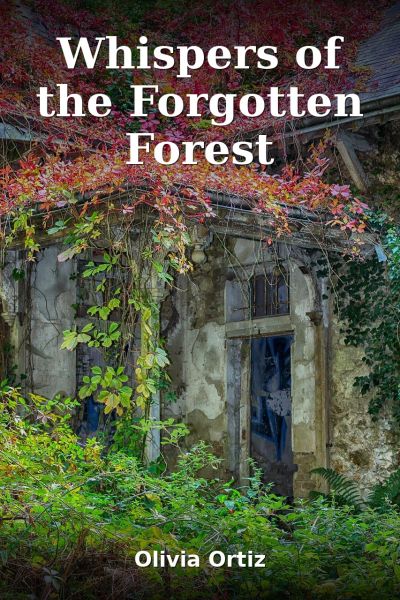
Most fantasy quests arm their heroes with swords or spells, but Finn O'Reilly carries a sketchpad and a compass. Olivia Ortiz's Whispers of the Forgotten Forest builds its entire narrative around the premise that seeing patterns—whether in geography or magic—is its own kind of power. The result is a fantasy adventure that feels both comfortably familiar and quietly subversive, rewarding readers who prefer their world-building layered with ecological and spiritual depth.
What the Book Is About
The novel follows Finn O'Reilly, a young cartographer from Oakhaven who discovers a timeworn map marked with a curious symbol: the Forgotten Forest. Drawn by legends of the Lumis Stone—an artifact said to "mend broken worlds" or "rend the fabric of fate itself"—Finn crosses the threshold beyond the "twin guardian stones" into a realm where maps whisper and ancient magic breathes. The story unfolds across twenty-five chapters that trace Finn's journey from the forest's edge through the Mire, the Whispering Caves, the Sunken Archives, and finally the Veil of Mist where the Lumis Stone resides. Along the way he gains allies: Lira, a telepathic wisp spirit; Elara, an enigmatic herbalist; and Kaelem, a banished fae warrior. Antagonists arrive in two flavors—Malakor, a sorcerer who seeks to dominate the Stone through brute force, and Lady Seraphina, his calculating successor who attempts to quantify and replicate its power through analytical devices. The book targets readers who enjoy intricate magical systems, environmental themes, and protagonists whose growth is intellectual and spiritual rather than purely martial.
The Cartographer's Eye as Magic System
Ortiz makes Finn's profession the lens through which the forest's magic becomes legible. Early on, Finn sketches a glyph from his mental map "without conscious thought," his hand moving instinctually to reproduce "a circle intertwined with a spiraling leaf" he'd only seen on the old parchment. Later, Elara confirms this isn't coincidence: "You have a rare gift, Finn. To not just see the land, but to feel its spirit, to translate the intangible into lines and forms." The novel treats cartography as a form of communion—Finn's maps evolve from physical surveys into "vibrant, almost impressionistic interpretations of the unseen," mapping "not just land, but spirit." This conceit pays off in the climax when Finn's re-woven forest defenses become "a living labyrinth" guided by his perception. The magic system never feels arbitrary because it's grounded in a skill the reader understands: observation, pattern recognition, and synthesis.
Two Villains, Two Philosophies of Corruption
The book distinguishes itself by pitting Finn against antagonists who represent different perversions of understanding. Malakor embodies brute domination: "He believes it will grant him ultimate control" and "seeks to twist the Lumis Stone to his will, to reshape destiny itself." His defeat comes when the Stone "fought back" and unleashed "a wave of pure, verdant energy" that stripped his power. Lady Seraphina, introduced in Chapter Sixteen, is more insidious. She declares: "Malakor failed because he sought to dominate, to twist. He did not understand the true nature of the Stone. I, however, have studied his mistakes." Her weapon is a brass-and-crystal device that attempts to "chart these, we can replicate them. Not wield the Stone directly, but mimic its influence." The contrast sharpens the novel's central argument: both force and reductionist analysis fail because the Lumis Stone "responds to purity of intent" and "is not a weapon to be wielded, but the very heart of balance." Seraphina's defeat—her device shattered, her ambition dissolved by Finn's flute melody—reinforces that the forest's magic cannot be reverse-engineered.
The Forest as Living Character
The Forgotten Forest isn't merely setting; it's a protagonist with agency, memory, and defenses. The Introduction establishes it as "a vast, intricate being" where "every shadow conceals both wonder and danger." This personification deepens through specific mechanisms: the Whispering Caves test "understanding, not strength"; the Mire's paths shift to confound intruders; the Labyrinth of Roots "shifts, grows, and entwines in response to the intent of those who enter." When Finn completes the Alchemist's Bargain, he doesn't just cast a spell—he "re-wove the very veils of the Forgotten Forest" so that "its paths will shift to protect its heart, guided by the wisdom you have poured into it." The forest's justice is restorative rather than punitive: Malakor and Seraphina are not killed but bound to Elder Runes, "their ambition replaced by a constant communion with creation itself." Even the opportunistic Clan of the Iron Heart receives purification rather than slaughter. This consistent logic makes the forest feel ancient and internally coherent, not a convenient plot device.
Sound as Conduit for Magic
A recurring motif ties auditory experience to magical authority. The forest's "song" guides Finn through the Hidden Vale; the Whispering Caves' illusions are auditory; the Elder Runes communicate through melody; and Finn's fae flute becomes his primary instrument of power. In the Sunken Archives, Finn disrupts Seraphina's analytical device by playing "a clear, pure note, like a single drop of crystal water" that causes her dials to spin "erratically." During the Reckoning, he channels "the full, complete Song of Lost Years" through the flute, producing "a wave of shimmering, multi-colored light" that purifies or dissolves invaders based on their willingness to accept harmony. The novel's final scene has Finn playing atop a cliff as "the ocean responded... waves... calmed into a gentle swell." This auditory thread gives the magic a sensory immediacy and provides Finn a non-violent means of agency consistent with his character.
Balance as Active Practice, Not Static State
Ortiz resists presenting harmony as a passive achievement. The Lumis Stone's power requires constant attunement: "The forest is resilient, Finn. But it needs constant attunement." After the Reckoning, Finn learns "the Stone's direct influence would be subtle, a persistent hum that guided, rather than dictated." His ongoing work involves traveling to places like industrial Ironspire, where he plays his flute to "subtly re-tune the very air, the very soil" and introduces engineers to "geological harmony" and "sustainable resonance." The transformed alchemist kneels and asks Finn to "teach me the true song of the earth." This portrayal of balance as daily practice—listening, adjusting, teaching—grounds the novel's spiritual themes in tangible action. The ending doesn't conclude with a coronation or a final battle won, but with Finn continuing his circuit, "a continuous act of being, of living in balance, of listening to the whispers of the world and helping it remember its own song."
Who Should Read This
Readers who enjoy fantasy with ecological consciousness, protagonists who solve problems through perception rather than combat, and magic systems rooted in metaphor will find much to appreciate. The pacing is deliberate—Ortiz spends chapters on Finn's apprenticeship with Elara and the cave trials—and the prose favors mythic resonance over gritty realism. Those seeking high body counts, moral ambiguity, or fast-paced plot twists may find the novel's earnestness and structural predictability less engaging. The book rewards patience: its pleasures accumulate through Finn's gradual competence, the forest's revealed depth, and the consistent internal logic of a world where understanding is the highest form of power.
Read “Whispers of the Forgotten Forest” on MixCache.com →
Please log in or create an account to leave a comment.
No comments yet. Be the first to say something.