
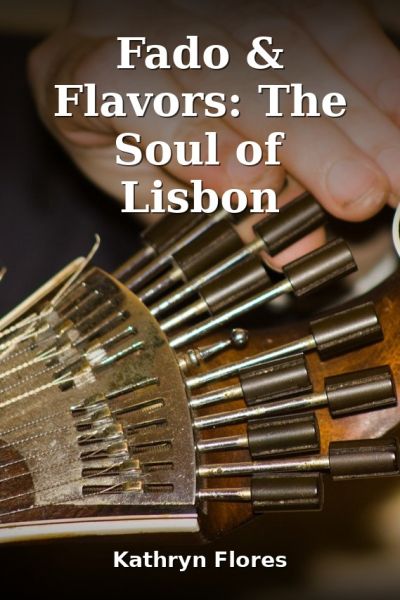
Lisbon does not hand itself over easily. It is a city of steep hills, narrow alleys, and long memories, where a Roman theater sits beneath a cathedral that was once a mosque, and the scent of grilled sardines mingles with the melancholy strains of a Portuguese guitar. Kathryn Flores understands this. Her book, Fado & Flavors: The Soul of Lisbon, does not merely catalog sights; it traces the fault lines where history, music, and cuisine intersect, showing how each layer of the city's past remains alive in its present.
What the book is about
The book unfolds across twenty-five chapters that move roughly chronologically but circle back repeatedly to the same neighborhoods, songs, and dishes. The first five chapters lay out Lisbon's foundations: Phoenician traders, Roman engineers, Moorish builders, the Age of Discovery, and the 1755 earthquake that leveled the city and gave rise to the Pombaline grid. Chapters six through ten walk the reader through Alfama, Bairro Alto, Belém, Mouraria, Graça, and a handful of lesser-known districts, treating each as a distinct character with its own rhythm. The next five chapters (eleven through fifteen) are devoted entirely to fado — its origins in working-class taverns, its golden age voices like Amália Rodrigues, the etiquette of the Casas de Fado, and its contemporary reinvention. Chapters sixteen through nineteen turn to the table: bacalhau in its countless forms, street-food staples like the bifana and prego, the monastic lineage of pastéis de nata, and the drinks and markets that anchor daily life. The final chapters offer recipes, a portrait of morning market rituals, an immersion in café culture, a calendar of festas, a survey of street art and design, and a practical closing guide for travelers and armchair dreamers alike. The intended reader is anyone who wants to understand Lisbon not as a checklist of monuments but as a living conversation between centuries.
History as geology: the city that refuses to flatten
Flores's most effective structural choice is to treat Lisbon's history as sediment. Chapter one opens with the Ulysses myth — the hero founding a city named for the siren Olyssipo — then immediately grounds it in archaeological fact: Phoenician "Allis Ubbo," Roman Olisipo, Visigothic rule. Chapter four devotes twenty pages to the 1755 earthquake, tsunami, and fire, quoting the Marquês de Pombal's famous directive: "Bury the dead and feed the living." The reconstruction that follows introduces the gaiola pombalina, a wooden cage embedded in masonry that made the new Baixa one of Europe's first earthquake-resistant cityscapes. Chapter five then contrasts this rational grid with the organic maze of Alfama, which "largely survived" the quake "due to its bedrock foundation and the flexibility of its Moorish-influenced construction." The effect is cumulative: the reader begins to feel the city's strata underfoot, each era visible in the next.
Fado as emotional infrastructure
If the streets are Lisbon's skeleton, fado is its nervous system. Chapters eleven through fifteen trace the music from its early-nineteenth-century emergence in the taverns of Alfama, Mouraria, and Bairro Alto — where sailors, dockworkers, and the marginalized sang of "everyday struggles, unrequited love, betrayal, and the profound, uniquely Portuguese sensation of saudade" — through the golden age of Amália Rodrigues, Alfredo Marceneiro, and Hermínia Silva, into the intimate rituals of the Casas de Fado and the genre's contemporary evolution with artists like Mariza, Ana Moura, and Carminho. Flores does not romanticize; she notes the "darker side" of fado's early milieu (brothels, spontaneous knife fights) and the commercial pressures that shaped later venues. She also explains the unwritten rules: silence during songs, waitstaff pausing service, applause only at the end. The result is a portrait of a tradition that remains "raw expression of joy, sorrow, and that profound saudade" rather than a museum piece.
Food as historical document
The culinary chapters work like edible archaeology. Chapter sixteen explains how bacalhau became "fiel amigo" (loyal friend) because salted cod could survive the long voyages of the Age of Discovery and satisfy Catholic fasting rules. Chapter seventeen breaks down the bifana (marinated pork simmered in its sauce) and the prego (garlic steak "nailed" to the grill), noting that the prego often appears as a "finisher" after a seafood meal — a tradition the author herself witnessed. Chapter eighteen traces the pastel de nata to the Jerónimos Monastery, where monks used leftover egg yolks from starching habits and clarifying wine, then sold the tarts after religious orders were dissolved in the 1830s. The recipe remains a "closely guarded secret, known only to a handful of master bakers." Even ginjinha, the sour-cherry liqueur served in chocolate cups in Óbidos, gets its origin story: a Galician friar at Santo António in the fifteenth or sixteenth century. Each dish carries a timestamp.
Neighborhoods as living communities, not postcards
Flores resists the tourist gaze. In Alfama (chapter six), she describes laundry strung across alleys, children playing in courtyards, and the pressure of short-term rentals on longtime residents. In Mouraria (chapter nine), she highlights the multicultural reality: "languages from across the globe mingle with the melodic tones of Portuguese," and the scent of "Portuguese stews to African spices" drifts from windows. Bairro Alto (chapter seven) is shown in its duality — quiet by day, "effervescent" by night — and the city's attempts to regulate noise without killing the district's soul. Even Belém (chapter eight), with its monumental monasteries and the queue at Pastéis de Belém, is framed as a place where the presidential palace sits beside a tropical botanical garden. The lesser-known districts of chapter ten — Príncipe Real, Estrela, Campo de Ourique, Alcântara, Ajuda — are presented as places where locals actually shop, eat, and live, complete with a flea market (Feira da Ladra) and a creative hub in a repurposed factory (LX Factory). The book's message: Lisbon's charm survives because people still live there.
A dual-purpose companion: guidebook and cultural history
The final chapter makes the book's hybrid intent explicit. It offers a Viva Viagem card for transit, warnings about pickpockets on Tram 28, the etiquette of declining the bread and olives that appear unbidden at restaurants, and tipping norms ("a small tip of a few euros for good service... rounding up the bill is appreciated"). But it also suggests ways to carry Lisbon home: cooking Caldo Verde while listening to Amália, reading Pessoa and Saramago, following contemporary street artists online. The recipes in chapter twenty — Caldo Verde, bifana, pastéis de nata, bacalhau à Brás — are written for a home kitchen, with technique notes like refogar (sautéing aromatics in olive oil) and assar (roasting). The book does not pretend to be exhaustive; it aims to be a "comprehensive celebration" that equips the reader to keep exploring.
Who should read this
This book rewards the reader who wants context before — or instead of — a guidebook's bullet points. It suits the traveler who lingers in a tasca long enough to hear the fado singer's voice crack, the cook who wants to know why the pastel de nata's custard is caramelized, and the armchair reader who enjoys urban history told through food and sound. Readers looking for a lightweight itinerary, glossy photography, or a purely practical phrasebook will find the narrative density slow going. But for anyone willing to walk Lisbon's hills in their mind first, Fado & Flavors offers a map drawn in stories, songs, and recipes — the kind that lasts longer than any paper ticket.
Read “Fado & Flavors: The Soul of Lisbon” on MixCache.com →
Please log in or create an account to leave a comment.
No comments yet. Be the first to say something.