
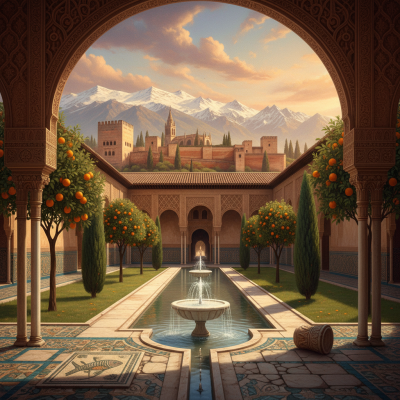
A History of Andalusia is a richly detailed chronicle that strips away romantic clichés to reveal the complex layers of a region shaped by millennia of crossroads. Miguel Gómez’s narrative unfolds as both a scholarly survey and a human story, tracing how each successive civilization—from Neolithic cave painters to modern tech parks—left an indelible imprint on southern Spain.
What the Book Is About
This 25-chapter work spans the entire arc of Andalusian history, beginning with geological origins and prehistoric settlements, moving through Phoenician trade, Roman province-hood, Visigothic transitions, Islamic conquest and the golden age of Al-Andalus, the Reconquista, colonial riches, and ending with the complexities of the 21st-century autonomous region. Written for general readers with a curiosity about history, the book assumes no specialist knowledge but rewards careful attention to its layered argument about identity, assimilation, and resilience. Its structure is chronological yet thematic, with each chapter focusing on a distinct period while highlighting recurring motifs like the tension between cultural fusion and social stratification.
The Deep Roots of Cultural Crossroads
The book opens with a striking assertion about Andalusia’s geography: “Situated at the southernmost extreme of Europe, separated from Africa by a mere nine miles of sea, Andalusia is the meeting point of two continents and the confluence of two great bodies of water.” This foundational idea frames the entire work. Gómez devotes early chapters to prehistoric peoples—Neanderthals in Gibraltar’s caves, painted artists in the Cueva de la Pileta—showing how the land’s natural resources and strategic position made it a magnet for settlement. The megalithic tombs of Los Millares and the Bronze Age Argar culture illustrate how early societies here were “the first true town in the Iberian Peninsula.” These layers set the stage for the region’s later history of repeated conquest and cultural synthesis.
The Myth and Reality of Islamic Convivencia
When discussing the Umayyad Emirate and Caliphate of Córdoba, Gómez confronts the romanticized notion of *convivencia*—the supposed harmonious coexistence of Muslims, Jews, and Christians. He acknowledges that “while they were subject to certain restrictions and a special tax, they were free to practice their religions and contributed significantly to the intellectual and economic dynamism of the state.” Yet he also notes the broader historical context: “The great wave of conquest in the 1230s and 1240s had fundamentally and permanently redrawn the map of Iberia.” The period’s real significance, he argues, lies not in a utopian social model but in how it fostered an environment where “scholars made groundbreaking advances in medicine, mathematics, and philosophy.” The intellectual flowering is presented as a product of proximity and pragmatism rather than universal tolerance.
The Reconquista and Its Bitter Aftermath
Gómez treats the fall of Granada not as a triumphant conclusion but as a catastrophic pivot point. The Treaty of Granada in 1492 promised religious freedom, but he frames its betrayal as inevitable: “Not all Muslims left. Many in the countryside, who were essential for agricultural labor, remained.” These *Moriscos* became a “large, alienated, and resentful minority,” their forced conversion destabilizing the social order. The narrative connects this early trauma to later events, showing how “the superficial unity imposed by the decrees of 1492 and 1502 had papered over deep fissures in the body politic.” The aftermath of 1492 thus becomes a lens through which to understand Andalusia’s later struggles with identity, exile, and the legacies of enforced assimilation.
Seville’s Global Moment and Its Limits
The Age of Discovery is portrayed as both Andalusia’s zenith and its trap. Gómez describes how “Seville was not merely a city in Spain; it was the capital of the world” during the height of the silver trade, transforming into “a bustling hub of a new global empire.” Yet he quickly complicates this prosperity: “The flood of American silver turned the city into a thriving cosmopolitan hub, fueled a golden age of painting, and forged enduring economic and cultural ties with the New World.” However, this wealth was also “a river of treasure… that flowed immediately out of the country to pay for troops in Flanders or debts in Genoa.” The silver influx becomes a metaphor for Andalusia’s recurring pattern: moments of extraordinary brilliance built on foundations that ultimately drained the region’s vitality.
The Twentieth Century’s Blood and Memory
Gómez handles the Spanish Civil War with stark clarity, showing how Andalusia became “a key and brutal theater of conflict.” The Nationalist advance under Franco is depicted not just as military maneuvering but as cultural erasure. In Granada, “the world-renowned poet and playwright Federico García Lorca… was arrested by Nationalist paramilitaries in August 1936 and murdered.” Post-war policies reinforced this erasure: “The great estates and the wandering herds of the powerful Mesta sheep-herders’ guild were banned” during the brief anarchist experiment, but under Franco, “the *latifundio* was triumphant, its power unchallenged and reinforced.” The Franco years are summarized as “a time of relative tranquility” that masked “deep and unresolved tensions.” The transition to democracy, however, is framed as genuinely transformative: “Andalusia had shrugged off the mantle of a stereotyped and marginalized periphery.”
Who Should Read This
A History of Andalusia rewards readers who want to move beyond postcard images of flamenco and Moorish palaces. History enthusiasts, students of cultural studies, and anyone curious about how identity forms in borderlands will find its scope compelling. The book’s density of detail and its thematic focus on recurring struggles with power and assimilation make it less suitable for casual tourists seeking light reading. Instead, it demands—and rewards—engagement with its central argument that Andalusia’s enduring character lies not in its legends but in its layered, often contradictory, historical experience.
Read “A History of Andalusia” on MixCache.com →
Please log in or create an account to leave a comment.
No comments yet. Be the first to say something.