
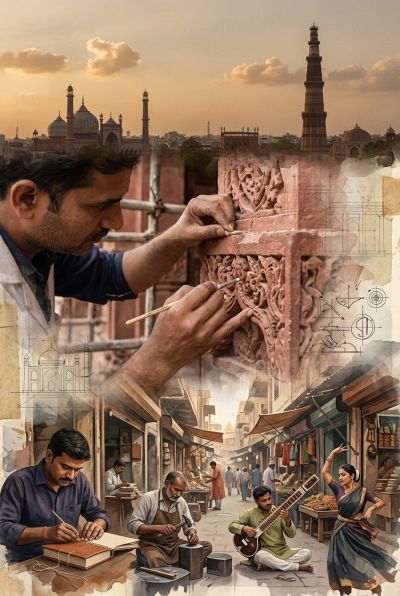
Heritage in Delhi is not a static catalog of monuments; it is a living negotiation among people, places, and time. This opening line from the Introduction sets the tone for Arthur Bailey’s detailed exploration of how the city’s multilayered heritage is constantly reshaped by law, institutions, community action, and competing urban pressures. The book moves beyond simple preservation tales to examine what works, what falters, and why, offering readers a grounded view of conservation as a civic project rather than a technical specialty.
What the book is about
Heritage Conservation in New Delhi is organized into three interlocking threads: stakeholder engagement, adaptive reuse, and legal and policy frameworks. After mapping Delhi’s historical layers in Chapter 1, the book walks readers through the constitutional and statutory foundations that govern protection, then introduces the array of actors—from the Archaeological Survey of India to local community groups—who negotiate those rules on the ground. Chapters 4‑15 dive into specific sites, ranging from the Humayun’s Tomb–Nizamuddin precinct to the Lutyens’ Bungalow Zone, while later chapters turn to intangible heritage such as qawwali, street foodways, and craft economies. The final chapter offers practical tools for practitioners, including heritage impact assessments, GIS‑based documentation, and innovative financing models. The intended reader is anyone involved in urban planning, heritage management, community activism, or simply curious about how a megacity negotiates its past while planning its future.
The legal framework that shapes preservation
Chapter 2 provides a clear, nuts‑and‑bolts view of the laws that dictate what can be touched, altered, or demolished in Delhi. The Ancient Monuments and Archaeological Sites and Remains Act of 1958 (AMASR Act) is described as the “primary legislation for safeguarding ancient and historical monuments, archaeological sites, and remains of national importance.” It defines an ancient monument as any structure “that is of historical, archaeological, or artistic interest and has existed for no less than one hundred years.” The Act creates a 100‑meter prohibited zone and a 200‑meter regulated zone around centrally protected monuments, a rule that later chapters show can both protect and impede urban life. Bailey also notes how the 2010 amendment led to the National Monuments Authority (NMA), which “regulates construction, repairs, and development activities within these zones” and is tasked with framing monument‑specific heritage bye‑laws. This legal scaffolding, while essential, often runs into friction with Master Plans, municipal bye‑laws, and the realities of dense, informal settlements.
Institutions and the people behind them
Chapter 3 reads like a directory of the city’s conservation ecosystem, emphasizing that no single agency can steer heritage outcomes alone. The Archaeological Survey of India (ASI) is portrayed as the “premier government organization… responsible for archaeological research and the protection of cultural heritage sites,” operating under a philosophy of minimal intervention and traditional materials. Complementing the ASI are bodies like the Delhi Development Authority (DDA), which shapes land use through Master Plans, and the New Delhi Municipal Council (NDMC), which enforces local building bye‑laws. The chapter also highlights non‑governmental players: INTACH’s extensive “Listing of Built Heritage of Delhi” provides a crucial inventory, while community voices—residents, religious trusts, market associations, and artisan groups—are described as “active custodians, inheritors, and often, the most vocal advocates for their local heritage.” The text stresses that successful conservation hinges on integrating these diverse stakeholders rather than imposing top‑down solutions.
Integrated conservation: linking monuments and livelihoods
Chapters 4 and 5 illustrate how monument restoration can be coupled with broader social and environmental benefits. In the Nizamuddin Revitalization Project, Bailey notes that “the monuments could not be isolated from the living community that surrounded them.” The project combined the meticulous repair of Humayun’s Tomb—where “over 200,000 square feet of stone masonry was carefully cleaned, repaired, or replaced”—with infrastructure upgrades, sanitation improvements, housing incentives, education and health initiatives, and livelihood generation for local artisans. The restoration of the tomb’s charbagh gardens revived a “sophisticated water management system” that brought the gardens back to life. Similarly, Sunder Nursery’s transformation from a neglected arboretum into a “significant green lung for Delhi” involved planting thousands of native trees, restoring fifteen heritage monuments, and creating micro‑habitat zones that now host 80 bird species and 60 butterfly species. These cases show that conservation can deliver ecological recovery, public space, and cultural vitality when it addresses both tangible fabric and living practices.
Adaptive reuse, gentrification, and the hotel‑haveli model
Chapter 10’s study of Dharampura Haveli offers a compelling look at private‑sector adaptive reuse and its social implications. The haveli, a “shadow of its former self” by the early 21st century, was acquired by Vijay Goel and painstakingly restored using traditional lime mortar, lakhori bricks, and original jharokhas. The team’s philosophy aimed to “reverse inappropriate alterations and reinstate the haveli's original splendor using traditional techniques and materials.” The eventual adaptive reuse turned the structure into a boutique heritage hotel and restaurant, a move that Bailey calls “a powerful exemplar” for demonstrating the economic viability of heritage conservation in a challenging urban context. Yet the chapter also flags the tension this creates: “The haveli's adaptive reuse into a luxury hotel also raised questions about accessibility and gentrification,” noting that high costs may exclude many Old Delhi residents and risk cultural divides. This duality—revival versus exclusion—runs through other chapters, such as the discussion of Hauz Khas Village’s transformation into a nightlife hub, where rising rents displaced long‑time residents and strained the medieval monuments amid commercial growth.
Modern heritage under threat: Hall of Nations and the Central Vista
Two chapters confront the fragility of post‑independence heritage. Chapter 17 recounts the demolition of the Hall of Nations at Pragati Maidan, a “world’s first and, at the time, largest‑span space‑frame structure built in reinforced concrete” designed by Raj Rewal. Despite international acclaim, the building was razed in 2017 because it fell short of a 60‑year age threshold in the Heritage Conservation Committee’s ruling, a “crucial loophole” that left modernist architecture vulnerable. Bailey quotes Rewal calling the demolition “an act of outrage,” and notes that the incident sparked debate about the need for heritage laws to evolve beyond arbitrary age limits. Chapter 16 turns to the Central Vista Redevelopment Project, which aimed to construct a new Parliament House, central secretariat, and official residences while reshaping Rajpath. Critics warned that the “high‑density central secretariat buildings would fundamentally alter” Lutyens’ low‑rise, sightline‑driven design, threatening the “ensemble heritage” of the precinct. The chapter records concerns about inadequate heritage impact assessments, the felling of mature trees, and the possible loss of “modern heritage” like the National Museum Annexe. Together, these cases underline how quickly recent architectural achievements can be lost when legal protections lag behind development pressures.
Tools for the future: impact assessments, data, and design
The final chapter equips readers with concrete methods to move from analysis to action. Bailey introduces the Heritage Impact Assessment (HIA) as a “crucial early‑warning system” that evaluates a project’s likely effects on heritage assets, including visual impacts, physical changes, and consequences for intangible practices such as traditional markets. He stresses that effective HIAs require baseline data, stakeholder engagement, and clear mitigation measures. Geographic Information Systems (GIS) and Lidar are highlighted as indispensable tools for mapping Delhi’s vast heritage, allowing planners to “visualize the overlap between a proposed development zone and heritage‑sensitive areas” and to create precise 3D models for restoration work. The chapter also advocates for adaptive reuse—citing Dharampura Haveli and Sunder Nursery—as a way to inject new life into historic structures while reducing waste and embodied energy. Financing mechanisms such as corporate social responsibility, philanthropy, and revenue‑generating reuse are presented as essential complements to public budgets. Ultimately, Bailey argues that treating heritage as a “dynamic resource rather than a static obstacle” can drive inclusive growth, environmental resilience, and cultural vitality in Delhi—and offers lessons for other rapidly evolving historic cities.
Who should read this
Urban planners, heritage professionals, architecture students, and community activists will find the book’s detailed case studies and practical toolkit directly applicable to their work. Researchers interested in the intersection of law, institutional politics, and lived culture will appreciate the thorough documentation of Acts, committees, and grassroots efforts. General readers curious about how a megacity negotiates its past while accommodating growth will gain a nuanced, non‑promotional view of the trade‑offs involved. Those seeking a light, narrative‑driven account or a guide focused solely on architectural aesthetics may find the density of legal and institutional detail overwhelming. Overall, the book rewards readers who want to understand heritage conservation as a continuous, contested, and deeply human process.
Read “Heritage Conservation in New Delhi” on MixCache.com →
Please log in or create an account to leave a comment.
No comments yet. Be the first to say something.