
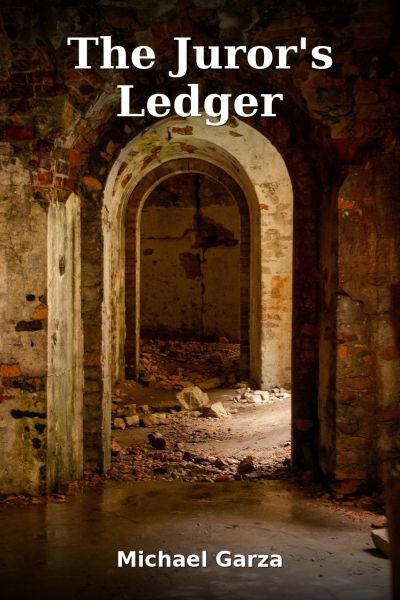
The Commonwealth did not begin as a flag or a treaty; it began as a ledger. That opening line from the Introduction sets the tone for Michael Garza's The Juror's Ledger, a legal thriller that imagines courts, law codes, and trials in a patchwork post-zombie commonwealth. Instead of chasing the undead through ruined cities, the novel builds its tension around voir dire by lanternlight, chain-of-custody arguments over charred hard drives, and a restorative circle where victims and accused speak as neighbors rather than adversaries.
What the Book Is About
The Juror's Ledger follows Judge Silas Thorne and his clerk Elara as they ride the Fourth Circuit to the settlement of Meridian for a High Trial. The defendants — systems architect Alistair Finch, scientist Dr. Evelyn Reed, and corporate executive Marcus Thorne — face charges of pre-Fall negligence and sabotage for their roles in the Great Disconnect, the catastrophic failure of containment grids that killed millions. The narrative unfolds across 25 chapters structured as court days: arraignment, evidentiary hearings, witness testimony, cross-examination, a restorative circle, and sentencing. Garza writes for readers who enjoy legal procedurals and speculative fiction in equal measure, assuming comfort with technical terminology (cryptographic keys, authentication protocols, military SERE encryption) but explaining the Commonwealth's invented legal framework — the Code of the Patchwork — through the trial itself. The book rewards patience; its pleasures are cumulative, built from procedural detail and moral complexity rather than action set pieces.
The Code of the Patchwork: Law as Improvisation
Garza's most inventive achievement is the Commonwealth's legal system, cobbled together from "salvaged precedents and lived custom." The Code of the Patchwork replaces statutes with three pillars: preservation of life, restoration of order, establishment of truth. Article Four governs evidence: "documents that have been altered or partially destroyed shall be admitted only with a note of their condition." Article Seven, the "siege clause," provides emergency exemptions for actions taken "in good faith to preserve life during a period of general emergency." These aren't background lore — they're argued in real time. In Chapter Twelve, Silas rules on the admissibility of burned logbooks and corrupted drives: "In this court, we do not have the luxury of pristine evidence. We have the artifacts of our survival." The law feels lived-in because it's constantly being interpreted, not just cited.
A Jury of Neighbors, Not Peers
The twelve jurors are not anonymous; they're Meridian residents with specific losses and trades. Maren Holt lost her brother at the Cascadian corridor locks. Tomas Veyra lost his forge to post-Fall riots. Jessup, seventeen, survived by hiding in a grain silo. Chapter Five's voir dire by lanternlight establishes their voices early: Maren says, "Loss makes me careful, not cruel. I want the truth, not a lynching." Their deliberations in Chapter Twenty-One — conducted in candle smoke over two days — show ordinary people wrestling with a verdict that has no precedent. They don't reach unanimity; two dissent on sentence duration. The jury's formal statement, read aloud in Chapter Twenty-Two, acknowledges "the harm described in this trial extends beyond three individuals, and that the Commonwealth must remain vigilant against the systemic failures that made this catastrophe possible." Garza refuses the satisfaction of a clean verdict.
Three Defendants, No Monsters
Finch, Reed, and Thorne are not villains. They're professionals who made choices within a system that rewarded efficiency over resilience. Finch designed backdoors as "emergency access points" for crisis management (Chapter Nine). Reed withheld preliminary airborne-transmission data because "releasing unverified data would have caused panic, potentially worse than the disease itself" (Chapter Two). Thorne authorized the standby override to preserve "critical infrastructure that would eventually serve the public" (Chapter Three). Their testimony in Chapter Nine — each taking the stand as the centerpiece of the defense — reveals men and women who believed they were holding the walls up. The tragedy is structural: "I was part of a system that valued efficiency over safety, because efficiency was measurable and safety was theoretical," Finch admits in the restorative circle (Chapter Thirteen). Garza makes their complicity understandable without excusing it.
The Restorative Circle as Narrative Engine
Chapter Thirteen's circle — "Restorative Circles, Razor Wire" — is the novel's emotional and philosophical center. After days of formal testimony, Silas reconfigures the warehouse: benches in a ring, defendants on stools at the same level as jurors and spectators. No oaths, no objections. Maren Holt asks Finch: "When you found out — when the advisory panel told you the system was flawed — what did you do?" Finch answers: "I filed the report. I continued to maintain the system. I told myself that the process would catch what I had missed." Veyra demands to know if any defendant can "make horseshoes? Can any of you fix a pipe?" Reed offers to train healers; Thorne offers logistics coordination. The circle doesn't produce forgiveness — Jessup, the teenage juror, says "I don't forgive you. Not yet. Maybe not ever" — but it forces the defendants to hear the specific harm they enabled. The sentences that follow (Chapter Nineteen) are restorative labor: Finch rebuilds the grid, Reed trains healers, Thorne coordinates reconstruction. Justice as repair, not retribution.
The Shadow Relay and the Unfinished Case
The trial resolves the defendants' accountability but opens a larger mystery. In Chapter Seventeen, Silas and a team breach Vault C beneath the Aegis facility and find the Chancellor's authorization: an order to "initiate systemic decoupling of regional grids to preserve federal assets in Sector 4," timestamped thirty minutes before the gates opened. The defendants were following a federal contingency plan. Later, at a coastal relay station (Chapter Twenty-Four), they discover the Appalachian Relay Network — a shadow communications system still broadcasting, its encrypted signals originating from the mountains. A recorded military transmission states: "Civilian authority suspended. Relay network assumes primary communications function." The Continuity Authority, a pre-Fall shadow government, designed the collapse as a controlled transition. The novel ends with Silas riding toward the mountains, the Ledger still open: "The next chapter belongs to those who come after us — to the courts that will convene in settlements we have not yet heard of." Garza denies closure; the Commonwealth's work has only begun.
Who Should Read This
Readers who enjoy legal procedurals (Anatomy of a Murder, The Trial) and post-apocalyptic fiction that focuses on institutions rather than survivalist action will find The Juror's Ledger uniquely satisfying. It demands attention — the middle chapters are dense with technical testimony and procedural argument — but rewards it with a fully realized legal culture and characters whose moral compromises feel earned. Readers seeking fast-paced zombie action or clear-cut heroism should look elsewhere. This is a novel about the slow, necessary work of building justice from scraps, and it takes that work seriously enough to let it remain unfinished.
Read “The Juror's Ledger” on MixCache.com →
Please log in or create an account to leave a comment.
No comments yet. Be the first to say something.