
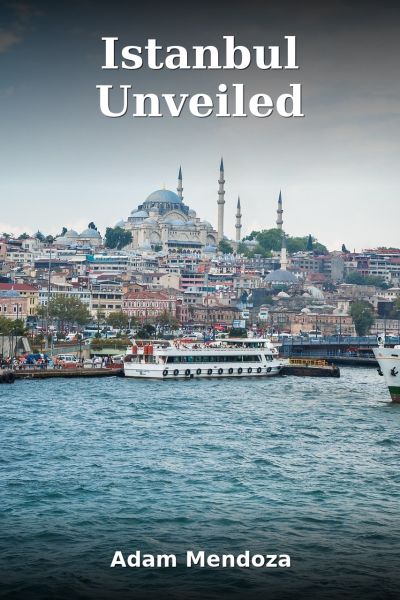
Straddling two continents and three empires, Istanbul has long resisted simple categorization. Adam Mendoza's Istanbul Unveiled meets that complexity on its own terms, offering not a checklist of sights but a layered portrait of a city that "entrances visitors with an explosive blend of minarets and skyscrapers, Ottoman domes and avant-garde galleries." The book's twenty-five chapters unfold like the neighborhoods they describe — each distinct, each connected to the others by streets, ferries, and centuries of shared history.
What the Book Is About
Organized as both chronological history and geographic exploration, Istanbul Unveiled begins with the city's foundations — Byzantium's strategic peninsula, Constantine's Nova Roma, Mehmed II's Ottoman transformation — before pivoting to neighborhood portraits of Sultanahmet, Beyoğlu, Kadıköy, Balat, and Üsküdar. The middle sections turn to culture as daily practice: five chapters on food (from meze culture to chef interviews and home recipes), two on art across eras, two on music and spiritual expression, and one each on houses of worship, festivals, and the Princes' Islands. Closing chapters reveal "hidden corners" — hammams, hans, literary cafés, secret gardens — and practical navigation advice. The intended reader is neither tourist nor academic but something between: a curious traveler who wants to understand why a simit vendor's cart matters as much as the Hagia Sophia's dome.
History as Living Architecture, Not Backdrop
The first five chapters refuse to treat history as settled fact. Chapter One opens with the Oracle of Delphi advising Megarian colonists to settle "opposite the land of the blind" — a founding myth that "highlights the undeniable geographic genius of Byzantium's location, a feature that would dictate its fate for millennia." Chapter Two traces Constantinople's walls, hippodrome, and the Hagia Sophia's transformation from church to mosque to museum to mosque again. Chapter Three details how Mehmed II converted the Hagia Sophia "respectfully but decisively," covering mosaics with plaster "that could be removed centuries later." Chapter Four follows the Tanzimat reforms, the Dolmabahçe Palace's European opulence, and the capital's move to Ankara. Chapter Five lands in today's "cosmopolitan Istanbul" of nearly 16 million, where the ezan mingles with "the contemporary hum of traffic, the rumble of the metro." The effect is cumulative: each empire's stones remain visible, repurposed, argued over.
Neighborhoods as Characters With Distinct Temperaments
Chapters Six through Ten give each district a voice. Sultanahmet is "a living museum" where "history isn't merely preserved in archives but is palpable in the air you breathe." Beyoğlu, once Pera, "shouts with the vibrant, sometimes chaotic, energy of contemporary Istanbul" — its Istiklal Avenue a "constant parade of humanity" served by the 1875 Tünel funicular. Kadıköy on the Asian shore embodies "a youthful, free-spirited vibe" where "hip cafes, bustling markets, and a lively arts scene thrive in harmony with a deep-rooted sense of community." Balat's "pastel hues of its restored Ottoman houses" tell "a distinctly different narrative" of Jewish, Greek, and Armenian coexistence. Üsküdar offers "a quieter, more traditional" rhythm, its 180-plus mosques and the Maiden's Tower legends grounding a district where "the rhythm of life feels more attuned to ancient traditions." Mendoza lets each neighborhood's architecture, food, and residents define its character without forcing a unifying theme.
Food as Cultural Memory and Daily Diplomacy
The five food chapters (Eleven through Fifteen) treat cuisine as "a delectable narrative spun from centuries of nomadic traditions, imperial opulence, and cultural exchange." Chapter Eleven traces meze to the Persian maza ("taste" or "relish") and mantı to Central Asian migrations along the Silk Road. Chapter Twelve walks the Spice Bazaar's "heaps of vibrant red sumac, golden turmeric, and emerald green mint" and the Eminönü waterfront where "the aroma of grilled mackerel wafts from the boats" selling balık ekmek. Chapter Thirteen dissects kebab's regional taxonomy — Adana's heat, Urfa's restraint, İskender's tomato-butter-yogurt symphony — and baklava's "dozens of wafer-thin layers of phyllo dough" perfected in Topkapı's kitchens. Chapter Fourteen introduces chefs who "deconstruct a traditional mantı, serving the delicate dumplings with a clarified yogurt foam and a paprika-infused oil spherification." Chapter Fifteen gives home cooks eight recipes — mercimek çorbası, çoban salatası, pirinç pilavı, izgara köfte, zeytinyağlı yaprak sarma, imam bayıldı, Turkish coffee, and çay — each with the granular detail ("rinse the rice thoroughly under cold running water until the water runs clear") that separates instruction from posturing.
The Sacred and the Secular in Daily Rhythm
Chapters Sixteen through Nineteen map a city where "east does not simply meet west; tradition converses with innovation, and the sacred shares the skyline with the boldly secular." Chapter Sixteen traces art from Chora Church's "Anastasis fresco" to Istanbul Modern's new Renzo Piano building and Arter's "experimental and contemporary art." Chapter Seventeen follows music from the ney's "haunting, breathy tones" in Mevlevi Sema to Istiklal Avenue's street performers and the Istanbul Jazz Festival's "open-air stages by the Bosphorus." Chapter Eighteen juxtaposes the dervishes' "cosmic dance of the planets" with Zorlu PSM stadium concerts and "underground clubs" for electronic music. Chapter Nineteen catalogs houses of worship — the Blue Mosque's "over 20,000 hand-painted Iznik tiles," Chora Church's "finest Byzantine mosaics," the Ecumenical Patriarchate's "modest but deeply revered sanctuary," and Balat's Ahrida Synagogue with its ark "shaped like a ship's prow." The through-line: spiritual practice and creative expression occupy the same streets, often the same buildings, without resolution.
Practical Wisdom as Cultural Insight
The final chapters (Twenty-Two through Twenty-Four) reveal how navigation teaches culture. Chapter Twenty-Two describes the hammam ritual — camekan, soğukluk, ılıklık, hararet, göbek taşı — and the Grand Bazaar's hidden hans, medieval caravanserais now housing "a quiet back-office, artisan workshops, or tranquil cafes." Chapter Twenty-Three guides readers to Yıldız Park's "picturesque ponds," Fethipaşa Grove's "uninterrupted panoramic views," and literary havens like Minoa Books & Coffee ("over 60,000 books") and Kuzguncuk's Nail Kitabevi & Kafe in a "19th-century building." Chapter Twenty-Four distills hard-won knowledge: the Istanbulkart as "golden ticket," the metro's M11 airport line, the T1 tram for Sultanahmet, ferries as "the most local and affordable way to experience the Bosphorus," and the bargaining etiquette of starting "at about half the asking price." Anecdotes — the "taxi meter scam," the "rug shop scam" — appear as cultural literacy, not warnings. The message: moving through Istanbul like a local means reading its rhythms, not just its maps.
Who Should Read This
Readers planning a first trip will gain a framework deeper than any checklist; repeat visitors will find language for what they've sensed but couldn't name. Armchair travelers get a city that thinks in layers — historical, culinary, artistic, spiritual — without reducing any to theme-park atmosphere. The book asks patience: its 25 chapters reward sequential reading but also allow dipping into neighborhoods or topics. Skip it if you want a lightweight itinerary or photo-heavy coffee-table volume. This is a book for people who believe a city's soul lives in its simit carts and subway maps as much as its sultan's mosques.
Read “Istanbul Unveiled” on MixCache.com →
Please log in or create an account to leave a comment.
No comments yet. Be the first to say something.