
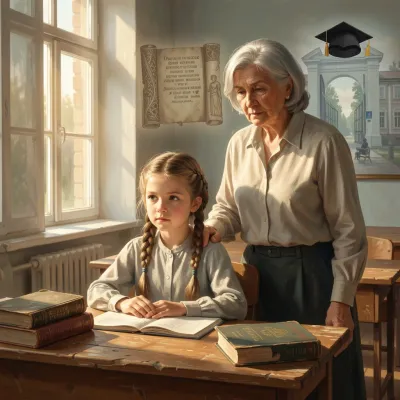
Ukraine's education system has survived Mongol invasions, Soviet Russification, and now a full-scale war — yet it continues to educate millions while reinventing itself. Sean Lopez's "Education In Ukraine" maps this improbable endurance with a level of granular detail that turns institutional history into a story of national survival. The book doesn't just catalog structures; it shows how each reform, each classroom decision, and each language policy becomes an act of sovereignty.
What the Book Is About
Organized across 25 chapters, the book moves chronologically and thematically from the Kyivan Rus' era through the Soviet period, independence, the 2014 conflict, and the 2022 full-scale invasion. It covers every tier: nurseries and kindergartens (Chapter 4), primary education's "New Ukrainian School" reform (Chapter 5), basic and complete secondary levels with the ZNO entrance exam (Chapter 6, Chapter 9), vocational and technical pathways (Chapter 7), and the Bologna-aligned higher education system (Chapter 8). Specialized chapters address teacher education (Chapter 11), inclusive education and Inclusive Resource Centers (Chapters 12–13), distance learning and the All-Ukrainian Online School (Chapter 14), private institutions (Chapter 15), international cooperation (Chapter 16), funding mechanics (Chapter 17), parent and community roles (Chapter 18), student life (Chapter 19), challenges and opportunities (Chapter 20), war's impact (Chapter 21), future trends (Chapter 22), adult education (Chapter 23), research and innovation (Chapter 24), and the role of Ukrainian language and culture (Chapter 25). The intended audience spans educators, policymakers, researchers, and anyone needing a structural understanding of how Ukrainian learning actually works on the ground.
A History Written in Classroom Language
Chapter 1 demonstrates that language policy has always been a battlefield. Under the Russian Empire, "the use of Ukrainian in official functions, including schools, was largely proscribed," and literacy fell to 26 percent by 1897. The Soviet era brought a brief Ukrainization — "by 1929, about 92% of children in the USSR attended Ukrainian-language primary schools" — before a "harsh reversal" made Russian compulsory in 1938. Independence triggered "a profound process of decolonization and de-Russification," reinstating Ukrainian as the primary language of instruction. The book traces this arc not as abstract policy but as lived classroom reality, showing how each shift rewrote what children heard, read, and identified with.
The New Ukrainian School: Competency Over Rote
Launched in 2017, the NUS reform represents the most ambitious pedagogical shift since independence. Chapter 5 describes its primary-level implementation: "Instead of rigidly compartmentalizing subjects, the NUS encourages an integrated approach, where different learning areas are woven together to create a more holistic and meaningful educational experience." The "I Explore the World" course combines natural science, social studies, health, and civics through "observation, experimentation, and discussion." Assessment moves from numerical grades to "descriptive assessments that highlight a child's strengths and areas for improvement." Chapter 6 extends this to secondary education with "profile-oriented learning" letting grades 10–12 choose specializations like humanitarian, scientific-mathematical, or technological tracks. The reform's success hinges on teacher retraining at massive scale — a work still in progress.
Inclusion Built Through Infrastructure, Not Just Intent
Chapters 12 and 13 reveal a system moving from segregated boarding schools to mainstream inclusion via concrete mechanisms. The Individual Development Program (IDP) is "a bespoke educational roadmap for each child with special educational needs" created by multidisciplinary teams. Assistant teachers work alongside main instructors, while Inclusive Resource Centers (IRCs) provide "comprehensive diagnostic assessments" and "therapeutic interventions, such as speech therapy, correctional development classes, and psychological counseling." The book notes persistent gaps: "Funding remains a persistent hurdle" and "attitudinal barriers also present a significant obstacle." Yet the legal framework — especially the 2017 Law on Education amendments — has made inclusion a mandate, not an aspiration.
War as Accelerant: Distance Learning at National Scale
Chapter 14 and Chapter 21 document how the 2022 invasion forced "a rapid and unprecedented shift to remote learning" that turned years of gradual digitalization into weeks. The All-Ukrainian Online School (VSHOO) became "a lifeline, providing structured digital lessons for students from grades 5-11 across the country." Teachers adapted from "basements, hallways, or even active war zones." The crisis exposed the digital divide — "issues of internet connectivity, access to devices… and digital literacy among both educators and learners became starkly apparent" — but also sparked partnerships with Google, Microsoft, and UNESCO delivering "Chromebooks and free software." The book frames this not as emergency triage but as a permanent transition toward blended learning models.
Language and Culture as Defense Strategy
Chapter 25 positions Ukrainian language and culture as "the very medium through which much of the learning experience unfolds, shaping minds, nurturing patriotism, and ensuring the continuity of a distinct national identity." The war intensified this: "The war has underscored the existential threat to Ukrainian identity, making the preservation and promotion of its language and culture an act of national defiance and resilience." Displaced children receive Ukrainian-language lessons abroad through "temporary learning centers and online educational platforms." Meanwhile, universities expand Ukrainian studies globally, "inviting foreign scholars to study Ukrainian history and literature." The classroom becomes a front line where cultural survival is taught daily.
Who Should Read This
Education policymakers, comparative education scholars, NGO workers in crisis contexts, and Ukrainian diaspora educators will find this an indispensable reference. Its encyclopedic scope makes it less suited for casual readers seeking narrative storytelling; the prose is functional, data-dense, and structured for lookup rather than continuous reading. But for anyone needing to understand how a national education system functions — and adapts — under existential pressure, this book delivers a complete, evidence-based architecture. It's a manual for resilience written in the language of curriculum, funding formulas, and classroom practice.
Read “Education In Ukraine” on MixCache.com →
Please log in or create an account to leave a comment.
No comments yet. Be the first to say something.