
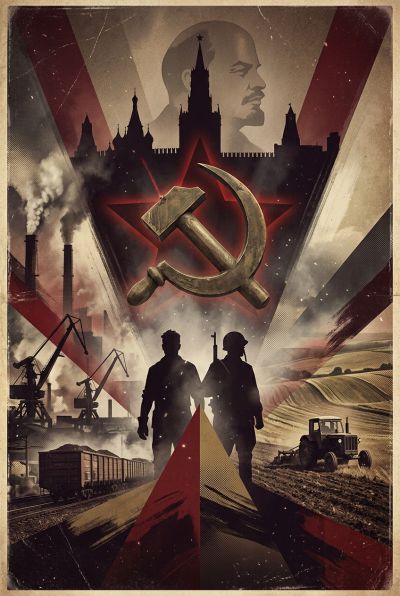
The Union of Soviet Socialist Republics was, in the author's words, "a colossal experiment in social, political, and economic engineering" that shaped the twentieth century. This revised edition walks readers through seven decades of revolution, war, terror, stagnation, and sudden collapse — not as a morality play but as a narrative that lets the contradictions speak for themselves.
What the book is about
The book unfolds chronologically across 25 chapters, beginning with the crises of Tsarist Russia in Chapter 1 and ending with the post-Soviet legacy in Chapter 25. Each chapter covers a distinct period or theme: the 1917 revolutions, Lenin's consolidation, Stalin's collectivization and purges, the Great Patriotic War, the Cold War, the Brezhnev-era "stagnation," Gorbachev's glasnost and perestroika, the 1989 Eastern Bloc revolutions, the August 1991 coup, and the Belovezha Accords that dissolved the USSR. The introduction states the work "aims for a balanced perspective, acknowledging the genuine aspirations and achievements of the Soviet project while unflinchingly confronting its brutalities and failures." It is written for general readers, students, and history enthusiasts who want a single-volume synthesis grounded in recent scholarship, with particular attention to social, economic, and cultural forces alongside high politics.
The gap between promise and reality
A central thread running through the narrative is the widening chasm between the Bolsheviks' egalitarian rhetoric and the lived experience of Soviet citizens. The Introduction frames this as "the evolution of Soviet institutions and the widening gap between the ideological promise and the lived reality of Soviet citizens." Chapter 6 shows how forced collectivization and the "liquidation of the kulaks as a class" produced catastrophic famine, particularly the Holodomor in Ukraine, while Chapter 7 details how the Great Purge "effectively eliminated all existing and potential opposition to Stalin's rule" and transformed the Party into "a rigid, hierarchical instrument of Stalin's personal power." The book does not treat these as aberrations but as structural outcomes of a system that prioritized ideological conformity over human welfare.
Nationality policy as a delayed fuse
Chapter 18 traces how Soviet nationality policy oscillated between 1920s indigenization (korenizatsiya) and later Russification, creating a federal structure that "provided a formal, if often superficial, recognition of ethnic diversity" while real power remained in Moscow. The author notes that "deep-seated ethnic identities proved remarkably resilient" despite the official goal of forging a unified "Soviet people." This unresolved tension erupts dramatically in Chapter 21, where glasnost unleashes nationalist movements in the Baltics, the Caucasus, and Ukraine. The "Baltic Way" human chain of August 1989 — "an estimated two million people formed a human chain stretching some 600 kilometers" — becomes a defining image of how national aspirations, once suppressed, became the primary engine of the Union's disintegration.
The economy: mobilization strength, systemic weakness
Chapter 17 offers a clear-eyed analysis of the command economy's contradictory record. It acknowledges the system's "undeniable capacity for rapid structural transformation" — industrialization in the 1930s, wartime relocation of industry, post-war reconstruction — while documenting the "profound and systemic weaknesses" that made it unsustainable: chronic misallocation, the "soft budget constraint" that shielded inefficient enterprises, the neglect of consumer goods (Group B) for heavy industry (Group A), and the environmental devastation exemplified by the Aral Sea disaster. The chapter concludes that "the inherent contradictions between ideological claims and economic realities, between military might and civilian privation" created a system "riddled with internal tensions that would eventually prove insurmountable."
Gorbachev's reforms and the loss of control
Chapters 20 and 21 present Gorbachev not as a saboteur but as a sincere reformer who "inherited a Soviet Union beset by a formidable array of challenges" and sought to revitalize the system through uskoreniye, then perestroika and glasnost. The Chernobyl disaster becomes a turning point: "The mishandling of the Chernobyl crisis... highlighted the dangers of excessive secrecy and underscored the need for greater openness." But glasnost "unleashed a torrent of public debate and critical inquiry that went far beyond Gorbachev's original aim," while perestroika's half-measures worsened shortages without creating functioning markets. The book captures the tragic irony: reforms meant to save the Union instead "unleashed forces that were proving increasingly difficult to control" and handed the initiative to republican leaders like Yeltsin.
The human dimension across seven decades
Throughout, the narrative returns to ordinary citizens — factory workers, collective farmers, soldiers, scientists, artists, dissidents. Chapter 9 describes the siege of Leningrad through Olga Berggolts's radio broadcasts and Konstantin Simonov's poem "Wait for Me." Chapter 15 introduces the "bard" singers like Vladimir Vysotsky whose magnitizdat tapes circulated "lyrics, often critical of the authorities or lamenting past injustices." Chapter 19 follows the "Afgantsy" veterans returning to a society that "often found their sacrifices unacknowledged or misunderstood." These moments ground the grand narrative in palpable human experience, reminding readers that the USSR's history was lived by millions whose voices the state alternately mobilized and silenced.
Who should read this
Readers seeking a single-volume, chronologically structured history that integrates political, economic, social, and cultural strands will find this book thorough and accessible. It assumes no prior specialist knowledge but rewards those who want to trace cause and effect across the full Soviet arc. Those looking for deep archival revelations or a tightly argued thesis may prefer monographs on specific periods; this is a synthesis, not a specialist intervention. For anyone wanting to understand why the USSR arose, how it functioned, and why it fell — and how its echoes "continue to resonate in contemporary debates about power, ideology, and national identity" — it is a reliable, balanced guide.
Read “The USSR” on MixCache.com →
Please log in or create an account to leave a comment.
No comments yet. Be the first to say something.