
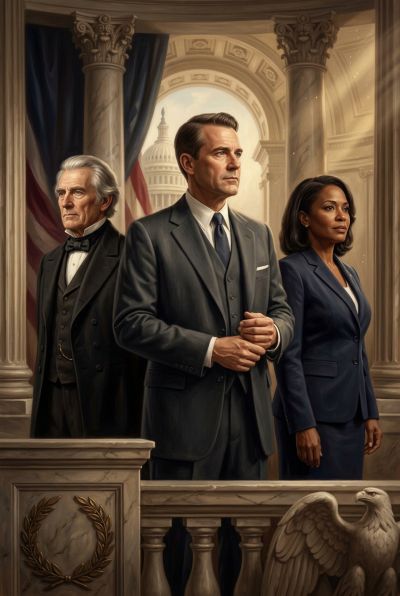
The United States Senate was designed to slow things down. Six-year terms, equal representation for states regardless of population, and a thicket of procedural rules all exist to check the passions of the moment. Yet from that friction emerged some of the most consequential leadership in American history. Bradford Gutierrez's The Greatest Senators does not merely collect biographies; it uses two dozen senators as case studies in how power is actually exercised in a body where no one can govern alone.
What the book is about
The book spans 25 chapters, beginning with the First Congress in 1789 and concluding with Harry Reid's tenure as Majority Leader in the 2010s. Each chapter focuses on a single senator — Daniel Webster, Henry Clay, John C. Calhoun, Charles Sumner, Stephen A. Douglas, Roscoe Conkling, James G. Blaine, George F. Hoar, Robert M. La Follette Sr., Hiram Johnson, Arthur Vandenberg, Robert A. Taft, Margaret Chase Smith, Lyndon B. Johnson, Everett Dirksen, Hubert H. Humphrey, Barry Goldwater, Edward M. Kennedy, Robert C. Byrd, Daniel Inouye, John McCain, Barbara Mikulski, and Harry Reid — plus an introductory chapter on the Founders and a final synthesis chapter. The structure is chronological, but the through-line is thematic: how different senators navigated the tension between principle and compromise, between state interests and national imperatives, and between public oratory and the invisible work of committee rooms and cloakroom deals. The intended reader is anyone curious about legislative power — students of history, political practitioners, or general readers who want to understand how laws get made (or blocked) in a chamber where a single senator can halt the machinery.
The architecture of compromise: Clay, Webster, and the art of holding the Union together
Three chapters — on Henry Clay, Daniel Webster, and Stephen A. Douglas — form a masterclass in legislative engineering. Clay's Missouri Compromise of 1820 and Compromise of 1850, Webster's "Seventh of March" speech endorsing the Fugitive Slave Act to preserve the Union, and Douglas's maneuvering to break the 1850 omnibus into passable pieces all illustrate a recurring pattern: the Senate's greatest legislative achievements often required senators to violate their own principles or alienate their bases. Webster's declaration — "I wish to speak to-day, not as a Massachusetts man, nor as a Northern man, but as an American" — captures the posture these men adopted. The book does not romanticize this; it notes that Webster's speech drew condemnation from Ralph Waldo Emerson and John Greenleaf Whittier, and that Clay's compromises merely postponed the Civil War. The takeaway is structural: the Senate's design rewards those who can assemble cross-sectional coalitions, even at terrible moral cost.
Conscience as counterweight: Sumner, La Follette, and Smith
If the compromisers represent the Senate's capacity for union, figures like Charles Sumner, Robert La Follette, and Margaret Chase Smith represent its capacity for moral witness. Sumner's "Crime Against Kansas" speech provoked a near-fatal caning on the Senate floor, yet his empty chair became "a powerful symbol of the widening chasm between North and South." La Follette's 18-hour filibuster against the Aldrich-Vreeland currency bill and his lone vote against World War I — after which he was "branded as pro-German and disloyal" and burned in effigy — show the price of dissent. Smith's 1950 "Declaration of Conscience" against McCarthyism, delivered when she was the only woman in the chamber, articulated principles that transcended party: "the right to criticize; the right to hold unpopular beliefs; the right to protest; the right of independent thought." These senators did not always win their immediate battles, but they shifted the Overton window. The book argues that the Senate's six-year terms exist partly to protect exactly this kind of constituency-defying courage.
Mastery of the machine: Lyndon Johnson, Robert Byrd, and Harry Reid
Three chapters reveal how procedural expertise becomes a form of leadership. Lyndon Johnson, as Majority Leader, "effectively centralized power in his office," using the "Johnson Treatment" — "an intensely personal and often overwhelming combination of cajolery, flattery, logical argument, appeals to loyalty, reminders of past favors, hints of future benefits, and, if necessary, thinly veiled threats" — to pass the first civil rights bills since Reconstruction. Robert Byrd, the longest-serving senator in history, carried a copy of the Constitution in his breast pocket and wrote a multi-volume history of the Senate; as Appropriations chairman, he directed billions to West Virginia, unapologetically calling it "vital to the economic development" of a neglected state. Harry Reid, facing unprecedented Republican filibusters of Obama nominees, invoked the "nuclear option" in 2013 to eliminate the 60-vote threshold for most nominations, a rules change that "had a lasting impact on the Senate, contributing to the escalating battles over judicial confirmations in subsequent years." Each man understood that the Senate's arcane rules are not obstacles but levers — and that knowing when to pull them separates majority leaders from mere presiding officers.
The evolution of foreign policy consensus: Vandenberg, Taft, and the bipartisan tradition
Arthur Vandenberg's chapter is a study in intellectual honesty. A staunch isolationist through the 1930s, he renounced that view on the Senate floor in January 1945 after Pearl Harbor, declaring that "the oceans no longer provided an impenetrable barrier." As chairman of the Foreign Relations Committee, he worked with the Truman administration to pass the Truman Doctrine, the Marshall Plan, and the Vandenberg Resolution that paved the way for NATO — insisting that "politics stops at the water's edge." His foil in the book is Robert Taft, the "Conscience of Conservatism," who voted against NATO in 1949, arguing it "would obligate the United States to go to war without a congressional declaration." The tension between Vandenberg's internationalism and Taft's skepticism of "over-extended American commitments" frames the foreign policy debate that still structures Senate deliberations today. The book suggests that bipartisan foreign policy was not inevitable but constructed — and that its maintenance requires senators willing to absorb intra-party criticism for the national interest.
Breaking barriers and building institutions: Inouye, Mikulski, McCain
The modern Senate's diversification appears in three late chapters. Daniel Inouye, a Medal of Honor recipient who lost his right arm in Italy, brought a "quiet dignity" to the Watergate and Iran-Contra hearings; his whispered "What a liar!" during John Ehrlichman's testimony became iconic. Barbara Mikulski, a former social worker, organized bipartisan dinners for women senators — "I see that it's my job to be able to organize the women in a way where their talents are served" — and led the "Pantsuit Rebellion" of 1993 that ended the informal skirt rule. John McCain's maverick streak — his thumbs-down vote against ACA repeal in 2017, his sponsorship of the Detainee Treatment Act banning torture — reflected a conviction that "the use of such methods was a betrayal of American values." These profiles argue that institutional change often arrives not through grand speeches but through the accumulation of seniority, staff expertise, and personal relationships that allow marginalized voices to shape the agenda.
Who should read this
Readers who want a clear-eyed, unsentimental guide to how the Senate actually works — not the civics-textbook version but the version where procedure is power, compromise is often morally ambiguous, and leadership takes forms ranging from thunderous oratory to patient vote-counting — will find this book rewarding. It is less useful for those seeking a unified theory of senatorial greatness; Gutierrez explicitly avoids ranking his subjects, and the final chapter acknowledges that "greatness" is measured in shifting, sometimes contradictory ways. The book assumes some familiarity with American political history but explains context well enough for motivated general readers. Skip it if you prefer narrative-driven biography over thematic analysis; each chapter stands alone, and the book's value lies in the patterns that emerge across them rather than in any single senator's life story.
Read “The Greatest Senators” on MixCache.com →
Please log in or create an account to leave a comment.
No comments yet. Be the first to say something.