
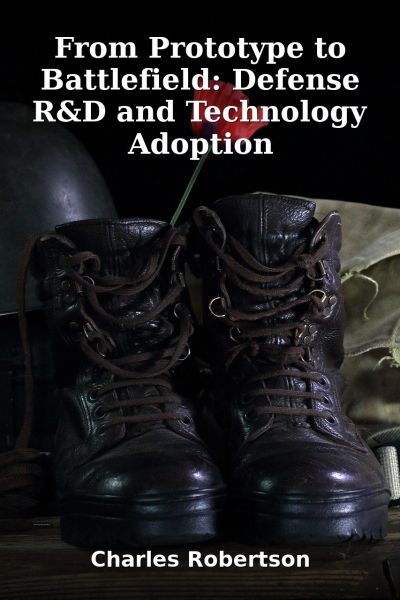
Every military innovation begins with a simple proposition: a new way to see farther, decide faster, or strike with greater effect under fire. Yet the journey from promising concept to trusted capability is anything but simple. Robertson's book traces that journey with the rigor of a practitioner and the clarity of a teacher, revealing the technical, regulatory, and human factors that determine whether an idea becomes a battlefield advantage.
What the book is about
From Prototype to Battlefield is a 25-chapter field guide to the defense R&D lifecycle, written for acquisition professionals, engineers, policy staff, and curious outsiders who want to understand how the U.S. military actually turns prototypes into combat power. The book moves chronologically: why militaries innovate (Chapter 1), how requirements are written (Chapter 2), the Technology Readiness Level framework (Chapter 3), the PPBE budget process (Chapter 4), contracting vehicles like OTAs and SBIR (Chapter 5), digital engineering and rapid iteration (Chapter 6), the defense industrial base ecosystem (Chapter 7), developmental and operational testing (Chapters 8–9), safety and range infrastructure (Chapter 10), cybersecurity and EW hardening (Chapter 11), interoperability and the kill web (Chapter 12), logistics and total ownership cost (Chapter 13), policy and ethics (Chapter 14), culture and change management (Chapter 15), international partnerships (Chapter 16), wargaming and concept development (Chapter 17), manufacturing readiness (Chapter 18), urgent needs and combat provenance (Chapter 19), measuring effectiveness (Chapter 20), and three deep case studies on radar, drones, and hypersonics (Chapters 21–23). It closes with failure modes (Chapter 24) and a forward look at AI, autonomy, and adaptive acquisition (Chapter 25). The tone is analytical but accessible — no jargon without definition, no acronym left unexplained.
The TRL ladder is more than a checklist
Chapter 3 makes the case that Technology Readiness Levels are not bureaucratic box-ticking but a risk-reduction grammar. Robertson walks the nine rungs from TRL 1 (basic principles observed) to TRL 9 (system proven in operational environment), emphasizing that each step demands specific evidence: analytical proof at TRL 3, breadboard validation in a relevant environment at TRL 5, prototype demonstration in an operational environment at TRL 7. He also flags the mirror framework — Manufacturing Readiness Levels — because a high TRL means little if the supply chain can't produce the widget at scale. The chapter's most useful insight: maturation is rarely linear. Programs loop back, stall, or jump rungs when a breakthrough arrives, and the book treats that messiness as normal rather than failure.
The valley of death has many on-ramps
Chapter 24 catalogs why promising programs become orphans. The valley of death — the gap between lab demonstration and acquisition commitment — reappears here with nuance: funding instability, requirements creep, cultural resistance, interoperability neglect, supply-chain fragility, and political churn all act as independent failure modes. Robertson cites the Comanche helicopter (canceled after billions and decades) and the Seawolf submarine (technically superb but cut from 29 hulls to three) as examples where multiple failure modes converged. He argues that learning from these deaths requires a culture that encourages honest post-mortems, not just after-action reviews that protect reputations. The chapter reframes failure as data: every orphaned prototype teaches something about where the system's guardrails are too tight or too loose.
Digital engineering rewrites the prototype loop
Chapter 6 is the book's quiet revolution. Robertson describes how model-based systems engineering, digital twins, and hardware-in-the-loop simulation let teams run thousands of design iterations before cutting metal. He quotes the introduction's framing: "Prototypes occupy a special place in this ecosystem. They are hypotheses in hardware and software — embodiments of design choices that can be instrumented, tested, and iterated. Good prototypes reduce uncertainty; poor ones simply move it downstream." The chapter shows how additive manufacturing, CI/CD pipelines for software, and open architectures turn prototyping from a serial waterfall into a parallel, continuous learning cycle. It also warns that model fidelity must be validated against live data — "garbage in, garbage out" applies brutally when lives depend on the output.
Culture eats strategy for breakfast
Chapter 15 argues that the hardest barriers to adoption are human. Military culture prizes discipline, hierarchy, and proven procedure — traits that stabilize operations but resist disruption. Robertson traces the drone's path from hobby craft to loyal wingman (Chapter 22) as a case study in cultural overcoming: early skepticism from manned-aviation communities gave way only after persistent combat utility, new career fields, and doctrinal integration made drones "legitimate." He notes that change management requires more than directives: it needs early user engagement, realistic training, champion networks, and psychological safety for "intelligent failures." The same dynamic plays out in industry, where prime contractors' risk-averse processes clash with startup speed. The book treats culture not as soft context but as hard infrastructure that must be engineered alongside the hardware.
Speed with rigor is the new mantra
The final chapter synthesizes the book's argument: 21st-century advantage requires "speed with rigor" — an agile ecosystem that leverages international partnerships and machine-speed decision-making while upholding legal and ethical standards. Adaptive acquisition, MVP fielding, OTAs, open architectures, and AI-assisted design are tools; the operating principle is continuous learning loops that close faster than adversaries can adapt. Robertson is clear-eyed about the friction: export controls, classification, trusted supply chains, and the ethics of autonomous lethality all constrain how fast the machine can run. The book's closing sentence frames the stakes: "The goal is not speed for its own sake, but speed with rigor: the ability to adapt faster than adversaries without compromising the standards that safeguard those we ask to fight."
Who should read this
Acquisition officers, systems engineers, program managers, and congressional staffers will find a single-volume map of the territory they navigate daily. Engineers moving from commercial tech into defense will appreciate the translation layer — TRLs, PPBE, OT&E, MRLs — explained without condescension. Policy analysts and journalists get a structural understanding of why defense programs succeed or stall. General readers fascinated by how complex systems get built will enjoy the case studies and the candid failure analysis. Skip it if you want a narrative history of weapons; this is a process anatomy, not a war story.
Read “From Prototype to Battlefield: Defense R&D and Technology Adoption” on MixCache.com →
Please log in or create an account to leave a comment.
No comments yet. Be the first to say something.