
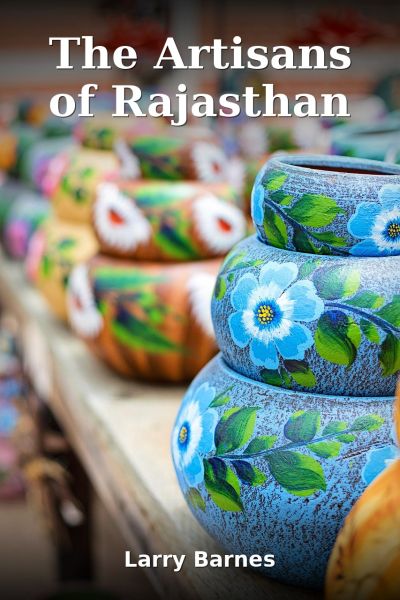
Rajasthan's crafts are often marketed as timeless souvenirs, but Larry Barnes's The Artisans of Rajasthan reveals them as something far more dynamic: living systems shaped by centuries of royal patronage, spiritual practice, and community resilience, now navigating globalization, digital markets, and climate stress. The book moves beyond cataloguing techniques to document the people, policies, and economic forces determining whether these traditions survive the next generation.
What the Book Is About
Organized across 25 chapters, the book follows a clear arc. It opens with historical foundations — royal courts and religious life as engines of craft production — then surveys major craft families: block printing (Bagru, Sanganer), miniature painting (Mewar, Kishangarh, Bundi schools), jewelry (Kundan, Meenakari, Thewa), textiles (Bandhani, Leheriya, Gota Patti, appliqué), pottery (blue pottery, Molela terracotta), woodcraft, leather (Mojaris, Juttis), and metal/marble inlay. Later chapters zoom into geographic hubs (Jaipur, Barmer, Molela, Sanganer, Bagru), market ecosystems (fairs, Shilpgram), and the forces reshaping the sector: globalization, design innovation, e-commerce, raw-material scarcity, NGO and government interventions, gender dynamics, caste marginalization, global fashion influence, and policy frameworks like the Rajasthan Handicrafts Policy 2022. The intended reader is anyone who wants a grounded, non-romanticized understanding of how craft economies actually function — travelers, designers, cultural workers, policy observers, and collectors who care about provenance.
Royal Courts and Sacred Practice as twin engines
The first two chapters establish that Rajasthani crafts were never merely decorative. Chapter 1 traces how Rajput rulers from the 7th century onward "actively commissioned and supported" artisans, turning skills into "institutionalized art forms" and creating a "self-sustaining ecosystem where artistic innovation was encouraged within traditional frameworks." Mughal influence later introduced Persian motifs and refined techniques, producing hybrid styles like the Mewar and Kishangarh miniature schools. Chapter 2 shows the parallel spiritual current: miniature paintings illustrating the Bhagavata Purana and Gita Govinda were "akin to a religious ritual, involving purification, prayer, and a deep connection to the divine." Blue pottery artisans "traditionally offered prayers before firing," and block-printed fabrics used colors with ritual meaning — "Indigo, for instance, represents Lord Krishna, while saffron is considered a sacred color in Hinduism." This dual lineage matters because it explains why crafts persisted even after royal patronage faded; they were embedded in daily devotion and community identity, not just court taste.
Technique as embodied knowledge, not just pattern
Chapters 3 through 10 devote extraordinary attention to process. In block printing (Chapter 3), the Dabu mud-resist method uses a paste of "black clay, lime (chuna), wheat chaff or spoiled wheat flour, and natural gum from the babool tree" applied with carved blocks, then sprinkled with sawdust and sun-dried before indigo dyeing — a sequence that yields "a subtly cracked, veined appearance" impossible to replicate mechanically. Miniature painting (Chapter 4) relies on pigments ground from "minerals, plants, precious stones, and even insects" — lapis lazuli for blue, cochineal for red — applied in translucent washes (pardakht) with squirrel-hair brushes. Jewelry (Chapter 5) details Kundan's "skeletal framework called Ghaat" where "a thin gold foil is placed between the stones and their mount" before polishing. Leatherwork (Chapter 9) distinguishes buffalo hide for soles from suede for uppers, and notes the Jawaja innovation of "stitching using thin leather strips instead of conventional threads, resulting in characteristic diamond-shaped stitches." These passages convey that each craft is a coherent technical system, not a visual style, and that mastery requires years of tactile learning.
The globalization squeeze and digital counter-moves
Chapter 16 frames globalization as a "double-edged sword": export markets and cultural tourism bring income, but "machine-made products, with their lower price points and ability to be produced in vast quantities, undermine the market for traditional, handcrafted items" and create "throat-cutting competition." Chapter 17 shows artisans responding by "meeting modernity on the loom" — Sanganeri prints scaled up for home decor, Gota Patti migrating from bridal wear to "palazzos and co-ord sets," Kundan-Meena reimagined in "minimalist, everyday wear designs." Chapter 18 documents the digital push: platforms like Etsy India, AuthIndia, and the government's indian.handicrafts.gov.in portal aim to "eliminate middlemen and improve artisan livelihoods," yet a survey found "only 16% of artisans had received training to sell products online, and of those, only a minuscule percentage could navigate applications with ease." The Digital Empowerment Foundation's DigiKargha and URMUL Seemant's e-commerce training attempt to close this gap, but infrastructure and literacy remain bottlenecks.
Gender, caste, and the question of who inherits
Chapters 21–23 confront the social architecture of craft labor. Women "are often the primary custodians of intricate skills, especially in textiles and embroidery," yet face "less decision-making power they often hold within household economies" and the "dual roles" of craft work plus "childcare, cooking, and water collection" (Chapter 22). Organizations like Sadhna and Jaipur Rugs Foundation's "Manchaha" program — "expression of my heart" — shift women from piecework to design authorship. Chapter 23 maps caste marginalization: in Barmer, "frequent droughts led to a decline in farming, forcing many rural poor, including those from marginalized groups, to lose their land to the upper classes," making craft "the sole means of livelihood" under exploitative middlemen. URMUL Seemant and Dastkar Ranthambore organize women into producer groups, linking them to "national and international markets" while building "a collective voice and strength." Chapter 21 notes the generational break: "younger individuals view traditional handcrafting as manual labor with limited financial returns," prompting the Rajasthan Handicrafts Policy 2022 to fund a Jodhpur design center, scholarships, and 100% interest-bearing loans up to ₹3 lakh to make craft "a more lucrative and dignified profession."
Policy, markets, and the shape of what comes next
The final chapters zoom out to structural levers. The 2022 policy targets empowering "six lakh (600,000) artisans" with marketing centers, an online sales platform, government procurement up to ₹10 lakh without tender, GI tagging, and a national Handicrafts Week. The 2024 Rajasthan Investment Promotion Policy designates handicrafts a "thrust sector" for subsidies. NGOs fill implementation gaps: Jaipur Rugs Foundation works with "over 40,000 weavers across more than 600 villages," Digital Empowerment Foundation bridges the digital divide, and URMUL Seemant builds "craft clusters" in the Thar. Chapter 24 documents global design uptake — Dries Van Noten, Hermès, Dior, Paul Smith all sourcing Rajasthani block prints and Bandhani — while warning that "the temptation to cut corners, use cheaper materials, or adopt faster production methods to meet deadlines and reduce costs can dilute the essence of the craft." Chapter 25 floats a desert craft university, digital archives, and global artisan exchanges as long-horizon infrastructure. The book's closing argument: survival depends on "honoring the past while embracing the future" through "preserving ancestral techniques, investing in the training and economic empowerment of the next generation, fostering innovation in design and marketing, and creating a supportive ecosystem that values traditional craftsmanship."
Who Should Read This
Designers and buyers sourcing from India will gain a map of which clusters do what, which techniques are genuinely hand-bound versus semi-industrial, and what certification signals authenticity. Cultural travelers can use the village chapters (13, 15) as a field guide to Molela, Sanganer, Bagru, and Shilpgram. Policy students and development practitioners get a case study in how state policy, NGO mediation, and market forces interact — sometimes aligning, often clashing. Readers looking for a coffee-table photo book or a purely aesthetic celebration will be disappointed; the prose is workmanlike, the images are not the point, and the tone is analytical rather than reverent. But for anyone who needs to understand the operating system behind the objects, this is the most thorough single-volume reference currently available.
Read “The Artisans of Rajasthan” on MixCache.com →
Please log in or create an account to leave a comment.
No comments yet. Be the first to say something.