
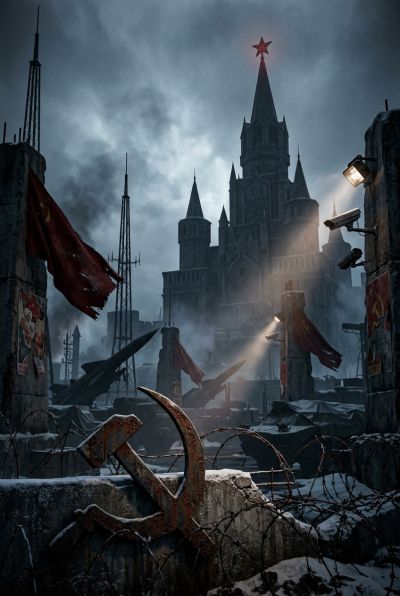
Most Cold War histories are written from Washington, London, or Berlin. James Everley's Evil Empire does something different: it plants the reader firmly inside the Soviet Union and watches the forty-four-year conflict unfold from the Kremlin, the factory floor, the gulag, and the kitchen tables where ordinary citizens whispered jokes about the system that ruled them. The result is a chronicle that feels less like a geopolitical survey and more like a vast, messy family biography of a superpower that ultimately died of its own contradictions.
What the book is about
Evil Empire spans twenty-five chapters, moving chronologically from the 1945 Yalta Conference to the lowering of the hammer-and-sickle flag on Christmas Day 1991. Each chapter tackles a distinct episode — the Berlin Blockade, the Doctors' Plot, Sputnik, the Cuban Missile Crisis, the Afghan war, Chernobyl, the August Coup — but the narrative thread is the lived experience of Soviet citizens and the internal logic of a system that called itself a workers' paradise. Everley draws on memoirs, declassified archives, and the samizdat record to show how policy decisions in Moscow translated into bread queues in Minsk, radiation sickness in Pripyat, and protest chants in Leipzig. The book assumes no specialized knowledge but rewards readers who want to understand why the Soviet project unraveled, not just that it did.
The human cost of the "workers' paradise"
Everley refuses to let statistics stand in for suffering. Chapter 3, "The Gulag Archipelago," reconstructs the camp economy in grim detail: the norma that tied a prisoner's bread ration to impossible work quotas, the caste system that privileged criminal blatnye over political kontriki, and the 1953–54 uprisings at Norilsk, Vorkuta, and Kengir where inmates briefly seized control. The camp motto — a perversion of socialist principle — reads: "He who does not work, shall not eat." As one prisoner's saying went, "You work for the ration, not for the life." Chapter 9 extends this texture into the Brezhnev era, where the "little deal" of guaranteed employment and subsidized rents coexisted with chronic shortages, the blat network of favors, and a nomenklatura elite shopping in closed beryozka stores. A joke captured the mood: Brezhnev shows his mother his dacha and foreign cars; she asks, "But what will you do if the Communists come back?"
Ideology as both engine and cage
The book traces how Marxist-Leninist doctrine simultaneously powered Soviet ambition and paralyzed its ability to adapt. Chapter 1 shows Stalin treating Eastern Europe as a security buffer, installing "People's Democracies" through "salami tactics" — slicing away opposition piece by piece. Chapter 5 details Khrushchev's Secret Speech, which dismantled Stalin's cult but drew a sharp line: the system was sound; only the man was flawed. "The problem, as he framed it, was a tragic deviation from the correct path caused by the character flaws of a single individual." That framing haunted later reformers. By Chapter 19, Gorbachev's glasnost and perestroika attempt to use openness as a crowbar against bureaucratic inertia, but the torrent of truth — about the Molotov-Ribbentrop Pact, the Katyn massacre, the true death toll of collectivization — poisons the regime's legitimacy. As Everley writes, "He had opened a political Pandora's box, unleashing forces of popular anger, nationalism, and democratic aspiration that were now swirling far beyond his control."
The arms race as economic suicide
Everley gives the military-industrial complex its own chapter (12) and returns to it repeatedly. The Red Machine — 50,000 tanks, the Strategic Rocket Forces, the blue-water navy — consumed the best engineers, the purest steel, the hardest currency. Chapter 7 captures the propaganda triumph of Sputnik and Gagarin's "Poyekhali!" but notes the program's roots in ICBM development. Chapter 8's Cuban Missile Crisis narrative — drawn from both ExComm transcripts and Soviet records — reveals how close the world came: Dean Rusk's "We're eyeball to eyeball, and I think the other fellow just blinked." Chapter 17 shows Reagan's SDI (“Star Wars”) not as a shield but as an economic weapon the USSR could not match. The Soviet economy, already hollowed out by the Afghan quagmire (Chapter 15), simply could not fund a new technological generation. The arms race didn't just drain resources; it dictated the shape of the entire civilian economy, down to the shoddy refrigerators and the decade-long wait for a Trabant.
Dissent, truth-telling, and the Chernobyl catalyst
Chapter 13, "Voices in the Dark," maps the dissident ecosystem: samizdat circulation, the Chronicle of Current Events with its masthead quoting Article 19 ("Everyone has the right to freedom of opinion and expression"), Sakharov's pivot from bomb-designer to conscience, Solzhenitsyn's Gulag Archipelago smuggled out page by page. The KGB's Fifth Directorate, created by Andropov, refined repression into "prophylactic conversations" and punitive psychiatry — diagnosing dissent as "sluggish schizophrenia." Chapter 20 makes Chernobyl the climax of this thread. The RBMK reactor's design flaws were state secrets; the initial cover-up doomed Pripyat's children to play in radioactive dust. Gorbachev later admitted Chernobyl was "the true birth of glasnost, the moment he realized that the old way of doing things was no longer possible." The disaster "did not just blow the lid off a nuclear plant; it blew the lid off the entire Soviet empire."
The collapse as seen from the inside
The final five chapters (21–25) are a masterclass in slow-motion dissolution. Gorbachev's "Sinatra Doctrine" — Gerasimov's quip that Eastern Europe could now do it "their way" — removes the Brezhnev Doctrine's iron hoop. Poland's Round Table talks, Hungary's border cutting, the Pan-European Picnic, the Leipzig demonstrations ("Wir sind das Volk!"), and Schabowski's bungled press conference ("Das tritt nach meiner Kenntnis… ist das sofort, unverzüglich.") all unfold without a single Soviet tank intervening. The August Coup (Chapter 23) is told through Yanayev's trembling hands, Yeltsin on Tank No. 110, and the three young men crushed in an underpass. The Belovezh Accords (Chapter 24) dissolve the USSR in a forest dacha over vodka and a steam bath. The final flag-lowering (Chapter 25) is almost anticlimactic: "The Evil Empire... expired quietly, almost anticlimactically, in the cold and darkness." No crowds, no riots — just two guards folding the red banner and raising the tricolor while Muscovites hurried home for Christmas.
Who should read this
Readers who want a single-volume narrative that balances high politics with street-level reality will find this book ideal. It serves well as a first serious Cold War history because it explains Soviet motivations without excusing Soviet crimes, and it connects the dots between a 1948 show trial in Prague and a 1989 protest in Leipzig. Specialists may quarrel with interpretations — the book's brisk pace means some debates (the exact death toll of the Gulag, the CIA's role in Afghanistan) get summary treatment — but the bibliography points toward deeper dives. Anyone who has only read the Cold War from the Western side will come away with a sharper sense of how the conflict looked, felt, and sounded to the people who lived inside the other superpower. Skip it if you want a purely military-diplomatic account or a cultural history; this is a political history with its boots on the ground.
Read “Evil Empire” on MixCache.com →
Please log in or create an account to leave a comment.
No comments yet. Be the first to say something.