

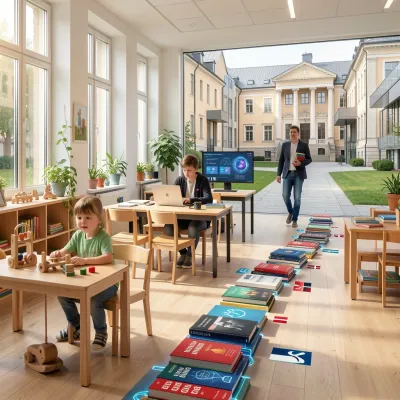
Estonia’s reputation for strong PISA scores and digital innovation often sparks curiosity about what actually happens in its classrooms and policy rooms. Elizabeth Wagner’s Education In Estonia satisfies that curiosity by walking readers through every layer of the system, from the historical roots that shaped its values to the day‑to‑day realities of teachers and learners. The book is not a promotional brochure; it is a careful, evidence‑based survey that invites readers to weigh what might be transferable and what remains uniquely Estonian.
What the book is about
The volume spans twenty‑five chapters, organized chronologically from early childhood education to adult lifelong learning, with thematic deep‑dives on curriculum design, assessment, teacher education, digital technology, inclusion, and governance. Each chapter follows a clear pattern: it outlines the legal and structural framework, describes typical classroom or institutional practices, and then reflects on strengths and tensions. Wagner writes for educators, policymakers, and anyone interested in comparative education, assuming little prior knowledge of Estonia but expecting readers to engage with details such as the eight key competencies, the Tiigrihüpe initiative, or the role of the Estonian Education and Youth Board (Harno). The tone is explanatory rather than polemical, aiming to present a balanced picture that acknowledges both achievements and ongoing dilemmas.
Historical foundations and guiding principles
Wagner begins by tracing how centuries of foreign rule, national awakening, and Soviet occupation have left an enduring imprint on Estonia’s educational ethos. She notes that “One of the most prominent is the principle of equity and accessibility,” a commitment that has persisted from parish‑school ambitions in the Swedish era to today’s universally free basic education. This historical thread helps explain why the system emphasizes minimizing achievement gaps and providing high‑quality schooling regardless of geography or socioeconomic background. The book also highlights the deep societal respect for teachers, describing how educators were “custodians of Estonian language and culture during periods of foreign domination,” a legacy that now translates into rigorous master’s‑level training and considerable classroom autonomy.
Early childhood and play‑based learning
Chapters Two and Three reveal that Estonia treats early childhood not as mere preparation for school but as a vital stage of holistic development. Wagner describes a typical kindergarten day where “morning circles might involve singing, sharing news, and discussing a theme, while later periods are dedicated to exploring different learning centers, engaging in artistic endeavors, or spending time outdoors, regardless of the weather.” The emphasis on play as the primary vehicle for learning is reinforced by the observation that educators “facilitate rather than dictate, creating rich environments that invite exploration and discovery.” Importantly, assessment at this stage is entirely developmental and non‑formal, relying on anecdotal records and portfolios rather than standardized tests, which aligns with the broader philosophy of meeting children where they are.
Assessment philosophy and formative feedback
One of the book’s most distinctive sections is Chapter Six, which explains how Estonian schools prioritize ongoing feedback over high‑stakes exams. Wagner writes that “Formative assessment in Estonian classrooms takes many forms. It includes regular classroom observations, where teachers carefully watch how students engage with tasks, interact with peers, and approach problem‑solving.” She further notes that the system encourages self‑ and peer‑assessment, and that grades are accompanied by detailed comments to support a growth mindset. Even the national basic school final examinations at the end of grade 9 are positioned as just one factor among many for guiding upper secondary pathways, reinforcing the idea that assessment should inform learning rather than merely rank students.
Digital integration and lifelong learning
Wagner does not treat technology as an add‑on but as a competence woven throughout the curriculum. Chapter Ten recalls the “Tiigrihüpe (Tiger Leap) program, launched in the mid‑1990s,” which aimed to computerize all schools and train teachers in digital literacy. Today, she observes, “Basic education students regularly use interactive whiteboards for collaborative learning, tablets for research and content creation, and laptops for assignments and projects.” The book also traces how this digital mindset extends into adult education, where initiatives like e‑learning platforms and validation of prior learning help adults upskill or change careers. Wagner stresses that the goal is not merely technical proficiency but critical digital citizenship—students learn to “evaluate the credibility of online information, understand digital privacy and security, and collaborate effectively in online environments.”
Challenges and future directions
No system is without pressures, and Wagner devotes Chapter Twenty‑Three to ongoing concerns such as demographic shifts, teacher workload, linguistic integration, and the need to keep curricula relevant amid rapid technological change. She quotes the observation that “One of the most pressing challenges stems from demographic shifts and population changes,” noting that rural schools face declining enrolment while urban areas contend with overcrowding. The book also discusses efforts to balance national frameworks with local autonomy, invest in teacher professional development, and pilot personalized learning pathways powered by data and AI. Rather than presenting these issues as fatal flaws, Wagner frames them as areas where Estonia continues to refine its approach, reflecting a culture of continuous policy improvement.
Who should read this? Educators seeking concrete examples of competency‑based curricula, policymakers interested in how historical context shapes modern reforms, and anyone curious about how a small nation sustains high equity and strong international assessment results will find valuable material here. Readers looking for a quick promotional overview or a narrative driven by personal anecdotes may prefer other sources, but for a thorough, source‑grounded exploration of Estonia’s educational landscape, Wagner’s book delivers a nuanced and trustworthy guide.
Read “Education In Estonia” on MixCache.com →
Please log in or create an account to leave a comment.
No comments yet. Be the first to say something.