
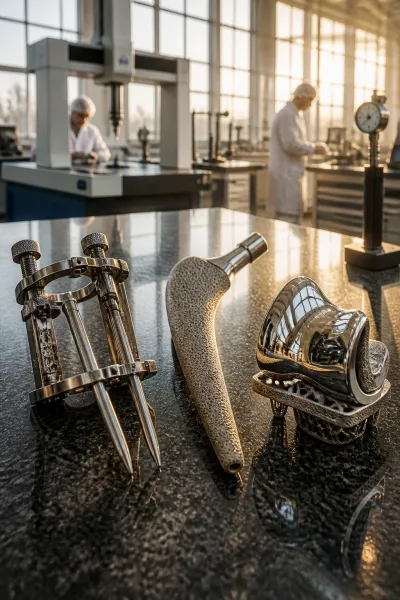
In the annals of American manufacturing, few stories rival the rise of Warsaw, Indiana — a town of fewer than 15,000 people that became the undisputed "Orthopedic Capital of the World." From this unlikely epicenter emerged two companies that would define modern joint replacement, trauma care, and spinal surgery, eventually merging into an S&P 500 giant. Amanda R. Aguilar's comprehensive history doesn't just catalog products and patents; it dissects the strategic decisions, cultural clashes, and leadership choices that turned artisan fracture frames into smart implants and digital health ecosystems.
What the book is about
"A History of Zimmer Biomet" spans 25 chapters and nearly a century, opening with the pre-Zimmer orthopedic landscape — where Civil War-era bone-setting gave way to X-rays and aseptic technique — and closing with the merged company's push into robotic surgery, AI-driven planning, and orthobiologics. The narrative follows parallel tracks: Frank Zimmer's 1927 founding of a quality-obsessed manufacturing firm, and the 1977 launch of Biomet by four OEC veterans betting on speed and surgeon-driven design. Chapters 1–12 trace each company's independent growth through wars, IPOs, regulatory mazes, and acquisition sprees. Chapters 13–16 detail the forces driving the 2015 merger and the brutal integration of IT systems, sales forces, and two diametrically opposed cultures. The final nine chapters examine post-merger innovation pipelines, global expansion, financial performance as an S&P 500 component, R&D in personalized medicine and smart implants, CSR commitments, adaptation to value-based care, key leaders' legacies, and strategic outlook. The book assumes no medical background but rewards readers familiar with corporate strategy, regulatory affairs, or medtech economics.
Warsaw's unlikely alchemy: geography as competitive advantage
The book makes a compelling case that Warsaw, Indiana, was not merely a backdrop but an active ingredient in both companies' success. Chapter 1 explains how Revra DePuy's 1895 splint factory exploited intersecting railroads for nationwide distribution, creating a cluster of specialized machinists, engineers, and regulatory talent. Zimmer (Chapter 2) and Biomet (Chapter 3) both tapped this labor pool, but the town's culture of "practical problem-solving" shaped their DNA differently. Zimmer's early fracture frames — "a more stable, adjustable, and standardized solution" for compound fractures — emerged from direct surgeon collaboration in local hospitals. Biomet's founders, all former OEC employees, leveraged the same ecosystem but with a disruptive mindset: "They believed they could create a company that was more responsive to surgeons' needs, more focused on rapid innovation." The concentration of expertise meant that when Biomet needed to scale porous-coated implant production in the 1980s, the tooling knowledge was literally next door. Aguilar argues this geographic density accelerated both companies' learning curves in ways that Silicon Valley-style remote collaboration could not replicate.
Two cultures, one merger: the methodical vs. the agile
Chapter 12 provides the book's most vivid contrast. Zimmer's culture, forged by Frank Zimmer's hands-on engineering, valued "methodical excellence," rigorous testing, and incremental improvement — "doing things right, even if it took a bit longer." Biomet's founders cultivated "an entrepreneurial atmosphere where risks were calculated but encouraged, and speed to market was a key competitive advantage." This clash erupted during integration (Chapter 15): "Employees from both sides might view the 'other' with suspicion, fear job losses, or resist changes to established ways of working." The sales force integration was especially fraught — Zimmer reps sold reliability; Biomet reps sold disruption. Leadership under David Dvorak and later Bryan Hanson explicitly pursued a "One Zimmer Biomet" vision, but the book doesn't sugarcoat the friction. Chapter 16 notes the deliberate choice to retain both names in the corporate identity — "acknowledging the strong brand equity and historical significance of each name" — as a cultural bridge. The synthesis remains incomplete in places, but the combined R&D engine (Chapter 17) now applies Zimmer's validation rigor to Biomet's rapid-prototyping instincts, yielding patient-specific instrumentation and smart implants faster than either could alone.
The merger as strategic inevitability, not opportunism
Chapter 13 reframes the 2015 deal not as a financial engineering play but as a response to structural forces reshaping orthopedics. Escalating R&D costs for robotic platforms and personalized implants demanded scale. Hospital systems and group purchasing organizations (GPOs) pressured vendors to consolidate — "preferred to deal with fewer, larger vendors who could offer a comprehensive suite of products." Regulatory complexity (FDA, EU MDR, Japan's MHLW) favored companies with deep compliance infrastructures. Zimmer's strength in hips/knees complemented Biomet's leadership in extremities, sports medicine, and dental — "a combined entity with an unparalleled product offering, capable of addressing nearly every aspect of musculoskeletal health." The $13.35 billion price tag (Chapter 14) reflected Biomet's private-equity owners' exit after operational improvements, but also Zimmer's calculation that "the combined revenues were projected to make Zimmer Biomet one of the largest orthopedic companies in the world." Antitrust divestitures in overlapping knee/hip lines (Chapter 14) were the price of regulatory clearance. The book portrays the merger as the logical endpoint of Chapter 11's pre-merger acquisition sprees — both companies had been consolidating the industry for decades; they finally consolidated each other.
Innovation's arc: from fracture frames to sensor-embedded implants
The book traces a clear technological lineage. Chapter 4 details Zimmer's early focus on external fixation — traction apparatuses, splints, "bone chisels, osteotomes, bone saws, and drills" — where metallurgy and ergonomics mattered more than software. Chapter 5 shows Biomet disrupting with porous-coated implants for biological fixation and modular hip systems. Chapter 8 marks the digital inflection point: CT/MRI imaging feeding CAD/CAM design, highly cross-linked polyethylene solving wear, navigation systems entering ORs. Post-merger, Chapter 17 and Chapter 20 converge on three frontiers: personalized medicine ("patient-matched instruments and custom implants" from pre-op CT scans), smart implants ("sensors and data collection capabilities directly into orthopedic devices to monitor performance, patient activity, and even bone healing in real-time"), and robotic-assisted platforms integrated with cloud analytics. The dental segment (inherited from Biomet) contributes digital workflow expertise. Aguilar emphasizes that this trajectory wasn't linear — each leap required parallel advances in materials, regulation, surgeon training, and reimbursement models. The book's strength is showing how commercial, clinical, and technical threads intertwine.
Leadership as the thread connecting eras
Chapter 23 rescues the narrative from institutional abstraction by profiling the individuals who made pivotal bets. Frank Zimmer, founding at 54, "sketching ideas and working alongside engineers." The Biomet quartet — Noblitt, Miller, Ferguson, Harroff — dividing strategy, invention, manufacturing, and sales. David Dvorak navigating Zimmer's pre-merger acquisitions and the integration gauntlet. Bryan Hanson simplifying the post-merger portfolio and betting on robotics/extremities. CFOs like James Lancaster and Glenn Boehnlein managing debt, currency risk, and synergy accounting. R&D chiefs translating surgeon wish lists into patentable devices. The book argues that leadership transitions — especially the founder-to-professional-manager handoffs — determined whether innovation stalled or accelerated. Zimmer's mid-century leaders "prioritized sustainable growth and a reputation for scientific rigor." Biomet's founders stayed operational for decades, preserving agility. The merger forced a new leadership synthesis: Dvorak's operational discipline plus Hanson's commercial focus. Aguilar suggests the next transition will test whether the "One Zimmer Biomet" culture can survive without a founder's living presence.
Who should read this
This book serves medtech professionals, healthcare investors, business historians, and strategy students who want a single-volume case study of industry consolidation, culture clash, and innovation management in a regulated global market. Readers seeking a light narrative or patient anecdotes will find the tone analytical and the detail dense — financial terms, regulatory pathways, and product codes appear frequently. But for anyone building, funding, or studying companies that must balance engineering rigor with commercial speed across decades, "A History of Zimmer Biomet" offers a rare, unvarnished look at how two midwestern workshops became a global standard-setter — and what the next chapter might demand.
Read “A History of Zimmer Biomet” on MixCache.com →
Please log in or create an account to leave a comment.
No comments yet. Be the first to say something.