
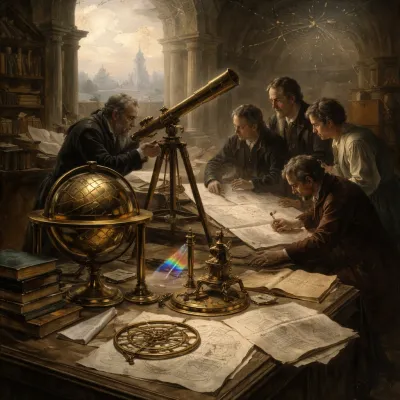
When we think of the Scientific Revolution, we often picture lone geniuses having eureka moments. But Jean Crawford's Science and Enlightenment reveals a far more complex story – one where telescopes and air pumps were as crucial as ideas, where knowledge flowed through coffeehouse conversations and colonial exploitation, and where the very definition of who could participate in science was constantly contested.
What the book is about: Spanning twenty-five chapters from the early 1600s to the late 1800s, Crawford's work traces how scientific thought, secular ideals, and intellectual networks intertwined to reshape European society. Rather than presenting isolated discoveries, she argues these elements collectively formed what she calls the "grammar of modernity" – the foundational ways of thinking and organizing that still shape our world today. The book moves from the concrete (instruments like telescopes and air pumps) to the institutional (academies and salons) to the global (colonial science and telegraph networks), ultimately examining who benefited from these changes and who was left behind.
The Tools That Extended Human Perception
Crawford emphasizes that the scientific revolution wasn't just about new ideas but about new ways of seeing and manipulating the world. Chapter 2 details how instruments like the telescope, microscope, and air pump transformed what humans could know about nature. As the text states, these devices "turned ideas into demonstrations, demonstrations into evidence, and evidence into a new way of knowing." The telescope revealed mountains on the Moon and moons orbiting Jupiter, challenging Aristotelian cosmology. The microscope opened "a hidden universe" in drops of pond water, while the air pump allowed researchers to test what happened when air was removed – showing that sound needed air to travel and that combustion required oxygen. These tools didn't just supplement senses; they fundamentally challenged the assumption that unaided human perception provided a reliable picture of reality, establishing that reliable knowledge required mechanical mediation and repeatable experimentation rather than reliance on ancient authorities or unaided observation.
Building Trust in the Republic of Letters
Before formal scientific institutions existed, knowledge traveled through what Crawford calls the "Republic of Letters" – a vast network of correspondence that connected scholars across Europe. Chapter 3 explains how this informal system functioned: letters carried experimental results, instrument sketches, and theoretical debates, with trust built through reputation rather than formal credentials. As Crawford notes, "the real challenge was trust" when receiving claims from distant colleagues, leading to norms of sharing data and acknowledging predecessors. This system gradually gave way to formal academies like the Royal Society and Académie des Sciences, which provided permanent structures for collective inquiry. Meanwhile, Chapters 9 and 10 show how salons, coffeehouses, and encyclopedias like Diderot's Encyclopédie created new public spheres where knowledge could be debated and disseminated beyond elite circles, with the Encyclopédie explicitly rejecting traditional hierarchies by arguing "that the skill of a master clockmaker or a skilled surgeon was as worthy of systematic description as the theorems of a mathematician."
The Entanglement of Science and Colonial Power
One of Crawford's most important contributions is showing how Enlightenment science was deeply intertwined with colonial extraction and exploitation. Chapter 13 details how scientific voyages like Cook's Pacific expeditions served dual purposes: gathering astronomical data while also mapping territories for conquest and identifying economically valuable plants. As the text states, "colonial naturalists relied heavily on the expertise of local people—guides, translators, herbalists, and collectors—whose intimate knowledge of local ecosystems made European exploration and documentation possible," yet these contributions were "almost never acknowledged in the resulting publications." Crawford highlights how botanical gardens became "way stations for the transfer of crops and specimens between colonies and the metropole," and how the very act of naming and classifying species was "an assertion of European authority over it, a way of incorporating it into a European intellectual system." This chapter confronts the uncomfortable reality that the same networks spreading ideas about liberty and reason also facilitated the extraction of knowledge and resources from colonized populations, with science serving "not merely as disinterested scientific studies" but as "research and development for plantation economies built on enslaved labour."
Who Was Left Out of the Enlightenment Project
Crawford doesn't shy away from examining the significant exclusions within the Enlightenment's universalist rhetoric. Chapter 23 documents how women, religious minorities, and working-class people were systematically barred from full participation in scientific life despite the era's proclaimed ideals of reason and progress. As the text notes, "universities, with few exceptions, excluded women from matriculation and degrees" and "scientific academies rarely admitted women as full members." While figures like Laura Bassi (who became a physics professor in 1732) and Émilie du Châtelet (who translated and commented on Newton's Principia) made significant contributions, their influence often depended on navigating "rigid social conventions" and presenting intellectual authority in "a manner deemed appropriate for their gender." Crawford also examines how enslaved people's knowledge was exploited – for instance, European botanists "relied heavily on the knowledge of enslaved healers" when studying tropical plants – while simultaneously being subjected to unethical experimentation and racial classification schemes that justified slavery. This chapter provides a crucial counterpoint to the traditional narrative of uninterrupted progress, showing how the Enlightenment's promise of universal reason was "constantly undermined by the particularisms of European society: its rigid gender roles, its ingrained religious prejudices, its exploitative colonial systems, and its deep class divisions."
Who should read this: This book will appeal to readers interested in the social history of science – not just what discoveries were made, but how they were made, who made them, and what social structures enabled or prevented participation. It's particularly valuable for those who want to understand science as a deeply human endeavor shaped by politics, power, and cultural contexts rather than as a linear march of objective truth. While the academic depth might be challenging for casual readers, Crawford's clear writing and concrete examples make complex ideas accessible to anyone willing to engage with the material.
For anyone seeking to understand how our modern scientific world came to be – with all its achievements and contradictions – Crawford's work offers an essential, nuanced perspective that goes beyond traditional histories of science.
Read “Science and Enlightenment: Intellectual Revolutions that Shaped Europe” on MixCache.com →
Please log in or create an account to leave a comment.
No comments yet. Be the first to say something.