
Browse by Category
Fiction
- Action & Adventure
- African American
- Anthologies
- Children's Fiction
- Classics
- Comics & Graphic Novels
- Coming of Age
- Contemporary
- Cultural & Regional
- Drama
- Erotica
- Fantasy
- General
- Historical Fiction
- Horror
- Humor & Satire
- Literary Fiction
- Mystery, Thriller & Suspense
- Poetry
- Religious & Inspirational
- Romance
- Science Fiction
- Short Stories
- War & Military
- Westerns
- Women's Fiction
- Young Adult
Non-Fiction
- Antiques & Collectibles
- Arts & Photography
- Biographies & Memoirs
- Business & Money
- Children's Non-Fiction
-
Computers & Technology
- Artificial Intelligence
- Computer Science
- Cybersecurity & Cryptography
- Data Science & Analytics
- Databases & Big Data
- Game Development & Design
- General
- Hardware & DIY
- Mobile App Development
- Networking & Cloud Computing
- Operating Systems
- Programming
- Robotics
- Software
- Software Engineering
- User Experience (UX) & Design
- Web Development & Design
- Cooking, Food & Wine
- Crafts, Hobbies & Home
- Education & Teaching
- Engineering
- General
- Health, Fitness & Dieting
-
History
- African History
- African History - North Africa
- African History - Sub-Saharan Africa
- American History
- American History - 20th Century
- American History - Civil War
- American History - Colonial Period
- Ancient History
- Asian History
- Asian History - China
- Asian History - India
- Asian History - Japan
- Asian History - Southeast Asia
- European History
- European History - Ancient Greece
- European History - Ancient Rome
- European History - Medieval
- European History - Modern
- European History - Renaissance
- General
- Middle Eastern History
- Military History
- Military History - Aviation
- Military History - Naval
- Social & Cultural History
- World History
- Humor & Entertainment
- Industrial Technology
- Language Learning
- Law
- LGBTQ+ Non-Fiction
- Literary Criticism
- Medical Books
- Parenting & Relationships
- Philosophy
- Politics & Social Sciences
- Reference
- Religion & Spirituality
-
Science & Math
- Agricultural Sciences
- Astronomy & Space Science
- Behavioral Sciences
- Biological Sciences
- Botany & Plant Science
- Chemistry
- Earth Sciences
- Engineering - Chemical
- Engineering - Civil
- Engineering - Electrical
- Engineering - Mechanical
- Environment
- General
- Geology
- Mathematics
- Nature & Ecology
- Oceanography
- Paleontology
- Physics
- Statistics
- Self-Help
- Sports & Outdoors
- Study Aids
- Sustainability & Green Living
- Textbooks
- Transportation
- Travel
- True Crime
- Urban Planning & Development
- Veterinary Medicine
- Writing & Publishing
Jump to Section
MixCache.com Total Access
Unlimited reading and audiobooks for every book published by MixCache.com.
Included titles carry the MTA badge.
Learn more →
Science and Enlightenment: Intellectual Revolutions that Shaped Europe
MTA
Tracing the rise of scientific thought, secularism, and intellectual networks from the 17th to 19th centuries
About this book:
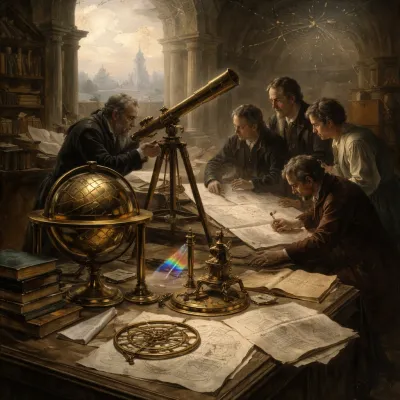
"Science and Enlightenment: Intellectual Revolutions that Shaped Europe" explores the intertwined development of scientific thought, secularism, and intellectual networks from the 17th to 19th centuries, arguing that these processes collectively forged the grammar of modernity. The book begins by charting the "Scientific Turn" of the 17th century, highlighting the shift from ancient authorities to systematic observation, experimentation, and mathematical reasoning, as exemplified by figures like Bacon, Descartes, Kepler, Galileo, and Newton. Crucially, it emphasizes the role of new instruments—telescopes, microscopes, air pumps—in extending human perception and creating verifiable evidence, establishing the foundations of experimental science.
The narrative then expands to detail how knowledge dissemination and institutionalization took root across Europe. The "Republic of Letters," a vast network of correspondence, journals, and print, facilitated intellectual exchange and built trust among scholars. This informal system gradually gave way to formal "Academies" like the Royal Society and the Académie des Sciences, which provided permanent structures for collective inquiry, publication, and state-sponsored research. The book also examines the intricate relationship between "Natural Philosophy and Natural Theology," demonstrating how scientists often saw their work as revealing God's design, even as emerging discoveries like deep geological time challenged traditional biblical narratives.
The practical applications of this scientific revolution are also extensively covered. "Mapping and Measuring" became crucial for states, driving innovations in cartography and the establishment of universal standards like the metric system. "Chemistry and Matter" evolved from alchemy to Lavoisier's quantitative revolution, transforming the understanding of elements and reactions. The "Life Sciences" advanced through systematic classification by Linnaeus, detailed anatomy by Cuvier, and vital debates about the nature of life. The rise of "Political Economy" saw thinkers like Adam Smith apply scientific methods to wealth and governance, laying the groundwork for modern economics. These intellectual shifts were nurtured in new "Public Spheres" like Enlightenment salons and coffeehouses, and consolidated through monumental projects like Diderot's *Encyclopédie*, which aimed to democratize and rationalize knowledge.
Finally, the book addresses the profound societal impacts and inherent contradictions of this era. It links "Science and Revolution," demonstrating how Enlightenment ideals fueled political upheavals in 1776 and 1789, while also exposing tensions between scientific progress and revolutionary violence. The "Empire of Knowledge" explores how scientific exploration and colonial extraction were deeply intertwined, facilitating conquest and resource acquisition while often exploiting indigenous knowledge. The demands of "Warfare and the Workshop" drove technological advancements in ballistics and metallurgy, contributing to the "Military-Fiscal State" and paving the way for the "Industrial Enlightenment," where steam power and factory systems reshaped labor and urban life. The expansion of "Education for a New Age" through polytechnics and popular lectures broadened access to scientific literacy, while innovations in "Medicine, Public Health, and the City"—from hospitals to vaccination—addressed the challenges of disease and urbanization. The rise of "Romantic Science" brought new perspectives on nature, energy, and the imagination, challenging purely mechanistic views. The emergence of "Statistics" transformed governance by enabling states to count and manage populations, creating the "Modern Research University" and fostering "Professionalization" in scientific fields. However, the book also critically examines the "Margins of Enlightenment," highlighting the systematic exclusion and struggles of "Women, Minorities," and enslaved people within these intellectual revolutions. The cumulative effect was a world increasingly connected by "Global Networks" like the telegraph and showcased in "World Fairs," culminating in a complex "Politics of Reform" where scientific reason, secularism, and state power reshaped society, often with profound and ambiguous consequences that continue to resonate in the modern world.
What You'll Find Inside:
- The book traces how scientific thought, secular ideals, and dense communication networks were intertwined processes that reconfigured European societies from the 17th to 19th centuries, creating a 'grammar of modernity'.
- It reveals how scientific practices became tools of state power as rulers sought accurate maps, taxation, and navigational mastery, transforming governance through measurement, classification, and statistics that bound knowledge to power in both emancipatory and coercive ways.
- The Enlightenment amplified these transformations by promoting reason as a means to critique authority and improve collective life, challenging religious monopolies while promoting secular education and toleration through salons, encyclopedias, and public spheres of knowledge.
- The book examines the global dimensions of Enlightenment science—how European empires extracted specimens, labor, and knowledge from colonized lands while relying on local expertise, creating circuits of exchange that simultaneously advanced metropolitan science and perpetuated colonial exploitation.
- It details the professionalization of science through laboratories, precision instruments, and specialized disciplines, while examining the social costs, exclusions of women and minorities, and contested legacy of institutions claiming universal authority.
Who's It For:
This book is ideal for historians of science, intellectual historians, and European history specialists seeking a comprehensive analysis of how scientific thought interacted with society, politics, and culture from the 17th to 19th centuries. It will also appeal to general readers interested in the origins of modern scientific institutions, the Enlightenment's global impact, and how knowledge production became entangled with power structures. Students studying the Scientific Revolution, Industrial Revolution, or the development of secularism will find valuable context for understanding how epistemological changes drove material and social transformations.
Table of Contents:
- Introduction
- Chapter 1 The Seventeenth-Century Scientific Turn
- Chapter 2 Instruments and Experiments: From Telescope to Air Pump
- Chapter 3 The Republic of Letters: Correspondence, Print, and Trust
- Chapter 4 Founding the Academies: Royal Society, Académie des Sciences, and Beyond
- Chapter 5 Natural Philosophy and Natural Theology: Negotiating Faith and Reason
- Chapter 6 Mapping and Measuring: Cartography, Longitude, and Standards
- Chapter 7 Chemistry and Matter: From Alchemy to Lavoisier
- Chapter 8 Life Sciences and the Order of Nature: Classification, Anatomy, and Vital Debates
- Chapter 9 Enlightenment Salons and Coffeehouses: Public Spheres of Knowledge
- Chapter 10 Encyclopedias and the Authority of Reason
- Chapter 11 Political Economy Emerges: Wealth, Labor, and the State
- Chapter 12 Science and Revolution: 1776, 1789, and the Reimagining of Citizenship
- Chapter 13 Empire of Knowledge: Exploration, Colonial Science, and Extraction
- Chapter 14 Warfare and the Workshop: Technology, Ballistics, and the Military-Fiscal State
- Chapter 15 Machines, Steam, and Industry: The Industrial Enlightenment
- Chapter 16 Education for a New Age: Schools, Polytechnics, and Popular Lectures
- Chapter 17 Medicine, Public Health, and the City: Hospitals, Vaccination, and Sanitation
- Chapter 18 Romantic Science and the Sublime: Nature, Energy, and the Imagination
- Chapter 19 Nation, State, and Statistics: Counting People, Governing Society
- Chapter 20 Laboratories, Precision, and Professionalization
- Chapter 21 Nature’s Deep Time: Geology, Fossils, and Earth History
- Chapter 22 Evolution and Its Discontents: Darwin, Debate, and Society
- Chapter 23 Women, Minorities, and the Margins of Enlightenment
- Chapter 24 Networks Go Global: Telegraphs, Exhibitions, and World Fairs
- Chapter 25 Knowledge, Secularism, and the Politics of Reform in the Long Nineteenth Century
Author:
Published By:
Date Published:
May 15, 2026
Type:
Nonfiction
Language:
English
Word Count:
84,618 words
Reading Time:
5 hours 56 minutes
Sample:
MixCache.com Total Access
Get unlimited access to this book + all books published by MixCache.com for $11.99/month
Subscribe to MTAOr purchase this book individually below
Order:
Buy the Science and Enlightenment: Intellectual Revolutions that Shaped Europe ebook on MixCache.com:
Buy Now
Full ebook will be available immediately
- read online or download as a PDF file.
$5 account credit for all new MixCache.com accounts, usable toward any ebook purchase!*





Ratings & Reviews
Ask Questions About This Book
Have a question about the content? Ask our AI assistant!
Start by asking a question about "Science and Enlightenment: Intellectual Revolutions that Shaped Europe"
Example: "Does this book mention William Shakespeare?"
Thinking...