
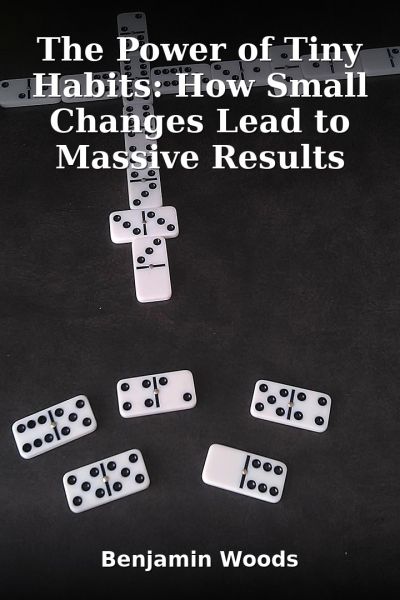
Most self-improvement books ask you to overhaul your life overnight. This one argues that the brain resists dramatic shifts and instead responds to actions so small they feel ridiculous — one push-up, one sip of water, one sentence written. Benjamin Woods builds a complete system around that insight, drawing on behavioral scientist B.J. Fogg's model to show how consistency beats intensity every time.
What the book is about
The Power of Tiny Habits is a 25-chapter nonfiction guide structured as a progressive curriculum. It opens by dismantling the myth of overnight success (Chapter 1), then walks through the neuroscience of habit loops (Chapter 2), the limits of willpower (Chapter 3), and neuroplasticity (Chapter 4) before introducing the Fogg Behavior Model — B=MAP, where Behavior equals Motivation, Ability, and Prompt converging (Chapter 5). The middle chapters teach practical tactics: choosing a "ridiculously tiny" starter habit (Chapter 6), stacking it onto an existing anchor routine (Chapter 7), redesigning your environment (Chapter 8), and celebrating immediately to release dopamine (Chapter 9). Later sections apply the method to health, productivity, finance, relationships, and well-being (Chapters 10, 21-24), address barriers like procrastination and perfectionism (Chapters 11-12), and provide tools for tracking, accountability, scaling, and adapting to life's seasons (Chapters 13-20). The book closes with a 30-day action plan (Chapter 25). It's written for anyone who has set ambitious goals only to watch them crumble, and who wants a low-friction, science-backed way to build lasting routines.
The Fogg Behavior Model turns habit design into a debuggable system
Woods devotes Chapter 5 to the core framework: B=MAP. Behavior happens only when Motivation, Ability, and a Prompt coincide. Most people blame low motivation when a habit fails, but the model shows two other levers. If Ability is high (the action is stupidly easy), you need less Motivation. If a reliable Prompt exists — ideally an "action prompt" anchored to a habit you already do — you don't have to remember. Woods writes, "When ability is high (meaning the action is very easy), you don't need a huge amount of motivation to get it done. The action practically does itself." This reframes habit failure as a design problem, not a character flaw.
Habit stacking makes new behaviors inevitable by hijacking old neural pathways
Chapter 7 introduces the "After I [EXISTING HABIT], I will [NEW TINY HABIT]" formula. Because the brain already runs the anchor habit on autopilot (via the basal ganglia), piggybacking a new micro-action onto it requires almost no cognitive effort. Woods gives concrete examples: "After I brush my teeth in the morning, I will do one push-up" or "After I pour my first cup of coffee, I will meditate for one minute." The anchor must be daily, stable, and specific — "After I brush my teeth" beats "in the morning." Once the stack is reliable, the new habit can become an anchor for another, creating chains that grow into full routines without ever feeling overwhelming.
Celebration isn't optional — it's the neurological glue that hardwires the habit
Chapter 9 argues that the habit loop's reward must be immediate, not delayed. Woods adopts Fogg's term "Shine" for the burst of positive emotion you generate right after the tiny action: a mental "Good for me!", a quiet fist pump, a smile. "The stronger the positive emotion you generate immediately after completing your tiny habit, the more deeply and quickly that new behavior gets encoded as an automatic routine," he explains. Dopamine released in that moment tells the brain "repeat this." Skipping celebration starves the loop of its reinforcement signal, which is why many well-designed habits still fade. The book insists you pick a celebration that genuinely feels good and use it every single time.
Scaling up happens organically through growing and multiplying, not by force
Chapter 16 distinguishes two expansion paths. Growing a habit means incrementally increasing the same action — one push-up becomes two, then five — but only when the current version feels effortless. Multiplying means using the established tiny habit as an anchor for a new one: "After I do one push-up, I will take one sip of water." Woods warns, "If the increased effort starts to feel like a chore, or if you find yourself procrastinating, it's a sign that you've scaled too quickly." The process stays iterative; you never jump to a "full workout" until the brain treats the smaller version as automatic. This respects the compound effect described in Chapter 17: "If you improve by 1% every single day for a year, you won't be 365% better; you'll be an astonishing 37 times better."
Self-compassion and the "never miss twice" rule protect consistency from life's chaos
Chapter 13 reframes missed days as data, not failure. Woods cites the "never miss twice" guideline: one slip is noise; two starts a trend. He prescribes a three-step response: acknowledge without judgment ("Okay, I missed my tiny habit today"), extract the lesson (was the anchor unreliable? the habit still too big?), and celebrate the rebound. Chapter 18 extends this to life transitions — new job, move, illness — urging "radical flexibility": shrink the habit to its mental version ("visualize one push-up") rather than break the chain. The 30-day plan in Chapter 25 bakes in weekly reflection and proactive adaptation so the system survives real-world disruption.
Who should read this
Readers who have repeatedly started and abandoned ambitious routines will find the step-by-step exercises and troubleshooting checklists immediately usable. The book suits people who prefer a structured, experimental approach over motivational rhetoric. Those looking for a quick inspirational boost or a single "magic habit" may be frustrated by the deliberate, iterative pace. But for anyone willing to trust that microscopic actions, consistently anchored and celebrated, can rewire the brain — this delivers the blueprint.
Read “The Power of Tiny Habits: How Small Changes Lead to Massive Results” on MixCache.com →
Please log in or create an account to leave a comment.
No comments yet. Be the first to say something.