
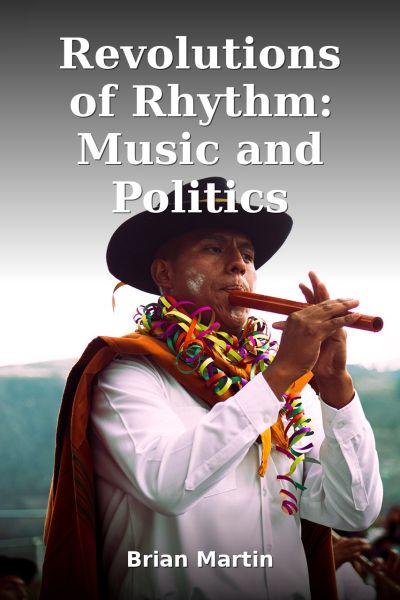
What if a drum pattern could topple a dictatorship, or a folk melody rewrite a constitution? Brian Martin's Revolutions of Rhythm argues that South American music has never been mere soundtrack — it has been a primary agent of political transformation. Across twenty-five chapters, the book demonstrates how sound organizes collective feeling, forges identities, and mobilizes publics from the colonial plaza to the digital stream.
What the book is about
Revolutions of Rhythm spans the long twentieth century into the present, moving across Argentina, Brazil, Chile, Uruguay, Colombia, Bolivia, Ecuador, and the borderlands between them. Its structure is both chronological and thematic: early chapters establish a framework for "listening to power" (Chapter 1) and trace nation-building through sound (Chapter 2), while later sections dive into specific genres — tango and Peronism (Chapter 4), samba under Vargas (Chapter 5), cumbia's migration (Chapter 6), Nueva Canción's leftist poetics (Chapter 7), Tropicália's aesthetic dissent (Chapter 8) — before expanding to Afro-Latin futures (Chapter 9), Indigenous plurinational politics (Chapter 10), Carnival as counterpublic (Chapter 11), gendered performance (Chapter 12), rock nacional (Chapter 13), exile circuits (Chapter 14), transitional justice (Chapter 15), infrastructural stages (Chapter 16), labor songs (Chapter 17), liberation theology's hymns (Chapter 18), censorship tactics (Chapter 19), Colombia's conflict (Chapter 20), digital activism (Chapter 21), regional flows (Chapter 22), state sonic symbols (Chapter 23), noise as protest tactic (Chapter 24), and the afterlives of these movements (Chapter 25). The intended reader is anyone willing to "read with your ears" — scholars of ethnomusicology and political history, certainly, but also general readers curious about how culture becomes a engine of social change.
Music as constitutive media, not reflection
Martin's central argument, laid out in the Introduction and Chapter 1, is that music "is not a backdrop to South American politics; it is one of its constitutive media." Rhythms coordinate bodies; choruses rehearse citizenship; repertoires transmit counter-histories. This is not the familiar claim that art reflects society. Instead, the book shows how a cadence can naturalize authority, how a groove opens space for dissent, how a chorus knits strangers into publics. The framework draws on ethnomusicology's attention to timbre and instrumentation and political history's focus on power, treating songs as "archives of collective life" and performances as "sites where power is made and contested." The payoff is a method that hears politics in a bass line, a drum cadence, a melody — not just in lyrics.
State co-optation and the sanitization of samba
Chapter 5 offers a masterclass in how power absorbs popular culture. Getúlio Vargas's Estado Novo didn't merely tolerate samba; it "transformed a stigmatized black music into a celebrated symbol of national unity and racial harmony" through the Department of Press and Propaganda (DIP). The raw batuque of Rio's morros was smoothed for radio, its African-derived percussion supplemented with piano and clarinet, its lyrics stripped of critique. The mulata dancer became an exported fantasy of racial democracy while Afro-Brazilians remained marginalized. Martin calls this "whitening" the music's social context while celebrating its "black" rhythmic essence — a pattern that recurs across the continent.
Coded messages and the grammar of subversion
Under military dictatorships, direct protest was suicidal. Chapter 19 details how artists developed "a sophisticated grammar of resistance" using allegory, domestic metaphor, and musical texture itself. A song about a "storm" signaled a crackdown; "waiting for someone who never returns" alluded to the disappeared. Charly García's line "the dinosaurs still rule the earth" became shorthand for aging generals. Even instrumental choices carried weight: a dissonant guitar solo could mimic machine-gun fire; a sudden dynamic shift enacted tension and release. The cassette tape became "the lifeblood of underground music," circulating banned songs through informal networks that the state "could never fully control." This cat-and-mouse game produced a lasting literary-musical vocabulary still used by contemporary artists.
Women's voices as political authority
Chapter 12 traces how women turned vocal performance into a site of power across genres. Mercedes Sosa's "deep, resonant alto projected an image of earthy strength and maternal solidarity"; Violeta Parra's "raw, pure" voice became a global anthem of resilience; Gal Costa deployed "untamed sensuality" as rejection of conservative femininity. Beyond singing, women were organizers and cultural workers: the Mothers of the Plaza de Mayo transformed their weekly vigil into "a soundscape of persistent, unwavering memory"; Indigenous women in the Andes used music to "preserve cultural memory and articulate a vision of a plurinational future." The chapter argues that female authority in South American music derives not from gender alone but from "unwavering commitment to the pueblo" and the ability to "control their own stories" through songwriting and performance.
Noise as tactic: the cacerolazo's acoustic insurgency
Chapter 24 elevates a household object into political theory. The cacerolazo — banging pots and pans — began in Pinochet's Chile as a decentralized, domestic noise that "the state's security forces struggled to contain." Its power lies in accessibility: "The state can arrest a singer, but it is much harder to arrest the sound of a thousand saucepans." The tactic transforms random clatter into collective rhythm, a "microcosm of political mobilization" where individuals become a crowd. Revived in Argentina's 2001 crisis and Chile's 2011/2019 uprisings, the cacerolazo adapted to digital coordination via WhatsApp and Twitter, its sound traveling globally while remaining rooted in the kitchen. Martin argues this expands the definition of politically significant sound: "The power of sound in politics lies not only in its aesthetic qualities but also in its ability to organize bodies and create a shared social experience."
Who should read this
Readers who want a single volume that connects tango's milongas to funk carioca's baile, Nueva Canción's peñas to TikTok protest anthems, will find the synthesis rewarding. The book demands patience — its 25 chapters are dense with historical detail, musical analysis, and theoretical framing — but it repays the effort with a usable framework for hearing politics in rhythm. Specialists may quibble with the breadth-over-depth tradeoffs in certain regional sections. Casual music fans looking for artist biographies or album guides should look elsewhere. For anyone studying social movements, media history, or Latin American politics, Revolutions of Rhythm is an essential reference that makes the inaudible audible.
Read “Revolutions of Rhythm: Music and Politics” on MixCache.com →
Please log in or create an account to leave a comment.
No comments yet. Be the first to say something.