
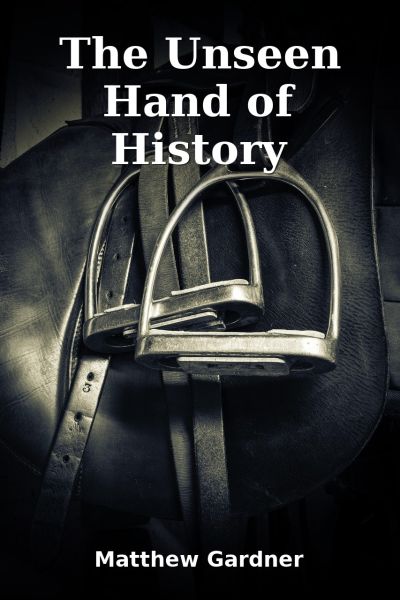
History books love emperors and battles. Matthew Gardner's The Unseen Hand of History prefers the plow, the stirrup, and the tax ledger. Across twenty-five chapters, he argues that empires rose and fell not on the sweep of grand strategy but on the cumulative weight of incremental solutions to everyday problems — how to feed more people, move water farther, record a transaction, keep a soldier in his saddle.
What the book is about
Gardner organizes his survey chronologically and thematically, moving from the heavy plow that opened Northern Europe's clay soils (Chapter 1) through Roman aqueducts (Chapter 2), Persian qanats (Chapter 3), and the angareion postal relay (Chapter 4) to shipbuilding (Chapter 5), Hammurabi's stele (Chapter 6), the Han meritocratic bureaucracy (Chapter 7), standardized weights and coinage (Chapter 8), Qin script unification (Chapter 9), Byzantine administration (Chapter 10), and a run of military innovations — phalanx, composite bow, stirrup, iron metallurgy, drill (Chapters 11–15). Later chapters widen the lens to cultural exchange on the Silk Road (Chapter 16), the spread of world religions (Chapter 17), urban planning (Chapter 18), guilds (Chapter 19), everyday ethics (Chapter 20), and finally the modern echoes of these patterns in infrastructure (Chapter 21), information networks (Chapter 22), the paradox of advantage turning into liability (Chapter 23), the diffusion of edges (Chapter 24), and a concluding reflection on today's unseen hands (Chapter 25). The book assumes no specialist knowledge; it speaks to readers who enjoy big-picture history but want the machinery exposed — the logistical, legal, and technical scaffolding that made the pageantry possible.
The plow that moved a continent
Chapter 1 makes the case that the heavy plow — wheels, moldboard, multiple oxen — was a geopolitical engine. It turned the dense, wet soils of Northern Europe from barrier into breadbasket, shifting Europe's demographic and economic center of gravity northward. The tool's cost and draft-animal demands encouraged communal ownership and the open-field system, which in turn fostered collective identity and labor organization. Gardner writes that the plow "directly contributed to the creation of the leisure and specialization necessary for advanced civilization." No plow, no surplus; no surplus, no legions, no bishops, no cathedrals.
Water, roads, and the nervous system of empire
Chapters 2–4 show how three empires solved the same problem — moving water and information across distance — with distinct but comparably incremental toolkits. Rome's aqueducts combined gravity gradients (1:4800), the arch, and extit{opus caementicium} into a 500-kilometer network that fed a million-person city. Persia's qanats went underground, using vertical shafts every 50–100 feet to tap mountain aquifers and carry water miles with near-zero evaporation. The same Persian state built the angareion, a relay of fresh horses and riders spaced a day's ride apart along the Royal Road, so that "messages traveled at the fastest possible speed, unimpeded by the exhaustion of a single horse or rider." Each system was a stack of small choices — gradient, shaft spacing, station interval — that only worked because they were maintained as institutions, not monuments.
Law and paperwork as power tools
Gardner gives equal weight to administrative technologies. Hammurabi's 282-law stele (Chapter 6) made justice public and proportional — "an eye for an eye" limited vendetta — while embedding status distinctions that reflected Babylon's hierarchy. The Han Dynasty (Chapter 7) swapped aristocratic patronage for a Confucian-educated bureaucracy selected by examination, creating "a powerful incentive for education" and a talent pool unbound by birth. Byzantium (Chapter 10) refined this into a self-perpetuating machine: the extit{thematic system} fused military command and civil administration in provincial extit{strategos} posts, and the extit{Logothetes tou Dromou} ran both the postal service and foreign intelligence. Standardized scripts (Chapter 9), weights and coinage (Chapter 8), and the extit{Book of the Eparch} regulating guilds (Chapter 19) all lowered the friction of governing at scale. The takeaway: empires that could count, record, and communicate reliably outperformed those that couldn't.
Military edge as a chain of tweaks
Chapters 11–15 trace how battlefield dominance emerged from layered improvements. The Greek phalanx relied on the extit{hoplon}'s double grip, which "allowed a hoplite to protect not only a portion of their own body but also to cover part of the man standing to their left." Epaminondas deepened one flank to fifty men at Leuctra; Philip of Macedon lengthened the spear to a two-handed extit{sarissa} and added companion cavalry. The Mongol composite bow — horn belly, sinew back, fish-glue laminate, recurved tips — stored more energy in a shorter frame, letting mounted archers shoot accurately at 300 meters. The stirrup (Chapter 13), a simple foot loop, "transferred the kinetic energy of the rider and weapon directly through the horse," enabling the couched lance and the feudal heavy cavalry that dominated Europe for centuries. Iron metallurgy (Chapter 14) democratized weaponry: bloomery forging, repeated folding, and eventual quenching and tempering turned the most abundant metal into reliable swords and plowshares alike. Drill (Chapter 15) made these tools usable en masse — Roman extit{testudo} formations and nightly extit{castra} construction turned individual skill into collective reflex.
When the advantage becomes the trap
The book's most provocative argument arrives in Chapters 23 and 24. Innovations that once conferred dominance eventually become liabilities. Roman roads, built for legion speed, later gave invaders "easily navigable pathways deep into Roman territory." Aqueduct maintenance costs strained treasuries until "sections fell into disrepair, water supplies became unreliable, and the very foundations of urban life began to crumble." The stirrup, gunpowder, papermaking, and silk production all diffused beyond their originators — sometimes by espionage (Byzantine monks smuggling silkworm eggs in hollow bamboo), sometimes by capture (Chinese papermakers taken to Samarkand), sometimes by trade. The Ming treasure fleets were deliberately dismantled, ceding the Indian Ocean to later European entrants. Gardner summarizes: "today's groundbreaking advantage is tomorrow's common practice." The only durable edge is the capacity to keep generating the next small innovation.
Who should read this
Readers who enjoy systems-level history — the logistics behind the legends — will find Gardner's framework clarifying. The book rewards patience with detail: it explains why a moldboard matters, how a qanat shaft spacing works, what a extit{logothetes} actually did. Generalists wanting a breezy narrative of conquests and personalities may find the technical passages dense. But for anyone who suspects that the world runs on standards, supply chains, and maintenance schedules — and that the next empire-shaping breakthrough is probably a boring-looking process improvement — this is a sharp, well-structured guide to the unseen machinery of power.
Read “The Unseen Hand of History” on MixCache.com →
Please log in or create an account to leave a comment.
No comments yet. Be the first to say something.