
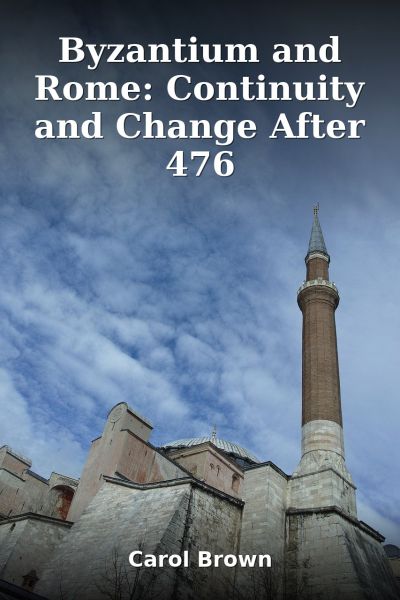
The year 476 has long served as history's convenient guillotine, cleanly severing antiquity from the Middle Ages. Carol Brown's Byzantium and Rome: Continuity and Change After 476 treats that date not as a rupture but as a diplomatic footnote — a moment when the Eastern emperor Zeno simply acknowledged a reality long in motion. The book's central claim is that the Roman state in the East survived precisely because it refused to choose between continuity and change, treating them instead as "partners."
What the book is about
Spanning twenty-five chapters, the work moves chronologically from the deposition of Romulus Augustulus through the Macedonian Renaissance, organizing its analysis around four axes: administrative resilience, legal codification, artistic transformation (especially the shift to domed architecture), and the persistence of Roman identity among a Greek-speaking, Christian populace. Brown writes for students of long-term historical processes, blending political, social, and cultural history while drawing on laws, edicts, archaeological reports, sigillography, numismatics, and art history. Each chapter asks three linked questions: which Roman structures survived intact, which adapted, and which disappeared — and why. The result is less a narrative history than an analytical framework for thinking about institutional survival across centuries of plague, war, and demographic collapse.
The myth of 476 as a diplomatic convenience
Chapter One dismantles the "hard dividing line" of 476 with striking specificity. Odoacer's deposition of Romulus Augustulus was "brisk and bloodless," and the Roman Senate in Rome "even sent a congratulatory embassy to Constantinople, suggesting that the eastern emperor Zeno might now rule a unified empire." Zeno's response — granting Odoacer the title of patrician in exchange for nominal loyalty — "maintained the legal fiction that the empire remained one and indivisible, even as local realities diverged." The chapter traces how later historians from Bede to Gibbon retroactively constructed 476 as a moral tale about civic virtue, while contemporaries saw only "one more twist in a long, messy story." Brown uses coin hoards, seal evidence, and linguistic data to show that economic and administrative divergence between East and West was already pronounced decades before Odoacer.
Administration as a living system: from prefectures to themes
Chapters Five and Six offer the book's most detailed demonstration of institutional adaptation. The late Roman separation of civil and military authority — Diocletian's great reform — proved unsustainable under seventh-century pressure. The Theme system emerged not as a clean break but as a pragmatic fusion: the strategos became "a general, a judge, and a chief tax farmer all in one," combining roles that had been distinct for centuries. Brown emphasizes this was "a shift born of Roman necessity, not a foreign import," and notes how Theme names deliberately echoed older provinces (Bithynia becoming Opsikion) as "an act of political and cultural continuity." The fiscal chapter traces the parallel shift from the cash-based annona to the land-based stratiotika ktemata, where soldiers' land grants replaced gold salaries — a "creative adaptation of an old idea" that "turned the empire's subjects into its primary defenders."
Law as the empire's connective tissue
Chapter Eight makes the case that Roman law functioned as "the connective tissue that allowed the Roman state to transform itself into Byzantium without losing its essential character." The Theodosian Code (438) provided stability; Justinian's Corpus Juris Civilis (529–534) rebuilt it into "a comprehensive legal edifice that would define Byzantine civilization." Brown shows how the Digesta preserved centuries of juristic reasoning while the Institutiones became a pedagogical tool ensuring "future generations of lawyers and officials would be trained in the new, unified legal system." Crucially, the law adapted to the Theme system: the strategos sat as supreme judge, yet "the substantive principles of Roman law, as preserved in the Justinianic Code, did not disappear." Legal pluralism — allowing Jewish, Armenian, and Syrian communities internal autonomy — continued as "a sophisticated solution to the problem of governing a multi-ethnic society."
Art and architecture: the dome as theological statement
Chapter Fourteen traces the visual transformation from basilica to domed space as more than aesthetic evolution. Hagia Sophia's pendentive dome, "seemingly suspended from heaven," created "a mystical, transcendent space designed to evoke the divine" rather than the "clear, rational space of a Roman basilica." Justinian's reported exclamation — "Solomon, I have outdone thee!" — framed the building as the New Covenant's architectural counterpart to the First Temple. The chapter connects this to theIconoclast controversy (Chapter Fifteen), where the debate over images became "a struggle over the limits of imperial power and the autonomy of the Church." Brown notes Iconoclasm was "not a blanket prohibition on all imagery" but a targeted ban on sacred figures, while secular palace mosaics continued — revealing the controversy as "a fundamentally imperial project" about authority as much as theology.
Identity as political technology
Chapter Twenty-Three argues that Romaion identity was "a conscious, sustained, and multifaceted project of memory." The empire's inhabitants never called themselves Byzantines — that term dates to sixteenth-century historian Hieronymus Wolf. They were Romaioi, ruled by the Basileus Rhomaion. This identity functioned as diplomacy: Persian and Arab rulers addressed the emperor as Kaisar or Qaysar, confirming "the world outside the empire consistently viewed Constantinople as the sole inheritor of Roman imperial power." Internally, the identity integrated diverse populations — Armenians, Syrians, Slavs — through a political rather than ethnic definition of Romanness. Even the 1453 fall saw the last emperor, Constantine XI Palaiologos, die "defending the New Rome against the Ottomans," the identity holding "until the very end."
Who should read this
This book rewards readers interested in comparative institutional history, state formation, and the mechanics of long-term cultural transmission. Its interdisciplinary method — combining legal texts, archaeological data, numismatics, and sigillography — makes it valuable for historians of late antiquity, medievalists, and political scientists studying state resilience. General readers without background in Roman administrative terminology may find chapters on fiscal regimes and thematic organization dense, though Brown's chapter introductions provide sufficient orientation. Those seeking a narrative-driven account of battles and emperors should look elsewhere; this is a structural analysis of how an empire reconfigured itself across a millennium while insisting it had never changed at all.
Read “Byzantium and Rome: Continuity and Change After 476” on MixCache.com →
Please log in or create an account to leave a comment.
No comments yet. Be the first to say something.