
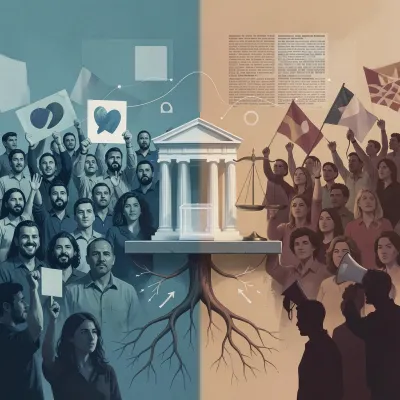
Populism has migrated from the margins of political commentary to its center, yet the term is still deployed so loosely that it often obscures more than it reveals. Austin Bennett's Populism Unpacked cuts through the noise by treating populism as a "thin ideology" — a portable frame that attaches to left‑wing, right‑wing, or other substantive agendas — and then tracing how that frame plays out in radically different institutional and cultural settings. The result is a book that is simultaneously a conceptual map, a global case‑study archive, and a workshop manual for democratic renewal.
What the book is about
The volume runs twenty‑five chapters, moving from definition through drivers, regional expressions, and finally a four‑part democratic toolkit. Chapters 1‑3 establish the core concept: populism as a moral struggle between "the pure people" and "the corrupt elite," a narrative that can be filled with either economic or cultural content. Chapters 4‑7 disaggregate the demand side — inequality, stagnation, precarity, globalization shocks, regional decline, identity anxieties, migration, gender, religion, and moral order. Chapters 8‑12 examine supply‑side mechanics: media ecosystems, charismatic leadership, party organization, electoral rules, and the courts. Chapters 13‑19 apply the framework to Latin America, Europe, the United States, Central and Eastern Europe, South and Southeast Asia, the MENA region, and Sub‑Saharan Africa. The final six chapters (20‑25) shift from diagnosis to prescription, offering a field guide for spotting populist rhetoric, early‑warning indicators for institutional stress, and four categories of remedies — policy, trust‑building, party strategy, and media governance — before concluding with a reflection on guardrails and pluralistic renewal. The intended audience is broad: scholars will appreciate the comparative rigour, practitioners the diagnostic checklists, and engaged citizens the clear‑eyed explanation of why populist appeals resonate and how democracies can answer them without mimicking their illiberal tactics.
The "thin ideology" chassis and its many body styles
Bennett's organizing metaphor — populism as a chassis onto which different engines and body styles can be fitted — appears in Chapter 1 and recurs throughout. The core structure is the claim that politics is a contest between a morally pure, homogeneous "people" and a corrupt, self‑serving "elite." Because this frame is thin, it travels easily: left‑wing variants (Chávez, Morales, Sanders) channel grievances against corporate and financial elites, while right‑wing variants (Orbán, Trump, Modi) redirect anxiety toward cultural threats like immigration and perceived moral decay. The book stresses that "these left‑right distinctions are not always neatly separable and can sometimes overlap in complex ways" (Chapter 2), citing France's Yellow Vests as a movement that began over fuel taxes but folded in anti‑immigrant rhetoric. This fluidity makes rigid categorization hazardous but also reminds analysts to watch for hybrid movements that blend economic protectionism with nativist identity claims.
Economic shocks as kindling, not the whole fire
Chapters 4 and 5 make a careful case that material grievances create fertile ground but do not deterministically produce populism. Rising inequality, wage stagnation, labor precarity, and the spatial concentration of deindustrialization — "left‑behind" regions from the U.S. Rust Belt to northern England — generate a "visceral sense of unfairness" that populists harvest. Yet the book shows how the same shocks yield different political outcomes depending on whether grievances are framed against economic elites (left) or cultural outsiders (right). The 2008 financial crisis and the Eurozone austerity that followed birthed Syriza and Podemos in Southern Europe, while the 2015 migration crisis supercharged right‑wing nationalism across the continent. Bennett also highlights a feedback loop: "Rising inequality means fewer resources for public services and a weakening social safety net, which in turn exacerbates precarity for those at the bottom." The policy implication is clear — redistribution, regional investment, and labor protections are necessary but insufficient if cultural anxieties remain unaddressed.
Media ecosystems as accelerants, not mere mirrors
Chapter 8 traces a lineage from Father Coughlin's radio sermons to TikTok's algorithmic feeds, arguing that each technological shift has lowered the cost of bypassing gatekeepers. Chapter 12 then dissects the "business models of outrage": platforms optimized for engagement reward content that provokes anger, fear, and righteous indignation — precisely the emotional registers populist narratives inhabit. The book notes that "nuance, complexity, and calls for compromise, which tend to generate less intense emotional reactions, struggle to gain the same algorithmic traction." This structural bias is compounded by microtargeting, AI‑generated deepfakes, and the collapse of local journalism, which leaves a vacuum filled by national‑level partisan feeds. Bennett avoids technological determinism — platforms are not the sole cause — but he insists that any democratic response must reckon with the incentive architecture that makes outrage profitable.
A diagnostic toolkit you can actually use
Chapter 20 stands out for its practical orientation. Rather than offering a single checklist, it provides layered instruments: a rhetorical field guide (six questions to ask of any speech), an institutional stress test (five domains to monitor — judiciary, media, elections, civil society, legislature), and an organizational/leadership analysis (six markers of personalist, loyalty‑driven movements). The chapter repeatedly warns against "isolated incidents" — "A single critical comment about the media doesn't make a leader a populist; a sustained, systemic campaign to delegitimize all independent media does." It also distinguishes populist rhetoric from populist governance, a distinction that matters because "many politicians adopt elements of populist rhetoric to win elections, but not all of them will necessarily pursue illiberal policies once in power." Regional adaptation is built in: the toolkit flags that in Sub‑Saharan Africa anti‑establishment politics intertwine with patronage networks, while in the MENA region populist claims operate under authoritarian constraint.
Four lanes of democratic response — and why they must run together
The prescriptive half of the book (Chapters 21‑24) organizes remedies into four mutually reinforcing lanes. First, policy actions that alleviate material insecurity: progressive taxation, universal healthcare, regional investment, living‑wage laws, gig‑worker protections, and affordable housing. Second, trust‑building measures — independent anti‑corruption agencies, transparency reforms, whistleblower protections, campaign‑finance limits, and open‑government initiatives — that make elite behavior visible and accountable. Third, party strategies that re‑engage disaffected voters through grassroots mobilization, inclusive coalitions, and a refusal to "accommodate concessions that sacrifice democratic norms." Fourth, media governance, media literacy, and deliberative dialogue (intergroup dialogue, citizens' assemblies, participatory budgeting) to counter disinformation and polarization. The conclusion (Chapter 25) argues that these lanes cannot be pursued sequentially; "democracy can renew itself by addressing root grievances, strengthening institutional guardrails, and fostering inclusive participation, thereby turning populist pressures into opportunities for pluralistic renewal rather than democratic erosion."
Who should read this
Readers who want a single, coherent framework for making sense of populist movements from Budapest to Buenos Aires, from Manila to Marrakesh, will find the book's comparative architecture clarifying. Policy analysts and civil‑society practitioners will benefit from the diagnostic checklists and the explicit linking of drivers to remedies. Journalists covering democratic backsliding will appreciate the precise language for describing rhetorical patterns without defaulting to "populist" as a synonym for "politician I dislike." General readers looking for a quick narrative history or a partisan polemic should look elsewhere — this is a systematic, evidence‑dense reference work that rewards sustained attention. For anyone willing to do that work, Populism Unpacked delivers something rare: a map that shows both where the traps lie and where the levers for democratic renewal can be found.
Read “Populism Unpacked: Causes, Variants, and Democratic Responses” on MixCache.com →
Please log in or create an account to leave a comment.
No comments yet. Be the first to say something.