
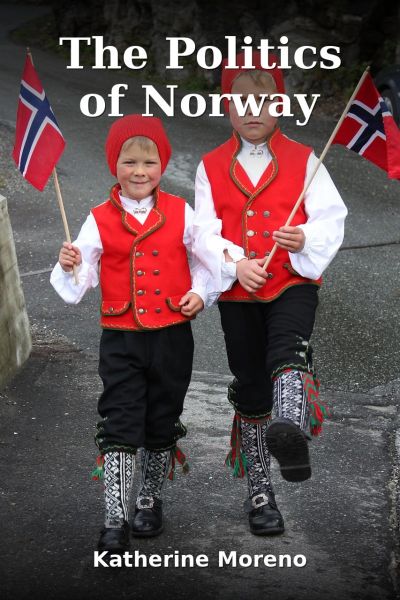
Norway consistently tops global democracy indices, yet its political machinery remains opaque to most outsiders. Katherine Moreno's The Politics of Norway demystifies how a nation of 5.5 million people built a system that combines a ceremonial monarchy, proportional representation, and the world's largest sovereign wealth fund into something remarkably functional. The book doesn't just describe institutions — it explains why they work, where they strain, and what happens when consensus culture meets hard choices about immigration, climate, and the end of oil.
What the book is about
The book spans 25 chapters, moving chronologically from the Viking Age unification through the 1814 Constitution at Eidsvoll, the union with Sweden, World War II occupation, and the post-war welfare state construction. It then systematically dissects each branch of government — the Storting's unicameral lawmaking, the King's ceremonial role, the independent judiciary — before tackling the electoral mechanics that produce perpetual minority coalitions. Later chapters cover policy domains: the welfare state's universalist logic, the Government Pension Fund Global's fiscal rule, the paradox of climate leadership alongside petroleum exports, immigration integration debates, gender quota innovations, and the "fax democracy" of EEA membership. The final chapters assess current reforms and future pressures. Written for students, researchers, and curious generalists, it assumes no prior knowledge but rewards readers who want structural depth over tourist-level summaries.
The 1814 Constitution as living artifact
Most constitutions from 1814 have been replaced; Norway's has been amended over 300 times but never discarded. Moreno traces how the Eidsvoll delegates — 112 men gathered at a manor house — synthesized Enlightenment ideas into a document that declared popular sovereignty while banning Jews and Jesuits. The Constitution survived the Swedish union because the Convention of Moss let Norway keep it, amended only for the union. Chapter 3 details how provisions like the Storting's budgetary power and the judiciary's independence became levers for gradual democratization: universal male suffrage (1898), women's suffrage (1913), and parliamentarism (1884). The 2014 bicentennial amendments modernized language and entrenched human rights. As Moreno writes, "The 1814 Constitution, born out of a moment of national crisis and aspiration, has proven to be a remarkably durable and adaptable document."
Negative parliamentarism and the art of minority governance
Since 1961, no single party has held a Storting majority. Chapter 10 explains how Norway turned this into a feature, not a bug. The system operates on "negative parliamentarism": a government doesn't need a confidence vote to form; it only falls if a majority explicitly votes no confidence. This lets minority cabinets govern for years by assembling issue-by-issue majorities. The current Labour-Centre coalition (formed 2021) relies on Socialist Left support without including them in cabinet — a "support party" arrangement that forces constant negotiation. When the Centre Party exited in 2025 over EU energy directives, Labour continued as a single-party minority. Moreno notes this "encourages parties to be more pragmatic and less ideologically rigid," though it also means legislative agendas get watered down to survive ad-hoc votes.
The oil fund's fiscal rule as political constraint
Chapter 18 reveals how the Government Pension Fund Global — now over $1.7 trillion — became a constitutionalized spending cap. The "spending rule" limits structural non-oil deficits to the fund's expected real return (currently ~3%), preventing petroleum wealth from overheating the domestic economy. This isn't just technocratic; it's a political settlement. Parties across the spectrum accept the rule because breaking it would trigger inflation, hurt competitiveness, and betray intergenerational equity. Yet Moreno documents the friction: during downturns, opposition parties demand more spending; when oil prices surge, government parties face pressure to loosen the purse strings. The fund's ethical guidelines — excluding tobacco, coal, certain weapons — also become political footballs. The result is a rare thing: a fiscal framework that survives government changes because no party wants to own the consequences of breaking it.
Climate ambition versus petroleum reality
Chapter 19 captures Norway's central contradiction. The Climate Act targets 90–95% emissions cuts by 2050 and 55% by 2030. Carbon tax (since 1991) and EU ETS participation make emitting expensive. Electric vehicle incentives created the world's highest per-capita EV ownership. Yet petroleum accounts for roughly half of exports and funds the welfare state. Moreno details the tension: emissions from production on the Norwegian shelf are regulated, but "the vast majority of emissions associated with Norwegian oil and gas occur when these fossil fuels are burned by consumers in other countries." An EFTA Court opinion now requires assessing these "exported emissions" in new project approvals. The Green Party wants production phased out; Labour and Conservatives back a managed transition with carbon capture; the Progress Party emphasizes economic stakes. This isn't resolved — it's the fault line running through every coalition negotiation.
The Sami Parliament and the limits of consultation
Chapter 13 introduces the Sámediggi, established in 1989 after the Alta hydroelectric protests forced a reckoning with assimilation policies. Its 39 representatives, elected from seven constituencies every four years, have advisory authority and a statutory right to be consulted on matters affecting Sami interests — grounded in ILO Convention 169. But as Moreno explains, "the Sami Parliament is a politically autonomous body and not part of the Norwegian state's hierarchical structure" and "cannot enact laws in the same way the national parliament does." Consultation doesn't equal consent. Conflicts over wind farms on reindeer grazing land and mining in traditional territories reveal the gap between procedural rights and substantive influence. The 2005 consultation agreement (updated since) formalized the process, but land rights remain unresolved. This chapter reframes Norwegian democracy: high scores on civil liberties coexist with an indigenous institution that has voice but not veto.
Who should read this
Political science students will find a ready-made comparative case study — proportional representation, negative parliamentarism, consociational tendencies — with all the institutional detail needed for coursework. Policy analysts get a clear map of how Norway's welfare state, fiscal framework, and climate policy interlock. General readers curious about why Norway scores #1 on democracy indices will appreciate the absence of jargon and the willingness to show tensions (the "democratic deficit" of EEA membership, integration struggles, the oil-climate paradox). Skip it if you want narrative history or biographical portraits; this is structural anatomy, not storytelling. For anyone building a mental model of how a small, wealthy, consensus-driven democracy actually functions — and where its fault lines lie — it's an essential reference.
Read “The Politics of Norway” on MixCache.com →
Please log in or create an account to leave a comment.
No comments yet. Be the first to say something.