
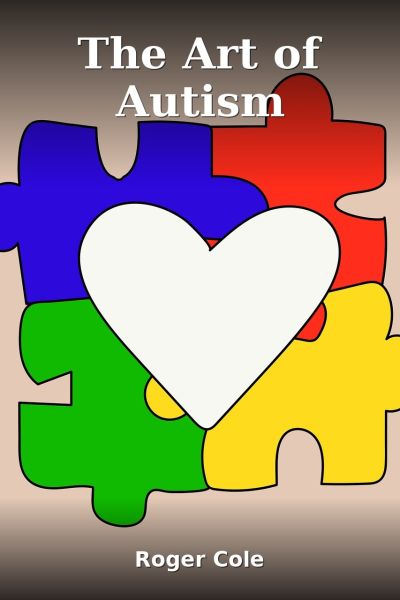
For decades, the prevailing narrative framed autism through a lens of deficit — rigidity, social awkwardness, a supposed lack of imagination. Roger Cole's The Art of Autism systematically dismantles that story, replacing it with something far richer: a portrait of neurodivergent cognition as a wellspring of original thought, pattern recognition, and artistic innovation. The book doesn't just argue for inclusion; it demonstrates, across 25 chapters, how the very traits once pathologized are the engines behind some of the most compelling creative work of our time.
What the Book Is About
The Art of Autism is a comprehensive nonfiction exploration of the intersection between autism spectrum disorder and creative expression. Organized into five major movements, it moves from foundational science — cognitive processes, myth-busting, the neurodiversity paradigm — into discipline-specific surveys of visual arts (Chapters 6–10), music (11–15), literature (16–20), and STEM innovation (21–24), closing with a practical toolkit for fostering neurodiverse creativity (Chapter 25). The intended audience is broad: educators, parents, employers, clinicians, and autistic creators themselves. Cole writes with scholarly rigor but without academic density, weaving research citations, first-person artist profiles, and actionable strategies into a single narrative. The book assumes no prior expertise, only a willingness to reconsider what creativity looks like when it emerges from a differently wired mind.
The Cognitive Architecture of Autistic Creativity
Cole devotes Chapters 2 through 4 to the neurological and cognitive underpinnings of autistic creative output. He details how "enhanced visual processing," "hyperfocus," "meticulous attention to detail," and "divergent thinking" operate not as compensations but as distinct computational strengths. Citing Temple Grandin's description of "thinking in pictures," the text explains that autistic brains often show increased activity in visual-processing regions even during language tasks. Chapter 4 introduces the "creative paradox": while autistic individuals may generate fewer ideas in standard divergent-thinking tests, "the ideas they do produce are often more unusual, original, and innovative." This reframing — from deficit to difference — anchors the book's strengths-based approach and gives readers a concrete framework for understanding why autistic creators so often arrive at solutions neurotypical minds miss.
Visual Arts: Perception Made Tangible
The visual-arts section (Chapters 6–10) reads like a curated gallery tour with neuroscientific commentary. Cole profiles artists whose work makes the invisible mechanics of autistic perception visible. Stephen Wiltshire draws "complex cityscapes from memory after seeing them just once." Niam Jain, largely nonverbal, creates layered acrylic paintings using "construction tools, pallet knives, twigs, and branches" in a process he describes as "unrestrained abandon." Gilles Tréhin has spent decades building Urville, an imaginary city documented in hundreds of architectural drawings complete with history, economy, and transit maps. These aren't anecdotes tacked on for color; each profile illustrates a specific cognitive trait — eidetic memory, sensory-driven abstraction, systemic world-building — that the earlier chapters theorized. The result is a rare alignment between theory and lived creative practice.
Music as Language, Memory, and Collaboration
Chapters 11 through 15 trace music's role from sensory regulation to savant-level mastery to social bridge. The book documents Leslie Lemke, who at 14 "after hearing Tchaikovsky's Piano Concerto No. 1 on television for the first time, he sat down at the piano and played it flawlessly" despite no prior training. It explores how perfect pitch and "expansive musical memory" correlate with autism more frequently than in the general population. But Cole doesn't stop at prodigy narratives. Chapter 14 details how ensembles like The AutistiX and ASD Band use shared musical structure to bypass verbal social demands, creating "a community where their unique talents are not only accepted but celebrated." Music therapy research is summarized without jargon, showing measurable gains in "shared attention, verbal and non-verbal communication, initiating behavior, and social-emotional reciprocity." The section makes a persuasive case that music is not merely a talent domain for autistic people but a uniquely accessible mode of connection.
Literature: The Written Word as Controlled Expression
The literature chapters (16–20) argue that writing offers autistic creators something spoken language often cannot: "a unique sense of control and predictability." Cole examines how first-person narration, literal precision, and non-linear structure become deliberate stylistic choices rather than limitations. He highlights Naoki Higashida's The Reason I Jump, written via alphabet grid at age 13, and contemporary novelists Madeleine Ryan, Rivers Solomon, and Viktoria Lloyd-Barlow, whose protagonists navigate neurotypical worlds with "candid, observant, and deeply analytical" voices. A particularly useful passage for writers and teachers notes that autistic students often struggle with "the mechanics of writing, including handwriting, spelling, punctuation, and grammar, partly due to fine motor challenges," but thrive when offered "keyboarding" and "speech-to-text software" — a concrete accommodation with immediate creative payoff.
The Autistic Edge in STEM and How to Cultivate It
The final third of the book extends the creativity argument into science, engineering, and technology. Chapter 21 identifies "pattern recognition" combined with "intense focus on detail" as the twin drivers of autistic innovation in fields from genetics to cybersecurity. Chapter 22 connects this to design thinking in architecture and engineering, where "systematic thinking" and "spatial reasoning" produce "designs that are not just functional but also thoughtfully constructed." Chapter 23 profiles historical figures — Alan Turing, Nikola Tesla — whose neurodivergent traits align with retrospective autism assessments, not to diagnose the dead but to illustrate a continuum. The practical payoff arrives in Chapters 24 and 25: neurodiversity hiring programs at Microsoft, SAP, and JPMorgan Chase; sensory-friendly office layouts; mentorship models; and a checklist for educators that includes "providing visual aids, written instructions, and clear rubrics" and "leveraging and integrating special interests." These aren't vague aspirations; they're implemented policies with documented results.
Who Should Read This
The Art of Autism will reward anyone who works with, teaches, parents, or employs autistic individuals and wants a strengths-based framework backed by both research and lived experience. Autistic creators themselves will find their cognitive styles described with rare accuracy and respect. Readers looking for a light memoir or a purely inspirational narrative may find the book's density — 25 chapters, extensive citations, multiple disciplinary deep dives — more reference than page-turner. But for those willing to engage its full scope, it functions as both a myth-busting manifesto and a practical manual for building environments where neurodivergent creativity doesn't just survive but leads.
Read “The Art of Autism” on MixCache.com →
Please log in or create an account to leave a comment.
No comments yet. Be the first to say something.