
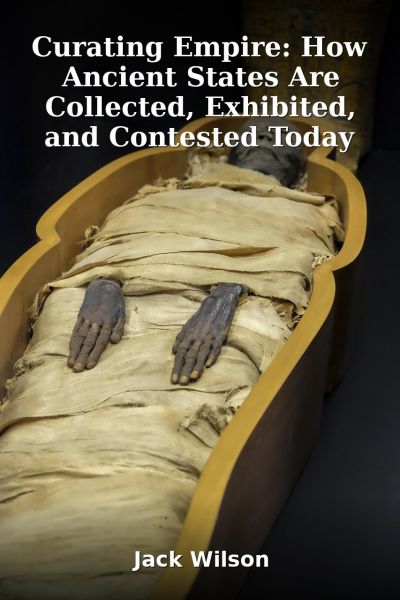
Walk through the grand halls of the British Museum or the Louvre and you encounter the marble facades of ancient empires — Assyrian lamassu, Egyptian sarcophagi, Greek friezes — displayed as universal treasures. But as Jack Wilson shows in Curating Empire, the journey of these objects from their places of origin to climate-controlled cases is rarely neutral; it is a story of loot, law, and the persistent power of colonial narratives that museums are only now beginning to confront.
What the book is about
Curating Empire is a 25-chapter nonfiction guide that moves chronologically and thematically from the ancient origins of collecting to the digital frontier of heritage stewardship. Wilson structures the book in three broad arcs: the historical formation of collections (Chapters 1–5), the ethical and legal frameworks governing them today (Chapters 6–14), and the case studies and emerging practices that point toward repair (Chapters 15–25). The prose is scholarly but accessible, aimed at museum professionals, students of public history, and engaged readers who want to understand why the Parthenon Marbles and Benin Bronzes dominate headlines — and what it would take for museums to become, in Wilson's phrase, "spaces of justice, dialogue, and repair."
The colonial engine that filled the galleries
Wilson devotes Chapters 3 and 4 to demonstrating that the "universal" collections of Europe were built on extraction. He writes that "the acquisition of these cultural objects, a polite term for what often amounted to systematic pillaging, frequently involved practices that would be considered flagrantly unethical by any modern standard." The British Museum's Assyrian reliefs, for instance, were removed from Nimrud in the 1840s with "elaborate engineering feats to transport them down rivers and across continents to England," while the Rosetta Stone entered the collection after the defeat of Napoleon's forces in 1801 — a war trophy reframed as scholarly prize. Chapter 4 dissects the partage system that governed Egyptian excavations under British administration, showing how colonial law "effectively sanctioned the large-scale removal of artifacts" while leaving Egypt with a disproportionately smaller share of its own heritage.
Provenance as ethical detective work
Chapter 6 reframes provenance research from a curatorial nicety into a moral imperative. Wilson describes it as "an artifact's autobiography, detailing every owner, every sale, every exhibition, and every significant event in its existence." He is candid about the obstacles: early museum registers might note only "Gift of Mr. X" or "Purchased from dealer Y," and the illicit antiquities market "deliberately obscures provenance to launder stolen objects into legitimate collections." Yet digital tools — digitized auction catalogs, collaborative platforms, open-access colonial archives — are "democratizing provenance research, allowing scholars and origin communities worldwide to engage with these histories." The chapter insists that transparency about gaps is itself a form of accountability: "The absence of documentation… can itself be a red flag."
Two case studies, two trajectories
The Parthenon Marbles (Chapter 15) and the Benin Bronzes (Chapter 16) illustrate the spectrum of repatriation outcomes. For the Marbles, the British Museum Act of 1963 "explicitly prohibits the British Museum from deaccessioning objects" — a legislative barrier that makes return dependent on Parliament, not ethics. Greece's Acropolis Museum, built with deliberate empty spaces awaiting the London pieces, turns architectural absence into argument. By contrast, the Benin Bronzes — looted in an 1897 punitive expedition that the Horniman Museum acknowledged was acquired through "force and violence" — have seen outright returns from Germany, the Netherlands, and the Horniman itself. Wilson notes that Nigeria's planned Edo Museum of West African Art "further strengthened Nigeria's case" by demonstrating capacity for care, undercutting the paternalistic preservation argument.
Decolonizing practice and the shift to shared authority
Chapters 11 and 21 move beyond restitution to institutional transformation. Wilson defines decolonization as "a profound, systemic shift in ideology, methodology, and power dynamics" that requires museums to "move beyond simply diversifying their programming or adding a few new labels, and instead, to truly transform their very DNA." Participatory curation, he argues, is not consultation but "shared authority" — co-curation where communities "make decisions about the display and future of their heritage." He points to Te Papa Tongarewa in New Zealand, founded on biculturalism with dual Māori and Pākehā leadership, where ancestral figures are "treated with the respect due to living beings, rather than mere objects." Digital repatriation — sharing 3D models and documentation — extends this partnership across distance, though Wilson warns it must respect "data sovereignty and control over digital assets" to avoid "new forms of digital appropriation."
Digital futures and the dilemmas that remain
The final chapters (20, 23–25) explore how VR, GIS, and AI are reshaping access while raising fresh ethical questions. Wilson envisions "digital twins" of sites enabling remote study and virtual reunification of fragmented objects, but he flags the "digital divide" that could marginalize communities lacking infrastructure. AI-driven personalization risks "filter bubbles that limit exposure to diverse perspectives or challenging narratives," and algorithms trained on biased data could "perpetuate colonial interpretations." The book closes with a sober assessment: legal barriers like the British Museum Act persist, the definition of "origin communities" for millennia-old empires remains complex, and funding pressures may tempt institutions toward blockbuster spectacle over difficult histories. Yet Wilson insists the direction is clear — museums must become "active agents of change, contributing to a more just, equitable, and globally interconnected future."
Who should read this
Curating Empire will reward museum professionals seeking a comprehensive ethical framework, graduate students in heritage studies needing a single-volume survey of the field's central debates, and general readers who want to understand the stakes behind headlines about contested artifacts. Readers looking for a light tour of museum highlights or a purely celebratory history of great collections should look elsewhere; Wilson's project is critical, granular, and unflinching about the violence embedded in many collections. For anyone willing to sit with that discomfort, the book offers not just diagnosis but a detailed map of where the profession is heading — and why the journey matters.
Please log in or create an account to leave a comment.
No comments yet. Be the first to say something.