
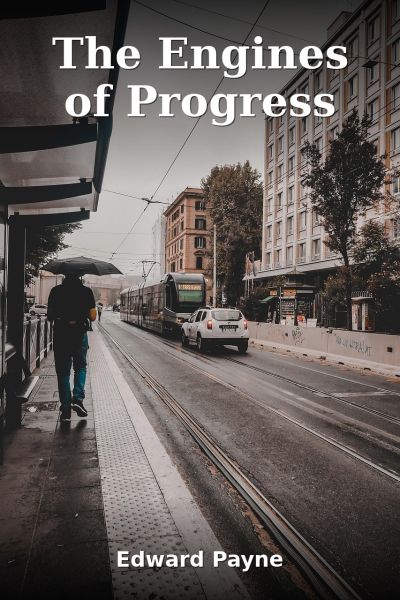
The story of civilization is, at its core, the story of how we move. From the first hominid footsteps preserved in volcanic ash to the algorithmic choreography of a drone delivery, every expansion of human reach has rewritten the rules of trade, power, and community. Edward Payne's "The Engines of Progress" doesn't just catalog vehicles; it maps the feedback loops between motion and society across 25 dense, brisk chapters.
What the book is about
Payne structures the work as a chronological march, each chapter keyed to a distinct technological threshold: bipedalism and animal domestication (Chapters 1–2), the wheel and early roads (3–4), chariots and the Silk Road (5), river and sea routes (6–9), canals (10), steam power and railways (11–14), the automobile ecosystem (16–20), aviation and the jet age (21–22), the digital navigation layer (23), and the electric/autonomous future (24–25). The prose is clean and reportorial, aimed at a general reader who wants the engineering facts but also the second-order effects—how a canal lowered the price of coal, how the Model T rewrote courtship rituals, how GPS turned logistics into a real-time optimization problem. Footnotes are sparse; the narrative carries the weight.
Transportation as a social contract, not just a technology
Payne repeatedly returns to the idea that each mobility breakthrough renegotiates the relationship between people and space. The Persian Royal Road wasn't merely a faster path; it was "a powerful symbol of Persian authority and helped to unify diverse regions under a centralized government" (Chapter 4). Roman roads did the same for legion speed and tax collection. The railway later forced the adoption of standardized time zones because "the need for synchronized train schedules necessitated the standardization of time" (Chapter 15). In the 20th century, the Interstate Highway Act "institutionalized the priority of the automobile in transportation planning for decades" (Chapter 18). The pattern is clear: infrastructure hardens political and economic priorities into concrete and steel.
The recurring cycle of capacity, congestion, and the next fix
A quiet argument runs through the book: every solution breeds a new bottleneck. Canals slashed freight costs but froze in winter and couldn't climb grades; railways solved the grade problem but required massive capital and fixed routes; trucks offered door-to-door flexibility but clogged the very highways built for cars. Payne illustrates this with the Erie Canal's "83 locks to overcome a 170-meter (560-foot) elevation change" (Chapter 10), then contrasts it with the Baltimore & Ohio Railroad's ability to "traverse prairies, cross mountains, and bridge immense distances" (Chapter 12). The jet age cut transatlantic travel from 14 hours to 6–8, yet "noise pollution around airports became a significant concern" and "the environmental impact of jet fuel emissions" emerged (Chapter 22). The narrative treats progress as a treadmill, not a finish line.
Energy transitions as the hidden driver
While vehicles grab the spotlight, Payne gives equal time to what powers them. The shift from muscle to animal power, then to coal-fired steam, then to petroleum, and now to electrons and hydrogen, structures the book's macro-arc. James Watt's separate condenser "transformed the steam engine from an expensive, stationary pump into a versatile and economical power source" (Chapter 11). The internal combustion engine won over steam and electric rivals because "the gasoline-powered internal combustion engine, despite its noise and need for gear changes, proved to be the most versatile and adaptable for general use" (Chapter 16). Today, lithium-ion batteries—"initially driven by the portable electronics industry"—have "kickstarted the modern EV revolution" (Chapter 24). Each energy regime redraws the map of what's profitable, habitable, and strategically vital.
From collective to individual and back again
The book traces a pendulum swing between shared and private mobility. Early transport was inherently communal: caravans, packet boats, railways, streetcars. The Model T and the Interstate Highway System flipped the default to the private automobile, "offering an unprecedented level of individual freedom and flexibility" but also leaving "those without access to a car—the poor, the elderly, and the young—with diminished mobility options" (Chapter 18). Now, Chapter 25 describes a swing back: Mobility-as-a-Service platforms, robotaxis, and drone delivery promise "usership over ownership," where "individuals access transportation on demand rather than owning a private vehicle." Payne doesn't romanticize either pole; he notes that shared systems require dense demand to work, while private cars sprawl the very density that makes sharing efficient.
The digital layer as the new nervous system
Chapters 23–25 argue that information has become a transport mode in its own right. GPS "fundamentally transformed navigation" by letting "a small, handheld device tell them exactly where they were and how to get where they needed to go" (Chapter 23). Smart traffic lights "dynamically adjust their patterns in real-time based on actual traffic flow" (Chapter 25). Blockchain ledgers track shipping containers "from manufacturer to consumer" (Chapter 25). The physical vehicle matters less than the data orchestrating it. Payne concludes that "the convergence of these technologies… is creating a landscape where mobility is increasingly personalized, on-demand, and environmentally conscious."
Who should read this
Readers who enjoy big-picture histories like Vaclav Smil's energy surveys or Jared Diamond's geographical determinism will appreciate Payne's scope and restraint. The book rewards anyone who wants to see the hidden wires connecting a Neolithic footpath to a hyperloop pod. Specialists in any single era—railway buffs, aviation historians, EV advocates—may find their favorite topic compressed, but the trade-off is a coherent framework for comparing across eras. Skip it if you're looking for biographical drama or deep technical schematics; this is a synthesis, not a monograph. For the curious generalist, it's a sturdy spine on which to hang more specialized reading.
Read “The Engines of Progress” on MixCache.com →
Please log in or create an account to leave a comment.
No comments yet. Be the first to say something.