
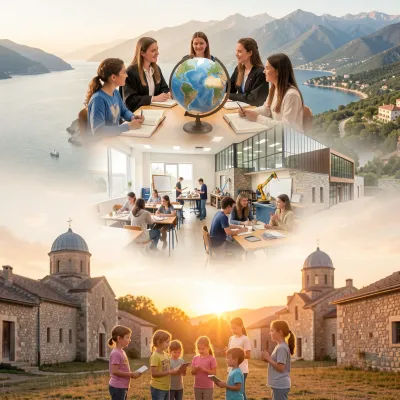
Montenegro's education system has traveled a remarkable distance from the monastic schools of the Petrović-Njegoš dynasty to a modern framework aligned with the Bologna Process and Erasmus+. Melissa Cook's Education In Montenegro maps that journey with the thoroughness of a policy document and the narrative sweep of a national history.
The book arrives at a moment when the country's educational infrastructure is under simultaneous pressure to modernize, include, and internationalize — making this overview both a record of progress and a diagnostic tool for what remains unresolved.
What the book is about
Education In Montenegro spans 25 chapters organized chronologically and thematically, moving from historical foundations through administration, funding, and each educational tier — early childhood, primary, secondary, vocational, higher, and adult — before addressing cross-cutting issues like inclusive education, teacher development, ICT integration, quality assurance, and international cooperation. The text draws on legislation, institutional mandates, curriculum frameworks, and statistical trends to describe how the Ministry of Education, Science and Innovation, the Bureau for Educational Services, the Centre for Vocational Education, and the quality assurance agency AKOKVO operate in practice. It is written for policymakers, researchers, educators, and students of comparative education who need a single, structured reference on a system in transition.
From theocratic seminaries to state-funded universality
The opening chapter traces a direct line from the 1834 Cetinje monastery school founded by Petar II Petrović-Njegoš — initially accommodating 21 students and using textbooks like "The Serb Elementary Reading Book" printed in Venice in 1812 — to today's compulsory nine-year primary education. The narrative highlights how Prince Nikola I oversaw the opening of 72 new schools between 1868 and 1875, making elementary education both mandatory and free. A striking detail: the Girls' Institute in Cetinje (1869) was funded by Russian Empress Maria Alexandrovna, marking early international cooperation. The book shows how each regime — theocratic, monarchic, socialist, independent — layered its priorities onto the system without fully erasing the previous structure.
Inclusion as structural mandate, not aspiration
Chapters 12 and 13 reveal that inclusive education in Montenegro is codified in the General Law on Education and the Law on the Education of Children with Special Educational Needs, not left to discretion. The text describes a multi-tiered support architecture: Individualized Education Programs (IEPs) developed by multidisciplinary teams, resource centers providing diagnostic and therapeutic services, and special educators deployed in mainstream schools. The book notes that "the goal is to move beyond mere integration to true inclusion, where every child feels valued, supported, and has opportunities to reach their full potential within the ECE setting." It also candidly identifies persistent gaps — rural access to specialists, funding sustainability, and societal stigma — that keep the mandate from being fully realized.
Vocational education tied to labor market feedback loops
Chapter 20 details how the Centre for Vocational Education (CZZO) designs curricula in "close collaboration with industry experts, employers, and professional associations" and how work-based learning is mandatory, not optional. The book lists specializations — tourism and hospitality, mechanical and electrical engineering, ICT, health and social care, construction — each with defined occupational standards. A key mechanism: employers sit on advisory boards within vocational schools and provide feedback on graduate competencies, which then informs curriculum updates. The text also outlines pathways for VET graduates to enter higher education through supplementary Matura exams or bridging programs, challenging the perception that vocational tracks are terminal.
Digital transformation as equity lever
Chapter 21 frames ICT investment as a tool for closing the urban-rural divide. The strategy includes universal high-speed internet for all schools, interactive whiteboards, learning management systems, and a national digital content repository. The book emphasizes that "the emphasis is on ensuring that teachers not only know *how* to use technology but *how to use it effectively to enhance learning outcomes*." Teacher training covers computational thinking, cybersecurity, and digital citizenship alongside basic device management. The chapter also notes the push for Open Educational Resources to reduce costs and expand access, and acknowledges ongoing challenges: device maintenance, bandwidth in remote areas, and keeping pace with rapid technological change.
Quality assurance built on European templates
Chapters 16 and 17 explain how Montenegro adopted the Bologna three-cycle degree structure (3+2+3), ECTS credits, and the European Standards and Guidelines for Quality Assurance (ESG) through the independent agency AKOKVO. The book describes a dual-layer system: external accreditation and re-accreditation every five years by expert panels, and mandatory internal quality units in every institution conducting self-assessment, stakeholder surveys, and action planning. The Diploma Supplement — issued automatically in Montenegrin and English — makes qualifications transparent abroad. The text notes that "the entire quality assurance system is designed to be transparent, with accreditation reports and evaluation outcomes often made publicly available," a deliberate move to build public trust and international recognition.
Who should read this
Readers who need a complete, citation-ready map of Montenegro's education architecture — ministry officials drafting reforms, academics writing comparative studies, NGO staff designing inclusion programs, or university administrators aligning with EHEA standards — will find this book indispensable. It is less suited for casual readers seeking narrative storytelling or classroom-level anecdotes; the tone is institutional, the detail regulatory, and the focus systemic. For its intended audience, however, it functions as both a historical record and a working reference, capturing a system mid-reform with unusual clarity.
Read “Education In Montenegro” on MixCache.com →
Please log in or create an account to leave a comment.
No comments yet. Be the first to say something.