
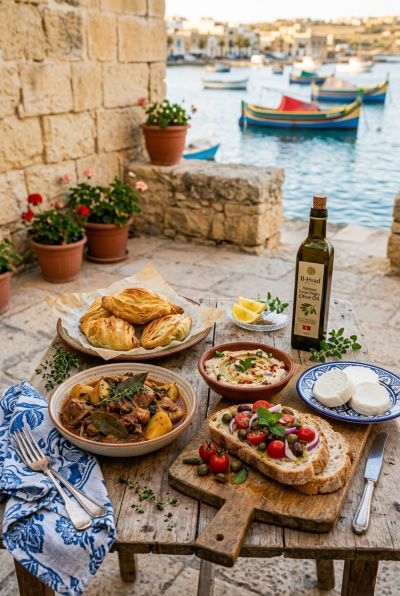
Maltese cuisine doesn't just sit at a Mediterranean crossroads — it was built there, layer by layer, by Phoenician traders, Arab agronomists, the Knights of St. John, and British administrators. Alex Bugeja's Maltese Food For Beginners treats every recipe as a historical document, showing how a rabbit stew became an act of defiance and why a diamond-shaped date pastry still echoes 9th-century North Africa.
What the book is about
The book spans 25 chapters, moving chronologically from Neolithic grain cultivation to modern meal planning. Early chapters establish the historical and ingredient foundations — tomatoes, broad beans, olive oil, the cheeselet ġbejna, and the sourdough ħobż tal-Malti. The middle section works through category by category: soups (minestra, kusksu, kawlata), baked pastas (imqarrun, timpana), the national rabbit stew stuffat tal-fenek, seafood specialties, stuffed vegetables, savory pastries (pastizzi, qassatat), and flatbreads (ftira and its Gozitan cousin). The final chapters catalog sweets tied to the Catholic calendar — Lenten kwareżimal, Carnival prinjolata, Easter figolla, Christmas qagħaq tal-għasel — plus drinks like the bittersweet soft drink Kinnie and almond-based ruġġata. Each recipe includes substitution notes and timing tips, making the book practical for home cooks while the historical framing satisfies culinary anthropology interests.
History as flavor: every ruler left a fingerprint
Chapter 1 argues that "the story of Maltese food is the story of Malta," and the subsequent chapters bear this out. The Phoenicians introduced olives and grapes; the Arabs brought citrus, cotton, sugarcane, and the spice palette (cinnamon, cloves, aniseed) that still defines Maltese sweets; the Knights of St. John may have tasted chocolate before anywhere else in Europe besides Spain and their kitchens birthed stuffat tal-fenek; the British contributed Worcestershire sauce, Bovril, and the curry powder that flavors pastizzi tal-piżelli. Even the word "kusksu" likely derives from North African couscous, adapted into a distinct pasta bead. Bugeja doesn't just list influences — he shows how Maltese cooks absorbed each wave and made it unmistakably their own.
Bread as cultural anchor, not just side dish
Two chapters devote serious attention to bread. Chapter 3 details ħobż tal-Malti, a crusty sourdough loaf fermented slowly from a living starter (il-ħmira) and traditionally baked in communal wood-fired ovens — so central that the town of Qormi was historically called Casal Fornaro, "the bakers' town." Chapter 17 covers ftira, the ring-shaped leavened flatbread whose hole ensures even baking and which UNESCO added to its Intangible Cultural Heritage List in 2020. Both breads function as edible utensils: ħobż biż-żejt (bread rubbed with tomato, olive oil, and topped with tuna, ġbejna, capers, olives) is described as "a cultural institution" that "evokes memories of childhood, family gatherings, and sunny days spent by the sea." The book makes clear that in Malta, bread isn't accompaniment — it's infrastructure.
The liturgical calendar as pastry schedule
Bugeja emphasizes that "many traditional Maltese sweets and pastries are only available at certain times of the year, closely tied to the Catholic liturgical calendar." Chapter 20's kwareżimal — a dense, vegan almond biscuit flavored with orange rind, cinnamon, and cloves — exists because Lenten rules prohibited eggs, butter, and milk, yet sugar (then considered a medicinal spice) was permitted. Chapter 21's prinjolata, a towering dome of sponge, candied fruit, chocolate, and pine nuts frosted with meringue, appears only during Carnival's pre-Lenten revelry. Easter brings figolla, almond-filled biscuits shaped like hearts, crosses, or fish, often blessed by a priest in the village square. Christmas means qagħaq tal-għasel, ring-shaped pastries filled with dark treacle (not honey, despite the name) spiced with aniseed, cloves, and cinnamon. These aren't just seasonal treats; they're edible markers of communal time.
Resourcefulness as a culinary philosophy
"The Maltese, historically, have had to be resourceful, making the most of limited resources and adapting to changing circumstances," Bugeja writes in Chapter 2. This shows up everywhere: soppa tal-armla (widow's soup) stretches cheap vegetables with a single ġbejna and beaten eggs; kawlata fed communities through WWII siege rationing via communal feeding kitchens; pastizzi transform a few peas or ricotta into portable calories; even the rabbit stew's two-course service — sauce over pasta first, then meat — extracts maximum value. The book frames this not as deprivation but as culinary intelligence: "Nothing goes to waste in a traditional Maltese kitchen. Bones are used to make flavorful stocks, stale bread is transformed into breadcrumbs or used in puddings, and vegetable scraps are added to soups and stews."
Two islands, one cuisine — with distinct dialects
Chapter 18 gives Gozo its due. The smaller island's ftira Għawdxija tops the same flatbread dough with paper-thin potato slices, local ġbejna t'Għawdex (noted for a "stronger, more pungent flavor" from unpasteurized sheep's milk and traditional drying), onions, and sometimes anchovies or Maltese sausage — baked open-faced or folded like a calzone. The Gozitan cheeselet itself gets a dedicated section, distinguishing its firmer, drier texture from the Maltese version. Bugeja presents Gozo not as a footnote but as a parallel tradition shaped by more rural rhythms and a fiercer attachment to artisanal methods, right down to family-run bakeries still using wood-fired ovens.
Who should read this
Home cooks wanting approachable Mediterranean recipes with cultural context will find the step-by-step instructions and substitution notes practical. Readers interested in food history will appreciate how each dish carries a traceable lineage. Those with Maltese heritage may recognize family traditions formalized in print. The book is less suited for experienced Maltese cooks seeking advanced technique, strict vegans (meat and dairy dominate mains), or anyone wanting only recipes without narrative — the historical framing is inseparable from the cooking. For everyone else, it's a thorough, unshowy invitation to a cuisine that, as Bugeja puts it, "celebrates the inherent goodness of its ingredients, allowing their natural flavors to shine through."
Read “Maltese Food For Beginners” on MixCache.com →
Please log in or create an account to leave a comment.
No comments yet. Be the first to say something.