

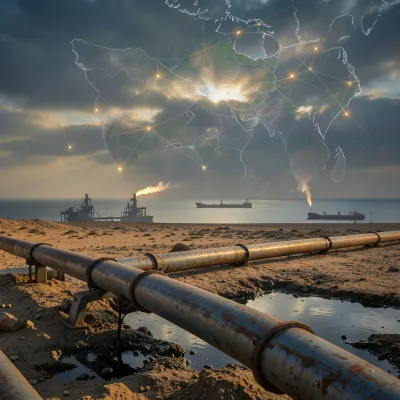
Iran sits atop one of the world's largest hydrocarbon endowments, yet its ability to convert geological luck into lasting economic leverage depends on a fragile chain of aging infrastructure, sanctioned finance, and diplomatic improvisation. David Harrison's Oil, Gas, and Geopolitics: Iran's Energy Strategy in the 21st Century follows a single molecule from the Zagros fold-thrust belt through pipelines, refineries, and contested straits to show how physical realities shape political choices at every stage.
What the book is about
The book proceeds across 25 chapters from subsurface geology to scenario planning for 2035 and 2050. It opens with the geological basins — Zagros, Interior Plains, South Caspian — that determine where oil and gas actually exist and how hard they are to extract. Subsequent sections trace the sector's institutional evolution from the 1901 D'Arcy concession through nationalization, war, sanctions, and the modern buyback contract model. The middle chapters dissect upstream field management, the South Pars/North Dome gas giant, midstream logistics, downstream refining and petrochemicals, and the domestic demand-subsidy nexus that consumes much of the output. Later chapters map the external environment: sanctions compliance and shadow-market pricing, pipeline politics with Turkey and Iraq, the Strait of Hormuz as maritime chokepoint, energy diplomacy across the Gulf, Russia, China, India, and Europe, and Iran's uneasy seat at the OPEC+ table. The final sections address technology transfer, environmental performance, cyber and physical security, the political economy of energy subsidies, and a set of calibrated policy levers. The intended reader is an investor, analyst, or policymaker who needs a structured framework linking reservoir engineering to geopolitical risk.
The geology writes the first draft; politics edits it
Harrison insists that "geology writes the first draft of the story, and everything else is an edit." Chapter 1 details how the Zagros fold-thrust belt's Asmari and Bangestan carbonates anchor oil production while the shared South Pars/North Dome structure holds the world's largest non-associated gas accumulation. But the rock imposes its own timeline: carbonate complexity, compartmentalization, water encroachment, and high-pressure corrosive environments mean that "the difference between managing a new pool and revitalizing an old one is etched into the data: initial potential can look similar, while the decline curve tells a vastly different story." This geological realism recurs in Chapter 3, where enhanced recovery is framed not as optional but as "the admission price for staying in the game." The book refuses to treat reserves as static numbers, showing instead how recovery factors shift with technology, price, and sanctions-driven equipment shortages.
Domestic subsidies as a structural constraint on export power
One of the book's most persistent arguments is that Iran's heavily subsidized domestic energy prices — gasoline, diesel, natural gas, electricity — create a "parallel universe of energy values" that directly competes with export ambitions. Chapter 7 documents how "every barrel of crude oil refined for domestic consumption at subsidized prices is a barrel not sold on the international market at full value," while winter heating demand forces seasonal gas curtailments to industrial users and export pipelines. The petrochemical sector, designed to capture higher-value margins, bids for the same molecules. This tug-of-war appears again in Chapter 18, where "subsidized domestic gas prices, which can make petrochemical production artificially profitable and distort the true opportunity cost of molecule allocation," force planners to choose between "national economic efficiency and foreign revenue." The political difficulty of reform is acknowledged in Chapter 22: "raising prices risks protests and reputational damage, while keeping them low encourages waste, strains fiscal accounts, and reduces exportable surplus."
Sanctions have been metabolized into a parallel commercial anatomy
Rather than treating sanctions as an external shock, Harrison shows how they "have learned to metabolize them, converting legal barbed wire into logistical topology and pricing premiums into expected costs of doing business." Chapter 9 maps the resulting shadow market: bifurcated tanker fleets (modern insured tonnage avoids Iranian cargoes; older vessels with opaque ownership step in), domestic and regional insurers filling gaps left by Western P&I clubs, payment choreography through yuan, dirhams, barter, and gold, and state-affiliated trading houses spinning off subsidiaries to maintain market access. The discounts on Iranian crude reflect "a blend of logistics costs, risk premia, and quality differentials" that fluctuate with diplomatic headlines. Chapter 10 adds that "real prices at which Iranian crude trades often diverge from official prices, a gap that widened during periods of intense sanctions and narrowed when export routes opened." This parallel anatomy is not temporary; Chapter 23 notes that "even if all restrictions were lifted tomorrow, the shadow of their return would linger in contract terms, financing costs, and buyer psychology."
Pipeline politics as both bridge and pressure point
Chapter 11 demonstrates that pipelines are "instruments of statecraft" as much as hydraulic systems. The Iran-Turkey gas line has created "habits of cooperation that make conflict more costly" but also requires constant recalibration of nominations, tariffs, and payment currencies — sometimes Turkish lira, sometimes barter. The Iraq gas relationship oscillates between lifeline and liability: "Iran remains a crucial supplier for Iraq's power generation" yet "energy ties carry political weight in Baghdad's internal politics" where nationalist voices seek to reduce dependency. The stalled Iran-Pakistan pipeline illustrates how "security concerns along the pipeline corridor are substantial" and "financing has been another persistent hurdle" under sanctions. Even functioning links like the Armenia-Iran line work only because "volumes are manageable, the infrastructure is relatively simple, and the political benefits for both sides outweigh the costs." The book treats each corridor as a live negotiation where "the difference between a breach and a force majeure event often depends on diplomatic weather as much as on contractual definitions."
Scenario planning as institutional discipline, not prediction
Chapter 23 frames scenario planning to 2035 and 2050 as "a disciplined way to rehearse uncertainty" across axes including energy transition speed, technology adoption, sanctions durability, regional dynamics, and infrastructure life cycles. The book identifies concrete trigger points: European and Asian buyers increasingly demanding "emissions transparency and lower-carbon supply chains," the potential for digital currencies or blockchain verification to reduce transaction costs in shadow trade, and the demographic pressures on Iran's engineering workforce. Chapter 25 translates this into "calibrated levers" — phased subsidy reform paired with cash transfers, sequenced upstream modernization prioritizing shortest payback, incremental export diversification (floating LNG before grand trains), contract template standardization, and institutionalized cross-functional stress-testing. The tone is pragmatic: "progress will be uneven and setbacks are part of the process."
Who should read this
This book rewards readers who need to understand Iran's energy sector as an integrated system — investors evaluating upstream or midstream entry points, analysts tracking sanction evasion patterns, diplomats mapping energy leverage, and scholars of resource politics. It assumes familiarity with oilfield terminology and commercial concepts; a general reader without that background will find the technical density slow going. For those willing to engage the detail, it delivers a rare combination: reservoir-level realism paired with geopolitical breadth, grounded in case studies from Azadegan field negotiations to South Pars phase disputes to Iran-Turkey pipeline interruptions. The recommendation is strong for professionals; optional for casual interest.
Read “Oil, Gas, and Geopolitics: Iran's Energy Strategy in the 21st Century” on MixCache.com →
Please log in or create an account to leave a comment.
No comments yet. Be the first to say something.