
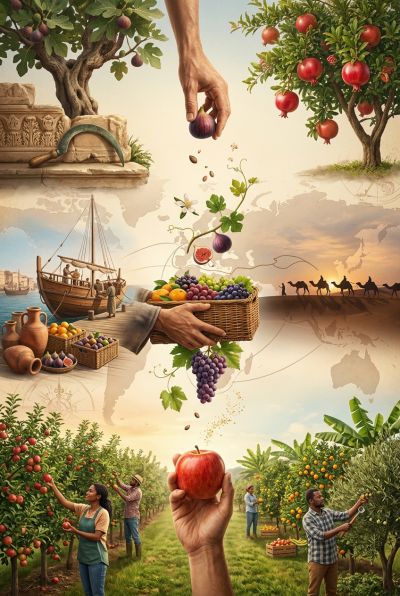
The relationship between humans and fruit is a profound and intricate dance, one that has not only nourished our bodies but has also shaped our cultures, driven our economies, and even defined our understanding of paradise and sin. Johnathan Wells's Fruit: A Human History takes that dance and expands it into a sweeping narrative, showing how the simple act of planting a tree became a declaration of faith in the future. The result is a book that reframes the produce aisle as a museum of human ambition.
What the Book Is About
Organized as 25 self-contained chapters, the book moves chronologically and thematically from the Fertile Crescent's first orchards to the vertical farms of tomorrow. Each chapter traces a single fruit — or a tight cluster of them — from wild origins to cultural icon: the fig that may have been Eden's true forbidden fruit, the date and grape that underwrote Mesopotamian cities, the apple that rode the Silk Road, the citrus that conquered scurvy, the tomato and pineapple that crossed the Atlantic in the Columbian Exchange, the pineapple that became Europe's ultimate status rental, the banana that built and broke republics, the peach that promised immortality in China, the olive branch that became peace's universal shorthand, and on through watermelon, coconut, avocado, durian, and the modern fight to revive heirloom flavors. The prose is accessible but dense with archaeology, botany, economic history, and mythology. It expects a reader who enjoys narrative nonfiction with a scholarly backbone — someone who wants to know not just what happened but why a seedless navel orange from a Brazilian monastery garden ended up defining the California dream.
The Fig That Started It All
Wells opens with a provocative revision: the forbidden fruit of Genesis was likely a fig, not an apple. The textual clue is immediate — Adam and Eve sew fig leaves the moment their eyes are opened — and the archaeological evidence is startling. At Gilgal I in the Jordan Valley, carbonized figs dated to 11,400 years ago reveal a sterile, parthenocarpic variety that "can only be propagated intentionally by humans, by planting cuttings or shoots from a parent tree." This pushes agriculture back a full millennium before grains. The fig's inverted flower structure — a syconium hiding its blossoms inside — becomes a perfect metaphor for hidden knowledge. Wells writes, "To open a fig is to reveal a world unseen, a complex internal structure of flowers and seeds. This act of revelation serves as a potent metaphor for gaining access to a new, previously hidden understanding." The chapter also explains how a Latin pun (malum for evil, mālum for apple) and an Old French semantic drift cemented the apple's place in Western art, while Michelangelo painted the truth on the Sistine Chapel ceiling: a fig tree with a serpent coiled around its trunk.
Fruit as Engine of Empire and Trade
Several chapters demonstrate how fruit moved from sustenance to strategic asset. The apple's journey from the Tian Shan mountains of Kazakhstan westward along the Silk Road created "a thousand-mile-long, accidental orchard" as merchants discarded cores. Roman mastery of grafting — "a kind of botanical surgery" — allowed them to clone superior varieties and plant them across Europe with their legions. The Columbian Exchange (Chapter 7) reshuffled the world's biological deck: tomatoes, once feared as "poison apple" nightshades, slowly conquered Italian cuisine; pineapples became instant celebrities, so rare that "the same fruit might grace dozens of tables over several weeks until it finally began to show signs of decay" via a rental market. The banana's story is darkest: United Fruit Company's El Pulpo empire turned Central American nations into corporate fiefdoms, culminating in the 1928 Banana Massacre in Colombia and the 1954 CIA-backed coup in Guatemala. Wells connects these dots without sensationalism, letting the contracts, land deeds, and body counts speak.
Symbolism Woven Into Daily Life
Fruit never stayed merely edible. The peach in China became the "Peach of Immortality" in Xi Wangmu's celestial orchard, where fruit ripened every three, six, or nine thousand years — a legend that drives the plot of Journey to the West when the Monkey King gorges himself and gains "multiple layers of immortality." The olive branch's status as peace's universal symbol is grounded in Athena's gift to Athens — a tree providing "food, light, and wealth that made a stable, peaceful life possible" — and the dove returning to Noah with "an olive leaf pluckt off." The pomegranate straddles life and death: Persephone's six seeds bind her to Hades for half the year, while its 613 seeds (by tradition) mirror the Torah's commandments. Even the cherry carries dual weight — Renaissance art shows the infant Jesus holding one as a symbol of paradise's sweetness, while Bosch uses it for "carnal temptation and sexual appetite." These associations persist because they were anchored in material reality: the olive's oil lit lamps and anointed kings; the pomegranate's rind expelled tapeworms; the peach's blossoms marked spring's arrival.
The Industrial Orchard and the Modern Fruit Aisle
Chapters 19 and 20 trace the technological rupture that severed fruit from season. Drying, honey-packing, and sugar-preserving were household arts until Napoleon's 12,000-franc prize spurred Nicolas Appert's glass-jar sterilization and Peter Durand's tin canister. The Civil War industrialized canning; the transcontinental railroad turned California into the nation's fruit basket. Mechanical refrigeration completed the revolution: Parker Earle's refrigerated railcars and the "Great White Fleet" of banana boats created a "cold chain" that made "a world of perpetual, global summer." Wells notes the trade-off: the "canning peach" was bred "not for its flavor when fresh but for its ability to hold its shape and texture through the rigors of the canning process." The Red Delicious apple, originally the flavorful 'Hawkeye,' was bred for "deep, uniform red color" until it became "famously beautiful but often bland and mealy." The modern supermarket aisle is the triumph of logistics over terroir.
Future Orchards: CRISPR, Climate, and Lost Flavors
The final chapters turn urgent. The Lost Apple Project in the Pacific Northwest has rediscovered "more than two dozen apple varieties that were thought to be lost forever" by matching fruit from abandoned homestead trees against USDA watercolors. Tom Brown spent a decade hunting the 'Juno' apple on a tip from a 92-year-old. These heirlooms matter because the Cavendish banana's monoculture vulnerability — threatened now by Tropical Race 4 fungus — proves "a monoculture is exquisitely vulnerable to disease." Genetic tools offer both rescue and redesign: the Rainbow papaya, saved from ringspot virus by "a small, harmless segment of the virus's own genetic code," and the Arctic apple, which uses RNA interference to silence the browning enzyme. CRISPR promises "a 'find and replace' function in a word processor" for traits like citrus canker resistance. Meanwhile, vertical farms grow premium Japanese strawberries "completely independent of the weather, while using up to 95% less water." Wells presents these not as sci-fi but as the next step in a 12,000-year conversation between human desire and botanical possibility.
Who Should Read This
Readers who enjoy microhistories like Salt or Cod will appreciate the similar structure — one commodity as a lens on world history — but Wells's scope is wider, weaving botany, archaeology, mythology, and economics into each chapter. Food professionals will value the technical depth on grafting, pollination biology, and preservation chemistry. General readers who like their nonfiction narrative-driven but rigorously sourced will find the pages turn quickly despite the density. Those seeking a light foodie memoir or a purely culinary guide should look elsewhere; this is a history book that happens to be about fruit, and it demands attention to the long arc. For anyone who has ever bitten into a peach and wondered how it got there, the answer is in these pages — layered, complicated, and deeply human.
Read “Fruit: A Human History” on MixCache.com →
Please log in or create an account to leave a comment.
No comments yet. Be the first to say something.