
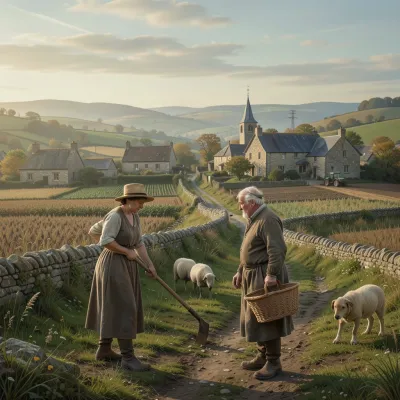
The European countryside has long been mistaken for a static backdrop to urban history—a place where little changed between harvests. Shirley Nichols's The Quiet Countryside dismantles that illusion across twenty-five chapters, showing how fields, villages, and the people who worked them were continuously remade by enclosure, migration, war, policy, and the slow violence of environmental change.
What the book is about
This is a social and economic history of European peasantries, land use, and rural reform from the medieval period to the present. Organized chronologically but driven by four analytical threads—enclosure and common rights, tenure and property regimes, agricultural innovation, and rural migration—the book moves from the manorial system through early modern proto-industry, the dramatic remaking of space via enclosure, the cooperative movement, two world wars, collectivization in the East, the Common Agricultural Policy in the West, and the cultural representations that shaped how Europeans imagined the land. Nichols writes for environmental historians and general readers who want to understand how today's food systems and land policies rest on "sedimented choices of the past." Each chapter pairs narrative synthesis with case studies, connecting local practices to continent-wide patterns without adjudicating a single story of progress or decline.
The countryside as a dynamic arena, not a stage
Nichols opens by refusing the pastoral myth. The Introduction declares the countryside "a dynamic arena where power, knowledge, and ecology continuously interact," and Chapter 1 demonstrates this through landscape and lifeworld: the chalk downlands of southern England, the vertiginous slopes of the Cantabrian mountains, the terraced rice paddies of Lombardy. The word "countryside" itself carried political weight before it became picturesque—"the word was political before it was picturesque." This framing recurs throughout: the open-field system was not a quaint arrangement but a "skeleton upon which the commons hung" (Chapter 3), and every enclosure, tax reform, or technological shift rewrote both the map and the social relations inscribed on it.
Commons, enclosure, and the remaking of rights
The tension between collective management and private appropriation runs through the book's spine. Chapter 3 details how commons functioned as "a sophisticated, hard-nosed system for managing scarce resources" governed by stinting, manorial courts, and customary law—not "a quaint relic of a simpler time." Chapter 7 traces enclosure from incremental Tudor conversions to the Parliamentary acts that enclosed six million acres between 1750 and 1850. The commissioners' awards "were final and legally binding. There was no effective mechanism of appeal." Nichols gives space to both the improver's "neatness, richness, and cultivation" and the cottager who lost "his cow, his geese, his furze, his faggots—and given in exchange a bare plot of land." The process was never uniform: France's revolutionary redistribution created small proprietors but fragmented holdings; Prussia's reforms converted obligations into marketable title; Scandinavia consolidated through village assemblies.
Environmental pressures and the nutrient cycle
Chapter 5 and Chapter 10 place ecology at the center of agrarian history. The Medieval Warm Period and the Little Ice Age were not backdrops but active forces: the Great Famine of 1315–1317 saw yields collapse to "less than a third of the normal output" and wheat prices quadruple. Nichols shows how famine was "not simply a function of how much rain fell" but of "who had access to food, who controlled the surplus, and whether the social safety nets… could hold." Chapter 10 reveals the barnyard as "a processing plant where crop residues, kitchen waste, and foraged materials were transformed into the fertility that kept the system alive." The disruption of this cycle—through enclosure, specialization, and urbanization—severed "the ancient link between livestock and arable farming," a rupture the Haber-Bosch process would later paper over with synthetic nitrogen.
Women's work and the invisible economy
Chapter 11 recovers labor that formal records erased. Women's work—milking, cheese-making, brewing, poultry-keeping, garden cultivation, gleaning—was "not a footnote to the 'real' economy" but its foundation. The spinning wheel became "the instrument of a woman's 'penury,'" yet also a source of nominal independence. Proto-industrialization (Chapter 6) drew women's spinning into merchant networks, paying by the piece and subordinating household rhythms to market demands. Widows could appear in manorial courts and negotiate leases, but "a wife's legal identity was largely subsumed into her husband's." The enclosure of commons hit women disproportionately: "their gleaning rights, their access to fuel, and their common pasture were tied to the household holding in ways that legal language did not fully capture."
Migration circuits that never stopped moving
Chapter 12 reframes migration as structural, not exceptional. Seasonal harvest circuits—the battue des moissons in France, the statute fairs in England, transhumance across the Pyrenees and Alps—moved tens of thousands along routes "worn smooth by generations of predecessors." Permanent emigration accelerated after 1800: fifty million Europeans left, from Irish famine ships to German chain migration to the Americas. Internal migration reshaped the continent too: three and a half million Russian peasants moved to Siberia between 1890 and 1914. Remittances sustained villages in southern Italy and Ireland, while returnees brought new skills and destabilizing expectations. The railway (Chapter 14) accelerated these flows and imposed standardized time, dissolving "the ancient isolation of the village."
Who should read this
Readers who want a single-volume synthesis that treats environmental history, social structure, and political economy as inseparable will find this indispensable. It rewards those willing to move between the granular—a manor court roll from Redgrave, a Bavarian dairy cooperative's ledger—and the continental scale of grain tariffs and collectivization decrees. Specialists in any single region or period may find familiar ground covered quickly, but the comparative lens is the point: Nichols shows how "similar pressures—market integration, state building, demographic change—generated divergent outcomes across regions and over time." Anyone working on food systems, land policy, or rural futures will come away with a clearer sense of how deep the roots of current dilemmas run.
Read “The Quiet Countryside: Agrarian Life and Rural Change in Europe” on MixCache.com →
Please log in or create an account to leave a comment.
No comments yet. Be the first to say something.