
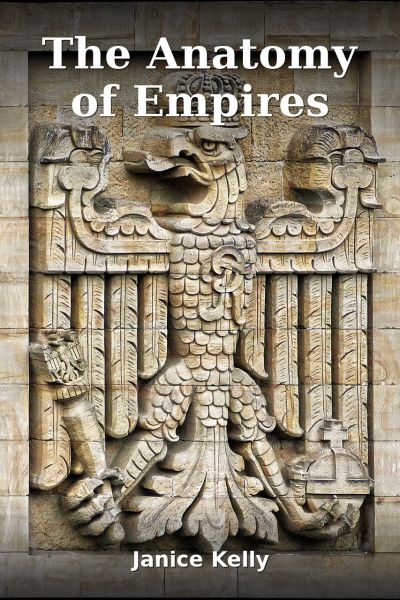
Empires rarely announce their decline with a single catastrophe. More often, they unravel through a thousand small betrayals — a tax collector skimming revenue, a provincial governor growing too independent, a currency quietly debased to fund distant wars. Janice Kelly's The Anatomy of Empires treats these not as anecdotes but as recurring structural features, mapping the anatomy of imperial power across 25 chapters that move from preconditions for expansion to the future of global influence.
What the book is about
The book operates as a comparative framework rather than a narrative history. Its 25 chapters each isolate a distinct mechanism — military innovation, monetary policy, cultural unification, succession law, bureaucratic decay — and trace how it functioned across multiple empires. Three deep case studies (Rome, the Mongols, the British Empire) anchor the analysis, while the final two chapters extend the lens to modern superpowers and the sustainability of power today. The intended reader is someone who wants to understand empire as a system: policymakers, strategists, students of history, and anyone who suspects that the forces shaping ancient Rome are still at work in contemporary geopolitics.
The seeds of empire are surprisingly mundane
Chapter 1 argues that imperial takeoff depends less on genius than on groundwork: a unified populace, a functioning bureaucracy, demographic vitality, and a defensible core territory. Rome spent centuries consolidating Italy before looking outward; Cyrus the Great inherited Median administrative structures rather than building from chaos. Kelly writes, "Before legions march, or trade routes proliferate, there must exist a fertile ground for such ambition to take root." The chapter reframes empire not as a burst of conquest but as the payoff of long, unglamorous consolidation — a useful corrective for anyone tempted by "great man" theories of history.
Infrastructure as the nervous system of control
Chapter 4 makes a compelling case that roads, aqueducts, and relay stations were not merely public works but instruments of integration. The Roman road network (250,000 miles) moved legions, grain, and imperial edicts; the Persian Royal Road and its mounted couriers let the center monitor provinces in near-real time; the Inca qhapaq ñan and chasqui runners achieved similar speed without wheels or writing. Kelly notes, "Infrastructure, in essence, is the nervous system of an empire, allowing for immediate responses to threats and efficient management of resources." The chapter also observes that decaying infrastructure — roads unmaintained, aqueducts crumbling — often signals imperial decline before any border falls.
Corruption as a structural disease, not a moral failing
Chapter 16 treats corruption analytically: as the diversion of public resources into private hands that cumulatively hollows out state capacity. The late Roman Empire's tax farmers siphoned revenue; Chinese dynasties battled "squeeze" payments and eunuch influence; the Abbasid Caliphate fragmented as regional governors withheld tribute. Kelly describes it as "termites silently devouring the timbers of a magnificent house." The chapter connects corruption to institutional rot — purchased offices, nepotism, judicial venality — and shows how each erodes the legitimacy that makes rule sustainable. It's a systems-level view that avoids moralizing while making the stakes clear.
Overextension as the geometry of decline
Chapter 17 argues that empires tend to grow past their ability to integrate and defend new territory. Rome's borders stretched from Britannia to Mesopotamia, requiring legions everywhere and concentrating nowhere. Spain's silver from the Americas funded European wars but couldn't cover the cost of the "Spanish Road" and its navy. The Mongol Empire fragmented because its administrative capacity couldn't scale with its conquests. Kelly frames this as diminishing returns: "Every new province brought not just resources and prestige, but also administrative burdens, military garrisons, and the perennial challenge of integrating diverse populations." The chapter's feedback-loop concept — early success breeding overconfidence, which drives further expansion — feels directly applicable to modern strategic overreach.
Modern superpowers as empires in different clothing
Chapter 24 is where the book's framework pays off for contemporary readers. Kelly maps imperial patterns onto today's great-power competition: the dollar's reserve-currency role echoes the pound sterling; China's Belt and Road Initiative mirrors Roman roads and British railways as infrastructure-for-influence; U.S. military bases and cultural exports function like garrisons and Hellenization. She writes, "They might not fly a flag over a distant colony, but their footprints are deeply impressed on the global economy, political systems, and cultural norms." The chapter also flags overextension (post-9/11 wars), legitimacy erosion (domestic polarization), and the return of multipolar rivalry as familiar imperial stressors. It's a restrained but sharp application of the historical template.
Who should read this
Readers who want a single-volume framework for comparing empires across millennia will find the book's structure rewarding — each chapter isolates a variable and tests it across cases. It's less suited for those seeking narrative drama or deep primary-source immersion in any one empire. The prose is clear and analytical, occasionally repetitive across chapters, but the cumulative effect is a toolkit for recognizing imperial dynamics in headlines about debt traps, supply chains, and great-power rivalry. If you've ever wondered whether the U.S. or China is "overreaching," this book gives you the vocabulary to make the comparison precise.
Read “The Anatomy of Empires” on MixCache.com →
Please log in or create an account to leave a comment.
No comments yet. Be the first to say something.