
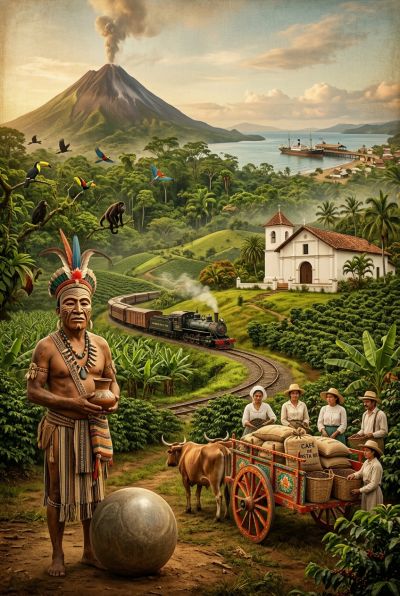
Costa Rica is often sold as a postcard: army abolished, rainforests protected, democracy intact, "Pura Vida" as a way of life. Brian Campbell's A History of Costa Rica doesn't dispute these achievements — it complicates them. The book argues that the country's celebrated exceptionalism emerged not from luck or innate virtue but from specific, often violent choices whose consequences are still unfolding.
What the book is about
Campbell structures the narrative across 25 chronological chapters, moving from the earliest human inhabitants (10,000–7,000 BCE) through the 2022 election of Rodrigo Chaves. The scope is comprehensive: pre-Columbian chiefdoms and the mysterious Diquís stone spheres; the protracted Spanish conquest; the colonial "backwater" period that inadvertently fostered a society of small landowners; the coffee boom that created a powerful oligarchy; the 1856–1857 war against filibuster William Walker; the liberal reforms of the late 19th century; the Great Depression and rise of the Communist Party; the transformative 1940s social reforms under Rafael Ángel Calderón Guardia; the 1948 civil war and abolition of the army; the Cold War navigation; the 1980s debt crisis and structural adjustment; Óscar Arias's Nobel-winning peace plan; the CAFTA referendum; and contemporary struggles with inequality, crime, and governance. Written for general readers but grounded in meticulous research, the book assumes no prior knowledge while offering enough depth for specialists. Its central argument — that Costa Rica's peace was born from conflict, its egalitarianism coexists with deep inequality, and its environmentalism sits alongside destructive agricultural practices — runs through every chapter.
The "Rich Coast" that wasn't, and the society it created
Campbell opens with the irony at the heart of the colonial era: Columbus named it "Costa Rica" — Rich Coast — after seeing gold ornaments, but the territory held no mineral wealth and had a fragmented indigenous population that resisted conquest for six decades. This failure shaped everything that followed. Without gold or a large labor force to exploit, the Spanish Crown neglected the province. Governors farmed their own land to survive. As one 1719 governor put it, Costa Rica was "the poorest and most miserable Spanish colony in all America." That neglect produced a distinctive social structure: "a society of small, independent landowners and subsistence farmers, creating what has often been romanticized as a 'rural democracy.'" The gap between rich and poor was "far less pronounced than in other colonies." This colonial accident laid groundwork for later egalitarian traditions — but Campbell is careful not to overstate it. The coffee boom would soon create a new elite.
Coffee, the oligarchy, and the paradox of 1948
The "golden bean" transformed Costa Rica from the 1830s onward. Campbell traces how coffee created the cafetalero class whose power derived not from growing but from processing and finance: "The key to their power was the beneficio, the processing mill where the coffee cherries were washed, de-pulped, dried, and prepared for export." Small farmers fell into debt cycles with mill owners. This oligarchy dominated politics until the 1940s, when Calderón Guardia — a physician trained in Belgium and influenced by Catholic social teaching — launched sweeping reforms: the University of Costa Rica, the Caja (social security), labor codes, and constitutional "Social Guarantees." Stunningly, he allied with the Communist Party and Archbishop Sanabria to pass them. The oligarchy viewed this as betrayal. The 1948 civil war (44 days, ~2,000 dead) erupted over a disputed election, but its roots lay in this class conflict. The victorious José "Pepe" Figueres Ferrer abolished the army — "both pragmatic and idealistic, intended to prevent future military coups and to redirect national resources toward education, healthcare, and social welfare." Yet Campbell notes the paradox: "this famed pacifism was born directly from a violent civil conflict." The 1949 Constitution enshrined the Social Guarantees, women's suffrage, and an independent Supreme Electoral Tribunal — creating the institutional architecture of the Second Republic.
Neutrality tested: the Cold War and the Arias gamble
Costa Rica's lack of an army made it an anomaly in Cold War Central America. Campbell details how the country became a sanctuary for exiles while walking a tightrope between Washington and revolutionary movements. President Rodrigo Carazo (1978–1982) quietly supported the Sandinistas against Somoza, turning Guanacaste into a "de facto safe zone" for FSLN fighters. When the Sandinistas took power in 1979, Costa Rica faced a new dilemma: a leftist neighbor and a Reagan administration demanding Contra support. Óscar Arias, elected in 1986, defied Washington with his own peace plan — the Esquipulas II Accord — demanding symmetrical concessions: ceasefires, dialogue with internal opposition, end to external support for irregular forces, and democratic elections. "The plan was both ambitious and audacious," Campbell writes. The U.S. called it "fatally flawed"; the five Central American presidents signed anyway. The Nobel Committee awarded Arias the Peace Prize in 1987, giving the process "immense international prestige and an unassailable moral authority." The Contra war withered; Nicaragua held elections in 1990 and the Sandinistas peacefully transferred power. Campbell presents this as the ultimate expression of Costa Rican identity: "An unarmed nation, led by a president armed only with a belief in the power of diplomacy, had successfully defied a superpower."
The environmental brand and its blind spots
Campbell devotes a full chapter to the rise of environmentalism and ecotourism — a story of scientists, activists, and political will. The 1970s saw a "heroic age of park creation" under Figueres's third term, with Mario Boza and Álvaro Ugalde building a national parks system from "a shoestring budget." The 1980s crisis forced a revaluation: "the national parks were no longer just a line item in the budget; they were a potential asset." By the 1990s, tourism surpassed coffee and bananas as the top foreign-exchange earner. Innovations like the Payment for Environmental Services (PES) program (1997) reversed deforestation: forest cover rebounded "from a low of around 21 percent in the late 1980s to over 50 percent." But Campbell doesn't romanticize. He highlights the "glaring contradiction": "While one part of the government was winning international awards for conservation, another part was promoting an agro-export model that was having a devastating environmental impact." The pineapple boom brought "large-scale deforestation, soil erosion, and, most alarmingly, the heavy contamination of water sources with pesticides and fertilizers." The "green republic" is "a complex and often paradoxical mosaic."
Contemporary fractures: inequality, crime, and the Chaves presidency
The final chapters trace the unraveling of the post-1948 consensus. Neoliberal reforms from the 1980s onward created a "dual economy": a high-tech, export-oriented sector (Intel, medical devices) alongside a stagnant domestic economy. The Gini coefficient rose, making Costa Rica "an outlier in a Latin American region that was, for a time, experiencing a general decline in inequality." Public services strained; the Caja faced longer wait times. Meanwhile, the country's location made it a drug-transit corridor. Cartels "put down roots," paying local gangs in product, sparking turf wars. The homicide rate more than doubled by 2017, reaching 12.1 per 100,000 — an "epidemic of violence" by WHO standards. "The Pura Vida lifestyle... began to retreat behind high walls, barbed wire, and the ubiquitous presence of private security guards." Corruption scandals (the "Cementazo," three former presidents implicated) eroded trust. The 2018 election became a culture-war referendum after the Inter-American Court ordered same-sex marriage recognition. Carlos Alvarado won, but his term was derailed by fiscal crisis, a massive public-sector strike, and COVID-19. The 2022 election brought Rodrigo Chaves, a World Bank technocrat running a populist, anti-establishment campaign. His confrontational style — attacking the press, the comptroller, the judiciary — has supporters seeing a decisive reformer and critics warning of "a budding autocrat." Campbell closes with the question that haunts the book: "Whether the Pura Vida spirit can survive the formidable challenges of this new century remains the great, unanswered question."
Who should read this
This book rewards readers who want to understand how a small country constructed a distinctive national model — and why that model is under strain. It's especially valuable for anyone interested in Latin American history, democratic consolidation, environmental policy, or the political economy of development. Specialists will appreciate the synthesis of social, economic, and diplomatic history; general readers will find the narrative accessible and the arguments clear. Readers looking for a celebratory travelogue or a purely environmental history should look elsewhere. Campbell's strength is his willingness to hold two truths at once: Costa Rica's achievements are real, and so are the contradictions that threaten them.
Read “A History of Costa Rica” on MixCache.com →
Please log in or create an account to leave a comment.
No comments yet. Be the first to say something.