
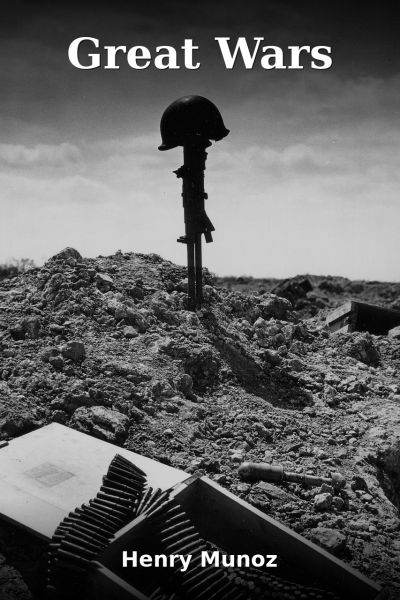
War has been the dark engine of history, reshaping borders, toppling empires, and rewriting the rules of human coexistence. In "Great Wars," Henry Munoz undertakes an ambitious survey of the conflicts that meet his criteria for greatness — those that mobilized entire societies, accelerated technological change, and left legacies that still dictate geopolitical fault lines today. The result is a sweeping yet accessible chronicle that connects the religious fires of 17th-century Europe to the asymmetric battles of the 21st century.
What the book is about
"Great Wars" spans 25 chapters, beginning with a framework for identifying historically decisive conflicts and then moving chronologically from early imperial rivalries through the Cold War and into the post-9/11 era. Each chapter examines a specific war or cluster of wars — the Thirty Years' War, the Seven Years' War, the Napoleonic Wars, the American Civil War, the two World Wars, the Cold War, and the conflicts in Afghanistan and Iraq among them — analyzing causes, key events, and enduring consequences. Munoz writes for the general reader who wants a coherent narrative rather than specialized military history; the prose avoids jargon while preserving analytical depth. The book assumes no prior expertise but rewards readers who recognize names like Westphalia, Verdun, or the Berlin Airlift by placing them in a continuous arc of cause and effect.
The anatomy of a "great war"
Chapter One establishes the book's organizing logic by asking what elevates a conflict from a regional skirmish to a "great war." Munoz identifies seven recurring criteria: widespread participation of major powers, staggering human and material cost, fundamental political and social transformation, technological acceleration, deep ideological undercurrents, protracted duration and intensity, and an enduring legacy that shapes subsequent generations. He acknowledges the imprecision — "Defining a great war is not an exact science. It's a bit like trying to categorize mountains" — but the framework proves useful across centuries. When he later describes the Seven Years' War as "truly earn[ing] its moniker" as the first global conflict, or notes that the Cold War "was a 'great war' fought not with direct total war between the main adversaries, but with ideological fervor, technological competition, and devastating proxy conflicts," the criteria become a lens rather than a checklist.
From cabinet wars to total mobilization
One of the book's most striking through-lines is the steady erosion of the distinction between combatants and civilians. The Thirty Years' War devastated Central Europe through "marauding armies, often unpaid and undisciplined, [that] lived off the land through brutal requisitioning and pillage," killing an estimated 4.5 to 8 million people — up to half the population in some German regions. The Napoleonic Wars introduced mass conscription and the "nation in arms." The American Civil War previewed industrialized slaughter with rifled muskets, trenches, and rail logistics. By World War I, the Western Front had become "a brutal and unprecedented form of conflict: trench warfare" where "gains were measured in yards and casualties in the hundreds of thousands." World War II completed the transformation into total war: "civilians became direct targets, their lives and homes caught in the deliberate crossfire." Munoz traces this trajectory without sensationalism, showing how each war expanded the circle of who fights and who dies.
Ideology as accelerant and aftermath
Religion, nationalism, democracy, fascism, communism — each great war in the book carries an ideological payload that outlives the shooting. The Thirty Years' War began as a Protestant-Catholic struggle before becoming a geopolitical scramble; the Peace of Westphalia enshrined "cuius regio, eius religio" and birthed the modern state system. The American Civil War "fundamentally transformed the character of the war" when the Emancipation Proclamation added abolition to union as a war aim. The World Wars pitted liberal democracy against fascism and communism in varying combinations. The Cold War was explicitly ideological: "The Soviet Union's totalitarian system, with its emphasis on state control and suppression of individual liberties, was fundamentally at odds with the capitalist democracies of the West." Munoz shows how victory often plants the seeds of the next ideological collision — the harsh Versailles terms feeding Nazi resentment, the Soviet occupation of Eastern Europe hardening the Iron Curtain, the Afghan jihad against the USSR spawning al-Qaeda.
Technology's double-edged legacy
Every major conflict in the book doubles as a crucible for innovation that migrates into civilian life. The Seven Years' War showcased the strategic value of naval power and global logistics. The Napoleonic Wars revolutionized military organization with corps systems and merit-based promotion. The American Civil War deployed railroads, telegraphs, and ironclads. World War I introduced tanks, aircraft, poison gas, and submarines. World War II birthed radar, jet engines, computers, and nuclear weapons. The Cold War gave us ICBMs, satellites, and the internet's precursors. Munoz notes the pattern: "The urgent demands of conflict often accelerate scientific and industrial advancements at an astonishing pace... technologies that then permeate civilian life, fundamentally altering how societies function." He doesn't celebrate this; he simply documents it as an inescapable feature of great wars.
The Cold War's distinct architecture
Chapters Eighteen through Twenty-One treat the Cold War not as an interlude but as a great war in its own right — one fought through proxies, nuclear brinkmanship, and ideological competition. Munoz devotes four chapters to its anatomy: the origins and Iron Curtain (Chapter 18), the proxy wars in Korea, Vietnam, and beyond (Chapter 19), the nuclear arms race and Mutually Assured Destruction (Chapter 20), and the internal reforms that dissolved the Soviet Union (Chapter 21). This structure captures the conflict's uniqueness: "a 'great war' fought not with direct total war between the main adversaries, but with ideological fervor, technological competition, and devastating proxy conflicts that left lasting scars on nations far from Washington or Moscow." The Cuban Missile Crisis receives a detailed, day-by-day account that conveys how close the world came to annihilation — "For thirteen agonizing days, the world held its breath" — while the Afghan quagmire is framed as "the Soviet Union's Vietnam," draining morale and resources.
Post-Cold War fragmentation and the return of asymmetric war
The final chapters confront a messier reality. The "new world order" proclaimed after the Persian Gulf War quickly fractured into ethnic wars in Yugoslavia, genocide in Rwanda, and the rise of transnational terrorism. Munoz writes that "the end of the Cold War did not usher in an era of global peace but rather unleashed a new wave of conflicts, many of them rooted in long-suppressed ethnic, religious, and political grievances." The wars in Afghanistan and Iraq (Chapter 24) illustrate the difficulty of applying conventional military superiority to counterinsurgency and nation-building: "They demonstrated the immense difficulty of achieving lasting stability and peace through military force alone, particularly in societies grappling with deep internal divisions and historical grievances." The book ends not with triumph but with a sober assessment: "The world continues to face complex challenges that could potentially lead to another global catastrophe, underscoring the importance of learning from history and fostering global cooperation."
Who should read this
Readers seeking a single-volume framework for understanding how major conflicts connect across four centuries will find "Great Wars" exceptionally useful. Its strength lies in synthesis — showing how the Westphalian system echoes in modern sovereignty disputes, how the Industrial Revolution's wars prefigured total war, how the Cold War's proxy logic reappears in contemporary hybrid conflicts. Specialists in any single war will want deeper monographs, but general readers, students, and anyone trying to place current headlines in historical context will appreciate the clear prose, consistent analytical structure, and refusal to treat history as a series of isolated episodes. If you prefer narrative-driven military history with battlefield-level detail, this isn't that book. If you want to see the pattern behind the battles, it is.
Read “Great Wars” on MixCache.com →
Please log in or create an account to leave a comment.
No comments yet. Be the first to say something.