
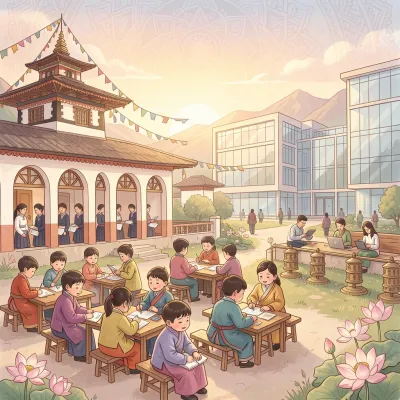
Most countries measure educational success through test scores and graduation rates. Bhutan measures it through Gross National Happiness. Sarah Alvarez's Education In Bhutan traces how a Himalayan kingdom built a school system where environmental stewardship, cultural preservation, and good governance aren't extracurriculars — they're the curriculum.
What the book is about
Alvarez structures the book as a 25-chapter walk through the entire Bhutanese education ladder: Early Childhood Care and Development (ECCD), seven years of primary, two each of lower secondary, middle secondary, and higher secondary, plus parallel tracks for Technical and Vocational Education and Training (TVET), monastic education, non-formal adult learning, and higher education under the Royal University of Bhutan. The chapters move chronologically (history, philosophy, governance) then vertically (each schooling stage), then horizontally across cross-cutting issues — curriculum, assessment, language policy, teacher training, special needs, technology, funding, international partnerships, and future policy. The intended audience is policymakers, educators, development practitioners, and researchers who need a single reference on a system that explicitly subordinates economic metrics to well-being.
Gross National Happiness as operating system, not slogan
Chapter Two makes clear that GNH is not aspirational wallpaper. The four pillars — sustainable socio-economic development, cultural preservation, environmental conservation, and good governance — are woven into subject standards, pedagogy, and assessment. The "Educating for Gross National Happiness" (EGNH) initiative, launched in 2009, directed teachers to "infuse GNH values into their daily teaching activities" so that "values are not just discussed as content but are appreciated and practiced in daily life." Chapter Nineteen shows how this plays out in Education for Sustainable Development: science lessons on ecosystems include "discussions on caring for animals and plants, aligning with the environmental conservation pillar of GNH," while group projects reinforce "community vitality and mutual respect." Even assessment tries to capture it: Chapter Twelve notes that "participation in cultural events, traditional sports, and community outreach programs can also provide opportunities for students to demonstrate their alignment with GNH principles."
From monastic memorization to Cambridge co-branding in six decades
Chapter One charts a striking compression of history. Before the 1960s, education was almost exclusively monastic: boys memorized Buddhist scriptures, Chöke (classical Tibetan), astrology, and traditional medicine in decentralized monastery schools. The Third King, Jigme Dorji Wangchuck, launched the First Five-Year Plan in 1961, building the first secular schools — often "under trees" — and importing Indian teachers. By 2023, the Bhutan Higher Secondary Education Certificate (BHSEC) became co-branded with Cambridge International, giving it "global recognition" while retaining Dzongkha and cultural studies. Chapter Seven notes the curriculum for Grades 9–12 is now "aligned with Cambridge International standards" to "enhance subject knowledge, critical thinking, and problem-solving skills" without "compromising the emphasis on Dzongkha and cultural studies." The 7-2-2-2 structure (Chapter Three) and centralized Ministry of Education and Skills Development emerged from this same royal vision.
A bilingual strategy that refuses to choose
Chapters Thirteen and Fourteen present the most deliberate language-in-education policy I've encountered. Dzongkha is the national language, compulsory at every level, and the medium of instruction for early primary and cultural subjects. English is the medium for mathematics, science, and most secondary subjects — a pragmatic gateway to global knowledge and higher education. The transition is phased: "In the initial years of primary school, Dzongkha is predominantly used… as students progress to upper primary and then to lower, middle, and higher secondary levels, English gradually assumes a more dominant role." The Dzongkha Development Commission (established 1986) actively coins new terminology for science and technology so the national language doesn't atrophy. Alvarez calls the outcome "additive bilingualism, where proficiency in both languages is actively nurtured and valued," and notes students "consistently demonstrate strong English language skills" while maintaining "a deep connection to their national language and cultural identity."
Central schools: boarding as equity lever
Chapter Seventeen identifies geography as the stubborn enemy of equity. In remote villages, children once walked hours across mountain passes; girls dropped out due to safety and domestic burdens. The government's answer: 63 central schools (as of 2018), full-residential hubs with "better infrastructure, including modern classrooms, science laboratories, well-stocked libraries, computer labs, and recreational facilities." Boarding removes the commute and "allows them to focus entirely on their studies without the distractions or demands of household chores." These schools also attract better teachers by offering "improved living conditions, access to amenities, and a more robust professional community." The model is expensive — Alvarez notes "transporting building materials… to remote sites is an incredibly expensive and logistically complex undertaking" — but it directly tackles the access gap that sporadic community schools could not.
Inclusive education: from special institutes to mainstream mandate
Chapter Ten traces a 50-year arc. The Muenselling Institute (1973) and Wangsel Institute (2003) began as segregated schools for blind and deaf children. By 1979, Muenselling was already integrating students into a mainstream school — decades before many nations attempted inclusion. The 2011 formal adoption of "Inclusive Education" shifted policy toward "the process of valuing, accepting and supporting diversity in schools and ensuring that every child has equal opportunity to learn." By 2023, 39 schools ran SEN programs, using "pull-out" and "push-in" models, differentiated curricula, and the 2018 "Guidelines on Assessment, Examination, Promotion and Transition of Students with Disabilities" for exam accommodations. Yet only 15% of children with disabilities attend school nationwide, and "infrastructure accessibility remains a major issue, especially for children with physical difficulties." The Ten-Year Roadmap for Inclusive and Special Education now aims for every school to have "learning resource rooms, adequate teaching-learning materials, relevant technology, and trained teachers."
Who should read this
Education planners and comparativists will find a rare case study of a system that treats well-being as a design constraint rather than a by-product. Teachers and teacher-educators can mine the chapters on GNH-infused pedagogy, bilingual classroom management, and inclusive practices for concrete strategies. Development professionals will appreciate the candid accounting of where external aid (World Bank, UNICEF, India, Australia, Japan) accelerated progress and where sustainability gaps remain. General readers looking for light cultural travelogue should skip it — this is a dense, policy-facing reference work. For anyone serious about how a nation aligns every classroom with a philosophy of happiness, it's the definitive English-language source.
Read “Education In Bhutan” on MixCache.com →
Please log in or create an account to leave a comment.
No comments yet. Be the first to say something.