
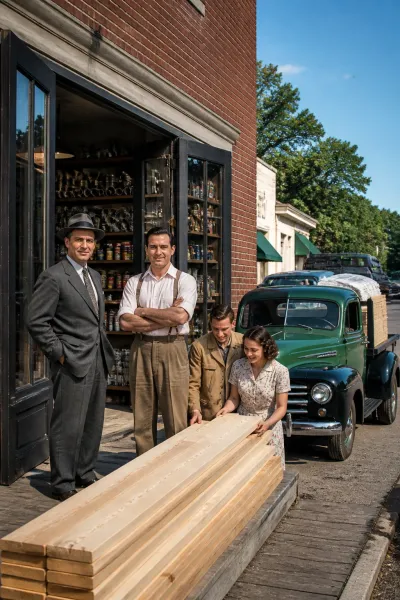
On C Street in North Wilkesboro, North Carolina, the store that Lucius Lowe built smelled of horse tack, snuff, and fresh produce alongside nails and lumber. The 3,500-square-foot general store had served the farming community since 1921, a place where a carpenter could buy framing nails and a homemaker could pick up fabric for a dress in the same trip. Lucius, a former farmer and rural mail carrier, had run it on a simple premise: stock what the neighbors need, treat them fairly, and they'll come back.
When Lucius died in 1940 at age 60, the business passed briefly to his daughter Ruth, who sold it to her brother James that same year for $4,200. James had barely settled in before the draft called him away. His mother Floy and sister Ruth kept the doors open through the early war years, but the shelves grew thin and the future looked uncertain.
The Partner Who Saw What Others Missed
In 1943, James brought his brother-in-law, H. Carl Buchan, into the business as a partner. Buchan had been wounded in the army and discharged, returning to North Wilkesboro with a limp and a conviction that the world was about to change. While the war still raged, he studied the housing data flowing from Washington: the GI Bill, the pent-up demand for homes, the millions of soldiers who would soon return needing places to live. He saw a construction boom on the horizon that nobody in North Wilkesboro was talking about yet.
Buchan's vision was radical for a town of 3,000 people. He proposed stripping the store down to its bones — eliminating the dry goods, the notions, the horse tack, the snuff, the groceries — and betting the entire business on hardware and building materials. James Lowe, still in uniform for part of this transition, trusted his brother-in-law's instinct. By 1946, the transformation was complete. The sign outside changed from Lowe's North Wilkesboro Hardware to simply Lowe's Hardware. The general store was dead; the specialist had been born.
Buying Around the Middleman
The product mix was only half the gamble. Buchan's second innovation was invisible to customers but revolutionary for the bottom line. Instead of ordering through regional wholesalers like every other hardware store in the Southeast, he and James began driving to factories themselves, negotiating direct contracts for train-car loads of lumber, paint, and tools. Cutting out the middleman shaved 10 to 15 percent off their cost of goods — margin they could pass to customers or keep as profit. Either way, it was a structural advantage no local competitor could match.
The strategy worked faster than either man expected. By 1949, they had enough confidence and cash flow to open a second location in Sparta, thirty miles west. The Sparta store was a carbon copy of the refined model: focused inventory, direct pricing, no distractions. It proved the formula wasn't a fluke tied to North Wilkesboro's particular demographics. The model traveled.
The Foundation Everything Else Built On
That three-year pivot — 1943 to 1946 — decided everything that followed. The public offering in 1961, the big-box transformation of the 1980s, the supply-chain automation of the 1990s, the e-commerce platform of the 2000s — all of it rested on the moment a wounded veteran convinced his brother-in-law to stop selling snuff and start stockpiling two-by-fours. The direct-procurement discipline Buchan instilled became the company's financial spine, funding every subsequent expansion. The specialized inventory philosophy kept the stores from bloating into department stores. Even the name change mattered: Lowe's Hardware told customers and suppliers exactly what the company was, a clarity that survived a century of growth.
Lucius Lowe would not have recognized the business his son and son-in-law built. He might have missed the smell of horse leather and curing tobacco. But he would have recognized the principle: know what your community needs before they do, and be the one who has it ready.
This is one episode in a much longer story. For the full account of the history of Lowe's, read “A History of Lowe's” by Alexander T. Dunn on MixCache.com.
Please log in or create an account to leave a comment.
No comments yet. Be the first to say something.