
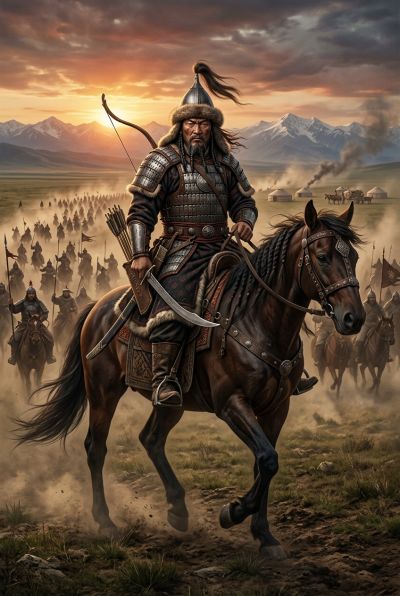
The Mongol Empire has long suffered from a split reputation: either a mindless horde that burned civilization or a globalization engine that accidentally wired the Old World together. Elias Marlowe's The Mongol Empire: A History refuses both caricatures. In twenty-five chapters, he follows the arc from Temüjin's childhood on the abandoned steppe to the moment Timur razes Sarai, showing how the same institutions that enabled slaughter — the decimal army, the Yam relay, the Yasa law — also created a century of secure trade, technological diffusion, and cultural hybridity that reshaped Eurasia's political map.
What the book is about
Marlowe structures the narrative chronologically but layers it with recurring analytical threads. The first three chapters establish the 12th-century steppe as a crowded arena of competing confederations — Tatars, Keraits, Naimans, Merkits, Khamag Mongols — manipulated by the Jin Dynasty's "divide and rule" policy. Chapters 4 through 7 dissect the military and administrative machinery Genghis Khan built: the decimal reorganization that broke clan loyalty, the composite bow and feigned retreat that let outnumbered cavalry win, the Kheshig guard that doubled as a leadership academy, the Yam network that moved orders at 200 miles a day, and the Yasa code that replaced blood feud with state law. Chapters 8 through 13 track the empire's greatest expansion under Ögedei, Möngke, and their brothers, including the European invasion (Chapter 9), the Khwarazmian and Persian campaigns (Chapters 6 and 12), and Kublai's Song conquest (Chapter 13). Chapters 14 through 17 examine each successor khanate — Yuan, Golden Horde, Ilkhanate, Chagatai — on its own terms. The final eight chapters trace dissolution, the Black Death's ride on Mongol-secured routes, the rise of Muscovy and the Crimean Khanate, and the legacy of gunpowder, compass, and printing reaching Europe via the Pax Mongolica. The book assumes no prior expertise but rewards readers who want structural explanations, not just battle lists.
The army was a bureaucracy on horseback
Marlowe devotes Chapter 4 to dismantling the "undisciplined horde" myth with granular evidence. Mongol forces were frequently outnumbered; their edge lay in a decimal organization (arban, jaghun, mingghan, tümen) that mixed men from hostile tribes so loyalty ran to the unit commander and ultimately the Khan. Discipline was enforced by collective punishment: "If one man in a unit of ten fled from battle without orders, the entire unit was executed." Warriors carried sixty arrows of specialized types — armor-piercing, broadhead, whistling for signaling — and each man maintained three to four remounts, enabling 100-mile days. The feigned retreat (manggudai) required such coordination that a single misstep could turn feigned rout into real one. When sieges demanded engineering the nomads lacked, they absorbed Chinese and Persian experts wholesale: "Genghis Khan's policy was to absorb and utilize the skills of conquered peoples." The result was a force that combined steppe mobility with siege trains, intelligence networks, and a logistics system (the Yam) that kept armies coordinated across continents.
Governing meant choosing between the saddle and the city
The tension between nomadic identity and sedentary administration runs through every successor state. Kublai Khan embodies the contradiction: he built Dadu as a Chinese capital on a grid, adopted Confucian ritual, and extended the Grand Canal, yet maintained Shangdu as a steppe summer court and forbade Mongols from taking Chinese names or marrying Han. The Yuan formalized this split into a four-tier hierarchy — Mongols, Semu-ren (Central/West Asians), Han-ren (northern Chinese), Nan-ren (former Song subjects) — that "became a source of deep and lasting resentment." In the Ilkhanate, Hulegu's Christian wife Doquz Khatun secured privileges for Christians while Muslims, the majority, were ruled by an elite "who viewed their faith with suspicion." Ghazan's 1295 conversion to Islam flipped the script, but only after the Ilkhanate had already fragmented. The Golden Horde's Berke converted earlier (1257), aligning with Mamluk Egypt against his cousin Hulegu — the first Mongol-on-Mongol war. The Chagatai Khanate split along the same fault line: Moghulistan stayed nomadic and Tengrist; Transoxiana urbanized and Islamized, eventually producing Timur. Marlowe shows each khanate negotiating the same dilemma — legitimize locally or stay distinct — with different outcomes.
Religious tolerance was a tax policy, not a philosophy
Chapter 7 and subsequent chapters return to a consistent insight: the Mongols exempted clergy from taxes and corvée not from enlightenment but because "it was easier to rule over willing, or at least quiescent, subjects." Genghis Khan's decree covered "Christian priests, Muslim imams, Buddhist monks, or Taoist sages." This bought cooperation from influential networks. In the Yuan, Kublai patronized Tibetan Buddhism through the lama Phags-pa, who created a "square script" for imperial use, while ordering the destruction of Taoist texts deemed heretical after staged debates. In the Ilkhanate, Doquz Khatun's intervention saved Baghdad's Christians during the 1258 sack, even as the House of Wisdom burned. The Golden Horde's Islamization under Uzbeg Khan (1313) triggered a purge of traditionalist nobles. Marlowe notes the limits: Islamic halal butchery and circumcision were sometimes banned for conflicting with Mongol custom. Tolerance was instrumental, revocable, and always subordinate to the Yasa's demand for absolute loyalty.
The Pax Mongolica moved ideas and plague on the same roads
Chapter 18 synthesizes the empire's most paradoxical legacy. The Yam relay, originally for military dispatches, became a commercial backbone: merchants with a paiza tablet could swap horses at stations every 25–40 miles, cutting a year-long journey to months. The ortoq partnership let Mongol aristocrats invest silver in caravans without sullying themselves with trade. Paper money (chao) eliminated specie transport. Along these arteries traveled gunpowder, the magnetic compass, block printing, Persian astronomy, Chinese medicine, and artistic motifs — cobalt blue from Persia onto Yuan porcelain, Chinese clouds and dragons into Persian miniatures. But the same integration carried Yersinia pestis. Marlowe traces the Black Death from Central Asian reservoirs through the Golden Horde to Kaffa, where besieging Mongols catapulted infected corpses into the Genoese port, and thence on fleeing ships to Constantinople, Messina, and Marseille. "It is the ultimate and most tragic irony of the Mongol Peace that the very system that had brought the Old World closer together than ever before also became the mechanism for one of its greatest catastrophes."
Fragmentation produced the modern map of Eurasia
The book's final chapters argue that the empire's breakup, not its unity, shaped today's borders. The Yuan's fall (Chapter 22) handed the Ming a unified China with frontiers roughly matching the modern state; the Ming "did not retreat to an older, smaller definition of China; they inherited the vast, unified state that the Mongols had forged." In Russia, two centuries of Golden Horde suzerainty centralized Muscovy: khans favored Moscow's princes as tax collectors, and the 1480 Great Stand on the Ugra River ended tribute without a battle. Ivan IV then conquered Kazan and Astrakhan, securing the Volga and opening Siberia. The Ilkhanate's collapse (Chapter 23) created the vacuum Timur filled, then the Safavids. The Ottoman rise in Anatolia exploited Byzantine weakness after decades of Ilkhanid–Golden Horde maneuvering. Even the Age of Discovery, Marlowe suggests, was a search for alternative routes after the Mongol peace evaporated and Ottoman power blocked the land Silk Road: Columbus carried an annotated Marco Polo, chasing the Cathay the Mongols had made accessible.
Who should read this
Readers who want a single volume that links military innovation, administrative experiment, religious policy, and long-term geopolitical consequence will find the book's scope rewarding. Its chapter-by-chapter structure lets you trace a theme — say, siege technology or succession law — across the whole empire without losing the narrative thread. Specialists may quibble with compression in the later khanate chapters, but the synthesis is deliberate: Marlowe prioritizes the connections between theaters over exhaustive detail in any one. If you prefer biographical drama or cultural history over structural analysis, the middle third (Chapters 8–17) delivers both; if you want the big picture of how a steppe confederation rewired Eurasia, the introduction and final chapter frame it cleanly. Skip it only if you need primary-source transcription or historiographical debate — this is a narrative synthesis, not a sourcebook.
Read “The Mongol Empire” on MixCache.com →
Please log in or create an account to leave a comment.
No comments yet. Be the first to say something.