
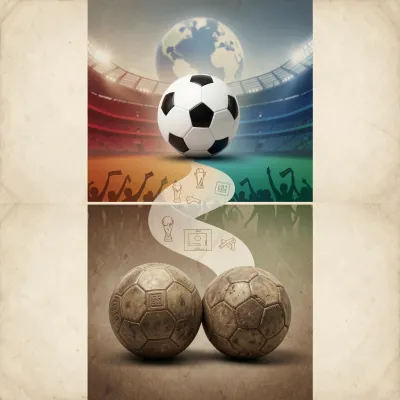
Every four years, billions of people synchronize their heartbeats around a single tournament. Yet the World Cup is only the most visible expression of a sport that operates as a daily rhythm in villages, factories, and favelas across six continents. Johnny Ruiz's "Soccer: A Concise History" unpacks that paradox — how a pastime with no fixed rules, no governing body, and no commercial apparatus became the closest thing our species has to a universal language.
What the book is about
The book moves chronologically through 25 chapters, opening with pre-modern ball games like Chinese cuju and Mesoamerican ōllamaliztli before settling into the 19th-century codification that birthed association football. It tracks the sport's global diffusion via British sailors, engineers, and teachers; the rise of national associations and FIFA; the interruption and revival across two world wars; the tactical revolutions that reshaped how the game is played; the long-suppressed emergence of women's football; and the commercial, technological, and ethical forces defining the modern era. Ruiz writes for the curious generalist — someone who knows the offside rule but wants to understand why it exists, or who cheers for a club but wonders how that club became a global brand. The tone is analytical but accessible, favoring clear narrative arcs over academic density.
From Chaos to Code: The Birth of Modern Soccer
The early chapters excel at showing how fragile the transition from folk football to organized sport really was. Medieval "mob football" involved hundreds of players, miles of terrain, and goals defined by church doors or trees. As Ruiz notes, "The sheer scale and uncontrolled nature of folk football often led to significant disruption and damage. Crops were trampled, property was destroyed, and public order frequently collapsed under the weight of the surging masses." Monarchs from Edward III to Henry VIII banned the game repeatedly, yet it persisted because it was "too deeply woven into the fabric of local life to be easily eradicated by royal decree." The breakthrough came not from above but from the English public schools and the 1863 meeting at Freemasons' Tavern, where the decision to outlaw "hacking" (kicking opponents' shins) split football into two codes. That single vote created association football as a distinct kicking game, and the FA's original 13 laws — published by John Lillywhite — remain the DNA of every match played today.
War, Resilience, and Rebirth
Chapter 8 delivers one of the book's most sobering sections. The First World War didn't just pause leagues; it decimated a generation of players. "More than 2,000 professional footballers served in the British armed forces, with an estimated 600 losing their lives," Ruiz writes. The 1914 Christmas Truce matches in no-man's-land — "a poignant symbol of humanity amidst unimaginable conflict" — illustrate football's stubborn capacity to reassert itself even in horror. The Second World War repeated the pattern, but the post-1945 revival brought record attendances and the 1950 World Cup's "Maracanazo," where Uruguay stunned Brazil before 200,000 spectators. That tournament also marked the return of the British Home Nations to FIFA, ending decades of isolation. The "Miracle of Bern" in 1954, where West Germany overturned a 2-0 deficit to beat Hungary, became "a powerful symbol of national resilience and hope" for a nation rebuilding its identity.
Tactical Revolutions: From Pyramid to Tiki-Taka
Chapter 15 traces a clear intellectual lineage across formations and philosophies. The 2-3-5 "Pyramid" dominated for half a century until the 1925 offside change (three defenders to two) invited Herbert Chapman's "WM" — a 3-2-5 that pulled the center-half back into defense. Italy's Vittorio Pozzo answered with the "Metodo," a 2-3-2-3 built on discipline and counter-attack, winning back-to-back World Cups. Then came Hungary's "Magical Magyars" and the withdrawn center-forward Nándor Hidegkuti, whose movement "dragging opposition center-backs out of position" prefigured the modern false nine. The Dutch "Total Football" of the 1970s demanded "immense technical ability, tactical intelligence, and exceptional physical fitness" from every outfield player. Finally, Pep Guardiola's Barcelona perfected "Tiki-Taka," a style that "emphasized extreme possession, short, intricate passing, and constant movement off the ball to create passing triangles and dominate the midfield." Each innovation provoked a counter-innovation, confirming Ruiz's thesis that tactics are "a continuous cycle of innovation and response."
The Women's Game: From Ban to Global Stage
Chapter 16 stands out for its corrective arc. Women played organized matches as early as 1895, and during the First World War, factory teams like Dick, Kerr's Ladies drew 53,000 to Goodison Park. Then came the 1921 FA ban: "the game of football is quite unsuitable for females and ought not to be encouraged." That prohibition lasted 50 years. Ruiz connects the 1971 lifting of the ban to Title IX in the U.S. (1972), which "had a profound impact, leading to a massive increase in girls' and women's participation in sports." The 1991 inaugural Women's World Cup and the 1999 Rose Bowl final — "over 90,000 spectators… a record for a women's sporting event" — mark the modern takeoff. Yet the chapter doesn't declare victory; it notes ongoing battles over "unequal pay, insufficient investment compared to the men's game, and ongoing battles for equal playing conditions." The trajectory is upward, but the climb continues.
Modern Challenges: Money, Technology, and Governance
The final chapters confront the sport's current contradictions. Chapter 19 details how the Bosman ruling (1995) shifted power to players, unleashing transfer fees that now exceed €200 million (Neymar, 2017). Chapter 21 examines VAR and Goal-Line Technology — "eliminated goal-line controversies" but sparked debate over "forensic, millimeter-level analysis that arguably goes against the 'spirit of the game.'" Chapter 23 catalogs the 2015 FIFA corruption indictments, Financial Fair Play's mixed results, fixture congestion pushing elites toward 70-match seasons, and the persistence of racism in stadiums and online. Ruiz doesn't moralize; he presents these as structural tensions between football's communal roots and its corporate present. The 48-team World Cup expansion (2026) epitomizes the dilemma: more inclusion, more matches, more revenue — but also "potential dilution of quality" and "immense logistical complexities."
Who should read this
Readers who want a single volume that connects Pelé to xG, the Christmas Truce to VAR, and Dick, Kerr's Ladies to the 2023 Women's World Cup will find this book indispensable. It rewards the fan who argues about formations at the pub and the student who needs a reliable timeline for a paper on sport and globalization. Casual viewers looking only for highlight-reel anecdotes may find the administrative and financial chapters dense, but those sections are precisely what make the book a history rather than a nostalgia trip. For anyone serious about understanding why soccer matters — not just how it's played — Ruiz delivers the context that turns passion into perspective.
Read “Soccer” on MixCache.com →
Please log in or create an account to leave a comment.
No comments yet. Be the first to say something.