
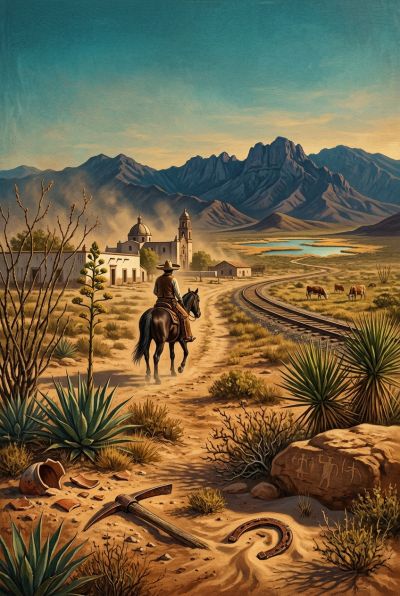
To call Coahuila "overlooked" is to mistake silence for absence. Mexico's third-largest state has been the stage for every major convulsion in the nation's history — from the first Spanish entradas to the spark of the Mexican Revolution, from the loss of Texas to the rise of the automotive corridor that now rivals Detroit. Ana Rodríguez's A History of Coahuila refuses the easy regional narrative, showing instead how a land defined by scarcity became a crucible where geography, culture, and power forged an identity that is continental in consequence.
What the book is about
Rodríguez structures the work as a chronological march across twenty-five chapters, beginning with Paleo-Indian hunter-gatherers 11,000 years ago and ending with the nearshoring boom and renewable-energy push of the 2020s. The book assumes no prior expertise; it explains the merced real land-grant system, the tienda de raya debt-peonage mechanism, and the Plan of Guadalupe with equal clarity. Readers get a complete political, economic, and cultural biography: the Tlaxcalan colonists who saved Saltillo, the hacendados who built latifundios the size of Belgium, the Madero and Carranza families who launched the Revolution, and the modern governors who steered the state through Zeta violence and a 35-billion-peso debt crisis. The prose is straightforward and evidence-driven — no sermonizing, no hype — making it accessible to general readers while still satisfying specialists who want the primary-source details (Cabeza de Vaca's La Relación, the 1591 Tlaxcalan capitulaciones, the 1917 Constitution's Article 27) woven into the narrative.
Geography as a relentless protagonist
The Chihuahuan Desert is not backdrop; it is a character that dictates every plot turn. Chapter One establishes the pattern: "The scarcity of water has for centuries dictated the terms of life." That line echoes through the founding of Parras (wild grapevines at springs), the location of Saltillo (a pass with a waterfall), the cotton kingdom of the Laguna (Nazas River irrigation), and the steel mill at Monclova (coal plus iron ore). Even the 2023 Villanueva solar park — 2.3 million panels across Viesca's gypsum dunes — answers the same imperative: exploit what the desert gives. Rodríguez shows that Coahuila's history is a long negotiation with aridity, and that every economic leap — viticulture, coal, cotton, steel, automobiles, solar — is a new answer to the old question of how to make a living where rain does not fall reliably.
The Tlaxcalan template: allies who became architects
Few colonial episodes are as surprising — or as consequential — as the 1591 arrival of 400 Tlaxcalan families. Granted hidalgo status, tax exemption, and the right to carry arms, they founded San Esteban de la Nueva Tlaxcala as a self-governing pueblo beside the struggling Spanish villa. Chapter Three details how they "immediately set about transforming the landscape, applying their centuries of agricultural expertise" and became "a self-funded and self-governed garrison, a living wall that protected the Spanish villa." Their weaving tradition birthed the Saltillo serape; their legal savvy defended communal lands against hacienda encroachment for centuries. Rodríguez traces their fingerprints forward: Tlaxcalan colonists seeded Parras, Monclova, and eventually Texas. The insight is clear — Coahuila's distinctiveness begins with a negotiated alliance that turned indigenous warriors into the frontier's most effective state-builders.
Revolution's double spark: Madero's idealism, Carranza's legalism
Chapters Twelve and Thirteen pair the two Coahuilans who gave the Mexican Revolution its political grammar. Francisco Madero, the "mild-mannered, five-foot-two, teetotaling vegetarian" spiritualist, wrote La Sucesión Presidencial en 1910 and coined "Sufragio Efectivo, No Reelección." His Plan of San Luis Potosí added Article Three — vague land restitution language that "galvanized hundreds of thousands of landless rural Mexicans." Venustiano Carranza, by contrast, was a "sober, calculating, and hardened practitioner of realpolitik" whose Plan of Guadalupe was "a constitutional indictment" naming himself First Chief of the Constitutionalist Army. Rodríguez lets their own words contrast: Madero's messianic "I am destined to serve humanity" versus Carranza's cold telegram rejecting Huerta: "It is the duty of the Government of Coahuila... to disown this series of acts." The tension between moral crusade and legal procedure becomes the revolution's central fault line.
Industrialization's three cities, three logics
Chapter Eighteen maps the mid-century "Mexican Miracle" onto three specialized urban economies. Monclova becomes a company town welded to AHMSA's blast furnaces — "the city's economic health was entirely dependent on the fluctuating, often volatile, global market for steel." Torreón diversifies: Met-Mex Peñoles smelting, Lala dairy, textiles — until NAFTA guts the garment sector. Saltillo-Ramos Arizpe bets on automotive; GM and Chrysler arrive in 1981, and NAFTA's rules of origin turn the corridor into "one of the most important and integrated automotive manufacturing clusters on the planet." The comparison reveals a structural lesson: monoculture (Monclova) breeds fragility; diversification (Torreón) cushions shocks; cluster effects (Saltillo) create self-reinforcing gravity. Each city's fate still turns on decisions made in Detroit, Washington, or Mexico City — a dependency the book never lets the reader forget.
Violence, debt, and the unfinished work of justice
The twenty-first-century chapters are the most harrowing. Los Zetas' 2007–2012 hegemony turned Coahuila into "a fiefdom... where the writ of the state stopped where the will of the cartel began." The Allende massacre (March 2011) — "dozens, possibly hundreds, of men, women, and children were kidnapped... murdered, their bodies placed in a storage shed, doused with fuel, and incinerated" — and the 2012 Piedras Negras prison break (131 Zetas walking out the front gate) illustrate the depth of state capture. Simultaneously, Governor Humberto Moreira's administration inflated public debt from 323 million to 35 billion pesos using falsified documents. Yet the book ends not in cynicism but in the stubborn activism of families of the disappeared (FUUNDEC-FUNDEM) conducting their own grave searches, and the Agua Saludable pipeline finally delivering clean surface water to 1.6 million people. Rodríguez's closing assessment is measured: "The same pragmatic, resilient, and fiercely independent spirit that has defined Coahuila for centuries remains its greatest resource."
Who should read this
Anyone teaching or studying Mexican history will find a ready-made case study of how regional dynamics drive national outcomes — the Texas loss, the Reform War, the Revolution, the PRI's rise and fall, NAFTA's winners and losers. Borderlands scholars will appreciate the binational lens (Comanche raids, braceros, maquiladoras, nearshoring). Economic historians get a longitudinal view of extractive-to-industrial transition in a single jurisdiction. General readers who enjoy sweeping, evidence-rich narratives — think The Power Broker for a Mexican state — will stay engaged. Readers looking for a light travelogue or a celebratory booster piece should look elsewhere; Rodríguez respects the brutality of the Allende massacre and the austerity of the 1980s as much as the serape's colors or the cabrito's aroma. The book demands patience — 25 chapters, dense detail — but rewards it with a coherent framework for understanding how a desert frontier became a pivot of North American history.
Read “A History of Coahuila” on MixCache.com →
Please log in or create an account to leave a comment.
No comments yet. Be the first to say something.