
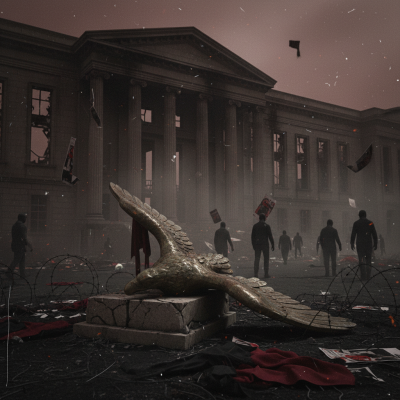
Few historical periods have been as exhaustively documented as Nazi Germany, yet the sheer scale of the catastrophe — twelve years that murdered millions and reshaped the world — can still feel incomprehensible. Alex Bugeja's Nazi Germany: A Descent Into Darkness meets that challenge by refusing to treat the Third Reich as a singular explosion of madness. Instead, it maps the incremental choices, structural weaknesses, and ideological certainties that turned a fragile democracy into a genocidal machine. The result is a narrative that feels less like a chronicle of monsters and more like a warning about how ordinary institutions fail.
What the Book Is About
The book spans twenty-five chapters arranged in strict chronological order, beginning with the Weimar Republic's birth in 1918 and ending with the Nuremberg Trials and the regime's legal and moral legacy. Each chapter tackles a distinct phase or mechanism: the Treaty of Versailles and hyperinflation (Chapter 1), Hitler's early putsch and imprisonment (Chapter 2), the ideological blueprint of Mein Kampf (Chapter 3), the Great Depression as electoral accelerant (Chapter 4), the backroom deal that made Hitler chancellor (Chapter 5), and the systematic Gleichschaltung that coordinated every sphere of German life (Chapter 6). Later chapters cover foreign policy gambits — Rhineland, Austria, Czechoslovakia, Poland — the Blitzkrieg victories, the turn eastward into Operation Barbarossa, the architecture of the Holocaust, resistance movements, total war mobilization, the bombing campaign, and the final collapse in Berlin. The intended reader is a general audience seeking a single-volume synthesis that is accessible without sacrificing nuance; the prose avoids academic jargon but assumes a willingness to engage with bureaucracy, military operations, and moral complexity.
The Descent Was Incremental, Not Inevitable
One of the book's central arguments is that the Third Reich did not arrive fully formed. The Weimar Constitution's proportional representation and Article 48 emergency powers created structural vulnerabilities that anti-democratic forces exploited long before Hitler's appointment. Chapter 1 details how the "stab-in-the-back" myth poisoned political culture, while Chapter 4 shows how the Depression turned a fringe party into the Reichstag's largest faction — still only 37.3 percent at its July 1932 peak. Even the Enabling Act (Chapter 6) required the Centre Party's votes, obtained through "vague assurances regarding the protection of Catholic rights." The consolidation of power unfolded through legalistic steps: the Reichstag Fire Decree, the Enabling Act, the banning of parties, the dissolution of trade unions, the purging of the civil service. Each step was presented as a necessary emergency measure, making resistance seem unreasonable until it was impossible.
Ideology as Operating System, Not Just Rhetoric
Bugeja makes clear that Nazi racial theory was not window dressing but the regime's operating logic. Chapter 3's analysis of Mein Kampf identifies three interlocking pillars: a racial hierarchy with "Aryans" as sole culture-creators, antisemitism framed as a biological struggle against a "bacillus" infecting the national body, and Lebensraum as the geopolitical imperative to conquer Eastern Europe. These ideas dictated policy once power was secured. The Nuremberg Laws (Chapter 9) translated racial fantasy into bureaucratic categories — "full Jew," "Mischling of the first degree," "Mischling of the second degree" — that determined who lived and who died. The invasion of the Soviet Union (Chapter 18) was conceived explicitly as a "war of annihilation" against "Jewish Bolshevism," with the Commissar Order and Einsatzgruppen shootings beginning immediately. The Holocaust (Chapter 19) emerges not as a wartime improvisation but as the fulfillment of a logic present from the movement's inception.
The Führer State: Chaos Beneath the Surface
Chapter 8 offers a corrective to the image of a perfectly synchronized dictatorship. While Hitler's authority was absolute in theory — the 1934 oath bound soldiers to "unconditional obedience to Adolf Hitler" personally — governance operated through "working towards the Führer," a phrase borrowed from historian Ian Kershaw. Subordinates like Göring, Himmler, Goebbels, and later Bormann built competing fiefdoms, interpreting Hitler's vague directives in ways that radicalized policy without his daily involvement. The Night of the Long Knives (Chapter 7) exemplifies this dynamic: Hitler hesitated, then authorized a purge that eliminated the SA leadership and settled scores with conservatives like Schleicher and Strasser, all while the cabinet retroactively legalized the killings with a single sentence: "The measures taken on June 30, July 1 and 2 to suppress treasonous assaults are legal as acts of self-defense by the State." The result was a system that encouraged initiative in the direction of the regime's most extreme impulses.
Propaganda as Engineering, Not Persuasion
Chapter 10 reveals the Ministry of Public Enlightenment and Propaganda as a bureaucratic machine for reality control. Goebbels' insight — that propaganda should appeal to emotion, not intellect, using simple slogans repeated endlessly — was institutionalized through the Reich Chamber of Culture, which mandated membership for anyone working in press, radio, film, theatre, music, art, or literature. The Volksempfänger radio brought Hitler's voice into every home; Leni Riefenstahl's films aestheticized power; the 1933 book burnings performed the exclusion of "un-German" thought. Yet the book notes limits: propaganda could not fully erase religious conviction or class solidarity, and its effectiveness waned as battlefield realities contradicted promised victories. The regime always supplemented persuasion with terror — the Gestapo, the concentration camps, the Volksgerichtshof.
Resistance Existed, But It Was Never Enough
Chapter 20 surveys opposition without romanticizing it. The SPD and KPD operated underground from 1933, penetrated by Gestapo informers. The Confessing Church defended theological autonomy more consistently than Jewish lives, though figures like Niemöller and Bonhoeffer paid with imprisonment and death. The White Rose students distributed six leaflets before their 1943 execution. The July 20 plotters acted late, motivated partly by military disaster. Ordinary Germans hid Jews at mortal risk. Yet the chapter concludes that resistance "was always a minority phenomenon, operating in an environment of profound hostility and isolation," and that the regime's popular legitimacy — buoyed by early economic recovery and foreign policy successes — remained a formidable barrier. The book refuses the comfort of a "good German" narrative while documenting the courage that did exist.
Who Should Read This
Readers new to the period will find a reliable, well-structured entry point that connects high politics to lived experience. Those already familiar with the history will appreciate the synthesis — especially the way domestic policy, foreign policy, racial ideology, and military strategy are shown as mutually reinforcing rather than separate tracks. The book's length and density mean it rewards sustained attention; it is not a quick overview. Anyone uncomfortable with detailed descriptions of genocide, mass shootings, and industrialized murder should know Chapter 19 spares no bureaucratic detail. For everyone else, this is a sobering demonstration of how a modern, cultured society can be dismantled from within when institutions bend, elites collaborate, and ideology hardens into policy. The final chapter's warning — that "the vigilance required to prevent its repetition is a constant and shared human responsibility" — is earned by the preceding nine hundred pages.
Read “Nazi Germany” on MixCache.com →
Please log in or create an account to leave a comment.
No comments yet. Be the first to say something.