
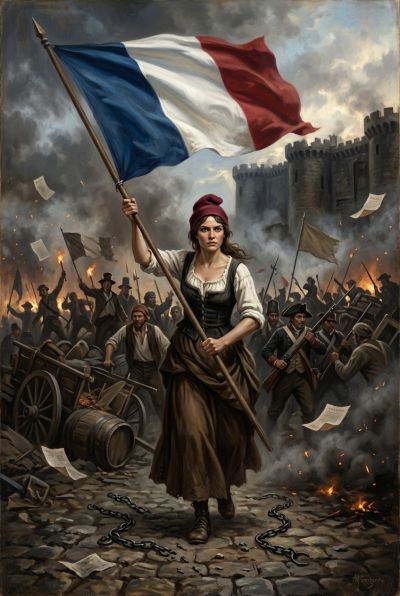
The French Revolution is often reduced to a few iconic images: the storming of the Bastille, the guillotine, Napoleon on horseback. George Hargreaves's The French Revolution: The Ten Years That Changed the World Forever restores the full, messy, exhilarating, and terrifying sequence that connects them. This is not a highlights reel but a chronological immersion in the decade that invented modern politics.
What the book is about
The book spans 1789 to 1799 in twenty-five chapters, moving from the structural rot of the Ancien Régime through the Enlightenment's intellectual ferment, the financial collapse that forced Louis XVI to summon the Estates-General, and the cascade of events that followed: the Tennis Court Oath, the Great Fear, the Women's March on Versailles, the Civil Constitution of the Clergy, the king's flight to Varennes, the September Massacres, the Reign of Terror, the Thermidorian Reaction, the Directory's corrupt instability, and finally Napoleon's coup of 18 Brumaire. Hargreaves writes for the general reader who wants narrative momentum without sacrificing complexity; he assumes no prior expertise but respects the reader's ability to follow shifting factions, economic mechanisms, and constitutional debates. Each chapter opens with a scene — the locked hall of the Tennis Court Oath, the foggy morning of Valmy, the chaotic Orangerie on 19 Brumaire — and then widens to explain causes and consequences.
The Ancien Régime as a system built to fail
Hargreaves devotes his first three chapters to showing why the old order could not reform itself. The three-estate structure concentrated privilege in the clergy (First Estate) and nobility (Second Estate), who together represented roughly two percent of the population yet were exempt from the taille, the gabelle, and the corvée. The Third Estate — 98 percent of the people — bore the entire tax burden while being shut out of power. The king's authority was "constrained by a bewildering and inefficient administrative apparatus" of overlapping provinces, parlements, and intendants. When Controller-General Calonne proposed a universal land tax in 1787, the Assembly of Notables refused, insisting only the Estates-General could authorize new taxes — "a fateful moment" where "the aristocracy, in a bid to protect its own fiscal immunities, had called for the one institution that could challenge not only their privileges but the entire political order." The financial crisis was not a bug but a feature of a system designed to protect privilege at the expense of solvency.
Ideas as kindling: the Enlightenment's practical politics
Chapter Two argues that the Enlightenment did not "cause" the Revolution in a simple sense — "the peasants who would later burn feudal manor houses were not, for the most part, reading Rousseau's Social Contract" — but it supplied the language that turned grievances into demands. Montesquieu's separation of powers, Voltaire's assault on religious intolerance ("Écrasez l'infâme!"), and Rousseau's doctrine of popular sovereignty ("Man is born free, and everywhere he is in chains") circulated through salons, coffeehouses, Masonic lodges, and the massive Encyclopédie. The result was a new "public opinion" that made the monarchy's actions subject to scrutiny. By 1789, concepts like "liberty," "equality," and "the nation" had migrated from philosophical treatises into the cahiers de doléances" — the grievance lists drawn up by every parish and guild — creating a shared vocabulary for revolt.
The radicalization ratchet: how each crisis birthed a more extreme phase
The book's central structural insight is that the Revolution did not follow a plan; it lurched from crisis to crisis, each solution creating new enemies. The Third Estate's declaration as the National Assembly (June 17, 1789) and the Tennis Court Oath ("not to separate… until the constitution of the kingdom is established") forced the king's capitulation, but his troop movements around Paris triggered the storming of the Bastille. The August 4 abolition of feudalism — born of a "patriotic delirium" where nobles competed to renounce privileges — still left peasants owing compensation for many dues, fueling rural unrest. The Civil Constitution of the Clergy (1790) created a schism that "made an enemy of a huge portion of the French population on the deeply personal grounds of religious faith." The king's flight to Varennes (1791) destroyed the constitutional monarchy's credibility. War (declared April 1792) begat the Brunswick Manifesto, which begat the August 10 insurrection and the September Massacres. Each chapter shows the ratchet tightening: "The Revolution was not one event, but a cascade of them, each more radical than the last."
Robespierre, Danton, and the architecture of the Terror
Hargreaves resists both hagiography and demonization. The Committee of Public Safety — "twelve men" in "a green-baize-covered room" — is portrayed as a collective dictatorship driven by genuine conviction and existential fear. Robespierre's "Republic of Virtue" drew on Rousseau: "Society… could not be sustained without a shared belief in a higher power and the immortality of the soul." His Cult of the Supreme Being was an attempt to anchor morality without Catholicism. Danton, "pragmatic and forceful," tried to pivot toward clemency ("Let us be terrible… so that the people do not have to be") but fell victim to the machine he helped build. The Law of 22 Prairial (June 1794) stripped defendants of counsel and witnesses, leaving juries only "acquittal or death." In six weeks, the Revolutionary Tribunal sent over 1,300 people to the guillotine — "more than in the entire previous year." The Terror consumed its architects: Hébertists guillotined in March, Dantonists in April, Robespierre himself on 9 Thermidor.
A legacy of contradictions that still frames our politics
The final chapter distills the Revolution's paradoxical inheritance. It abolished feudalism and created the modern French state — eighty-three départements, a centralized prefecture system, the metric system, the Napoleonic Code cementing "equality before the law, the right to choose one's profession, and… the absolute security of property." It invented the political vocabulary of "left" and "right," "terrorism," and "human rights." The Declaration of the Rights of Man became a tool for Haitian slaves and later feminists to claim rights its authors denied them. Yet the same Revolution produced the Law of Suspects, the noyades at Nantes, and a model of revolutionary dictatorship that "provided a chilling blueprint for the totalitarian regimes of the twentieth century." It ended with Napoleon, a "child of the cannon" who preserved 1789's social gains while extinguishing its political liberty. Hargreaves concludes: "To ask whether the French Revolution was 'good' or 'bad' is to ask the wrong question. It was a promise of universal rights and a reality of brutal repression; a celebration of reason and an unleashing of passion."
Who should read this
Readers who want a single-volume narrative that balances drama with analysis will find this book ideal. It rewards anyone interested in how modern political categories — constitution, citizenship, emergency powers, secularism — were forged under pressure. Specialists may miss footnotes and historiographical debate, but the bibliography points to deeper waters. Those allergic to military detail should note that campaigns (Valmy, Italy, Egypt) are covered efficiently but not skipped. If you've ever wondered how a movement for liberty becomes a machine for terror, or how a republic becomes an empire, this decade — and this book — is where the patterns first appear.
Read “The French Revolution” on MixCache.com →
Please log in or create an account to leave a comment.
No comments yet. Be the first to say something.