
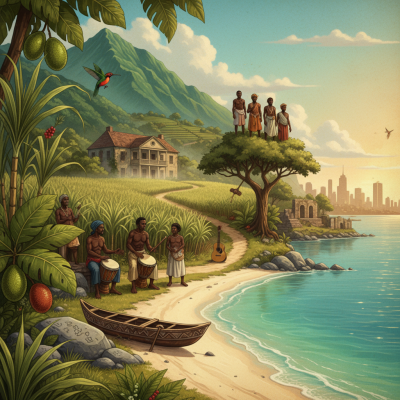
Jamaica's history is often reduced to a handful of touchstones: Columbus, sugar, Marley, Bolt. Philip Smith's A History of Jamaica refuses that simplification. In twenty-five chapters, he builds a narrative that connects the Taíno's *conuco* farming mounds to the bauxite pits that replaced them, the Maroon's *abeng* horn to the dancehall's digital riddim, and the 1831 Sam Sharpe rebellion to the 2010 Tivoli Gardens incursion. The result is a single volume that reads less like a textbook than a long, argued conversation about how a nation forged in resistance continues to negotiate its freedom.
What the book is about
The book moves chronologically from the island's first inhabitants — the Taíno, who settled around 650 AD — through Spanish colonization, English conquest, the sugar revolution, emancipation, Crown Colony rule, the rise of party politics, independence in 1962, and the turbulent decades since. Each chapter tackles a distinct era or theme: the Maroon wars, Marcus Garvey's Pan-Africanism, the 1938 labour rebellions, the West Indies Federation, Michael Manley's democratic socialism, Edward Seaga's neoliberal turn, the FINSAC financial crisis, and the evolution of music and religion. Smith writes for the general reader who wants depth without jargon; he assumes no prior knowledge but rewards it. The prose is clear, the pacing brisk, and the sourcing transparent — he tells you when oral tradition fills gaps in the written record.
The Taíno world before Columbus
Smith devotes his first two chapters to a civilization usually dispatched in a paragraph. The Taíno called the island Xaymaca, "land of wood and water," and built over 200 villages organized around central plazas where they played *batey*, a ceremonial ball game that doubled as diplomacy. Their language survives in English words we use daily: "hammock" (*hamaca*), "hurricane" (*huracán*), "tobacco" (*tabaco*), "barbecue" (*barbacoa*). They processed cassava into *bammy*, still a Jamaican staple. Chapter 2 details the rupture: Columbus's 1494 arrival, the *encomienda* system that worked them to death, and the smallpox epidemic that killed up to 90% of the remaining population by 1518. Smith notes the psychological toll — "women, in an ultimate act of defiance and hopelessness, were reported to have induced abortions or killed their newborn infants to save them from a life of slavery." By 1534 the Taíno as a distinct society had been "effectively annihilated," though genetic traces persisted through mixing with Africans and Spaniards.
Maroon resistance and the limits of freedom
The Maroons — escaped Africans who formed autonomous communities in the Cockpit Country and Blue Mountains — receive two full chapters (6 and 7) and appear throughout. Smith portrays them not as romantic rebels but as strategic military actors. The First Maroon War (1720s–1739) forced the British to spend £240,000 and pass 44 acts before suing for peace. The 1739 treaty granted the Leeward Maroons 1,500 acres and internal autonomy in exchange for a clause that would haunt them: they agreed to "capture and return all runaway slaves." This turned the Maroons into "a colonial police force" and created "a deep social and psychological rift between the two black communities." The Second Maroon War (1795–96) erupted when two Trelawny Town Maroons were flogged by an enslaved jailer — "the punishment itself was less offensive than the fact that it was administered by a slave, a man whom they considered their inferior." Governor Balcarres imported Cuban bloodhounds to break their morale, then betrayed the surrender terms negotiated by General Walpole, deporting nearly 600 Maroons to Nova Scotia and later Sierra Leone. Smith calls it "a shameful act of political betrayal."
The rivalry that built modern politics
Chapters 13 through 16 trace how the 1938 labour rebellions at Frome sugar estate produced two cousins who would dominate Jamaica for four decades: Alexander Bustamante and Norman Manley. Bustamante, "a flamboyant, charismatic, and unpredictable moneylender," founded the Bustamante Industrial Trade Union and later the Jamaica Labour Party (JLP). Manley, "a brilliant Rhodes Scholar" and barrister, launched the People's National Party (PNP) on democratic socialist principles. Their rivalry was personal and structural: "two powerful political parties that were not based on distinct ideologies in the European sense, but on the rival personalities of two charismatic leaders and their direct affiliation with two competing trade unions." The 1944 election under universal adult suffrage — the electorate expanding from 60,000 to 660,000 overnight — gave Bustamante a landslide. Manley won in 1955 and championed the West Indies Federation, but a 1961 referendum rejected it (54% to 46%). Bustamante's "Jamaica first" nationalism prevailed. Independence arrived August 6, 1962, with the new flag's black triangles representing "the strength and creativity of the people, who, it was explicitly stated, had borne and overcome hardships."
Culture as Jamaica's most powerful export
Chapters 22 and 23 make the case that Jamaica's global influence flows from culture, not economics. Smith traces music from mento's rhumba box and double-entendre lyrics through ska's "off-beat guitar chop" (Millie Small's "My Boy Lollipop" went global in 1964), rocksteady's melodic basslines, reggae's Rastafari consciousness ("Babylon" for the corrupt Western order, "Zion" for Africa), dub's studio-as-instrument innovation (King Tubby, Lee "Scratch" Perry), to dancehall's digital "Sleng Teng" riddim and the contemporary "Reggae Revival" of Chronixx, Protoje, and Grammy-winner Koffee. Religion gets equal weight: Anglicanism as the planters' church, non-conformist missionaries as subversive educators, Revivalism's blend of Christian and African spirit possession, and Rastafari's transformation from persecuted sect to global philosophy. Smith notes the 1860–61 Great Revival "ignited a spiritual explosion that blended Christian teachings with African ritual" and that Marcus Garvey's prophecy — "Look to Africa, where a black king shall be crowned" — found fulfillment in Haile Selassie's 1930 coronation, birthing a movement whose "influence on Jamaican culture and identity far outweighs the number of its adherents."
The economic rollercoaster: from sugar to services
Chapter 24 distills three centuries of economic dependence into a clear arc. Sugar dominated for 200 years, then collapsed under beet competition and freed labour. Bananas — "green gold" — shifted Jamaica's trade axis from London to New York via the United Fruit Company. Bauxite made Jamaica the world's leading producer by the 1960s, but the 1974 levy that quintupled government revenue coincided with the oil crisis, and later WTO rulings eroded preferential access. Tourism surpassed all sectors but suffers from "leakage" as all-inclusive resorts import food, management, and profits. The 1990s financial liberalization spawned a "frenzied, gold-rush atmosphere" that ended in the FINSAC bailout costing "over 120 billion Jamaican dollars, a staggering sum equivalent to around 40% of the country's GDP." Today, Business Process Outsourcing (call centres) employs tens of thousands, while the informal economy — higglers, unlicensed taxis, and the drug trade — sustains millions. Smith concludes: "From the structured brutality of the sugar plantation to the complex, globalized, and often precarious mix of tourism, services, and informal enterprise that defines it today, the Jamaican economy has been in a state of constant, and often painful, evolution."
Who should read this
Readers who want a single, coherent narrative that connects Jamaica's political, economic, and cultural threads will find this book indispensable. It suits students, travellers, diaspora members, and anyone who has heard a dancehall riddim or watched a sprint final and wondered about the history behind the sound and the speed. Those seeking deep archival analysis or theoretical frameworks may find the synthesis-level approach limiting, but the chapter-by-chapter structure makes it easy to dive into specific eras. Smith's even-handedness — he critiques both Manley's IMF defiance and Seaga's garrison politics, both the planters' cruelty and the post-independence corruption — makes it a trustworthy guide. For a bookshelf that already holds C.L.R. James or Carolyn Cooper, this is the panoramic companion that shows how all the pieces fit together.
Read “A History of Jamaica” on MixCache.com →
Please log in or create an account to leave a comment.
No comments yet. Be the first to say something.