
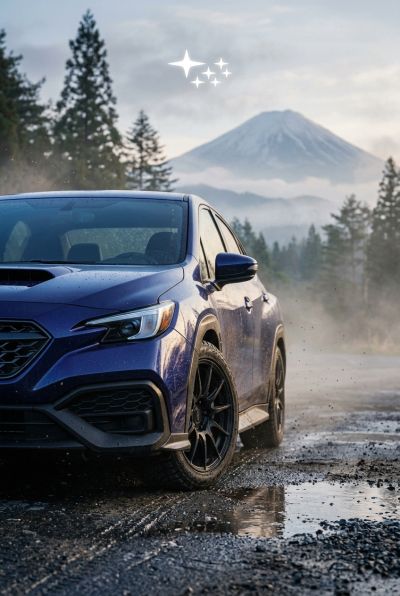
In the crowded field of automotive histories, few brands offer a narrative as distinct as Subaru's: a company born from the ashes of a wartime aircraft giant that stubbornly clung to a flat-four engine and all-wheel drive until the rest of the industry caught up. Carl Johnson's Subaru: Portrait of a Japanese Automobile Company doesn't just catalog models; it explains how a niche player turned engineering quirks into a global identity.
What the book is about
The book spans 25 chapters, moving chronologically from the 1917 founding of Nakajima Aircraft through the 2022 launch of the Solterra EV. Johnson structures the narrative around pivotal vehicles — the 360 "Ladybug," the Leone 4WD wagon, the Legacy, the Impreza WRX, the Outback, the Forester — and the engineering decisions that linked them. He gives equal weight to the boardroom (the 1953 merger that created Fuji Heavy Industries, the 2005 Toyota partnership) and the rally stage (Colin McRae's 1995 championship, the Prodrive alliance). The intended reader is neither a pure gearhead nor a casual fan; Johnson assumes curiosity about how product, culture, and circumstance intertwine, and he rewards it with technical detail that never feels gratuitous.
Aviation DNA that never left the chassis
The book's strongest through-line is the persistence of aircraft-era thinking. Chapter 1 details how Nakajima's vertical integration — designing airframes and engines in-house — became Subaru's default mode. When the P-1 prototype needed an engine and Prince Motor Company balked at supplying one, Fuji Heavy Industries simply built its own (Chapter 2). That self-reliance reappears in the boxer engine's adoption (Chapter 4), the monocoque body of the 360 (Chapter 3), and the Subaru Global Platform (Chapter 20). Johnson quotes the company's first president, Kenji Kita: "If you're going to build a car, you've got to build a proper car" — a line that echoes the aviation standard of no compromises. The result is a brand where the engine sits low, the drivetrain runs straight, and the structure absorbs energy like a fuselage.
The Leone wagon: an accident that became a strategy
Chapter 5 reveals that Subaru's defining feature — mass-market all-wheel drive — began as a custom order. Tohoku Electric Power Company needed a passenger car that could handle mountain service roads; Subaru engineers adapted the Leone's front-drive layout by adding a transfer case and a driveshaft. The 1972 Leone 4WD Station Wagon became "the first mass-produced, affordable four-wheel-drive passenger car in the world." Johnson notes the timing was deliberate: the launch coincided with the Sapporo Winter Olympics. The U.S. ski-team partnership (Chapter 6) cemented the association. What started as a utilitarian fix for Japanese utilities became the template for every Subaru since, culminating in the Symmetrical All-Wheel Drive systems detailed in Chapter 8 — viscous coupling, VTD, DCCD — each a refinement of that original "on-demand" lever.
Rally as R&D lab and brand builder
Chapters 10 through 13 make the case that the World Rally Championship did more than burnish Subaru's image; it forced engineering leaps that migrated to showrooms. The formation of Subaru Tecnica International (STI) in 1988 (Chapter 10) created a skunkworks that could iterate faster than the main factory. The Legacy's 100,000-km endurance record at Arizona Test Center — "average speed of 138.780 mph" over 19 days — proved the EJ engine's durability before the Impreza even existed. When the Impreza 555 arrived (Chapter 11), its smaller footprint and stiffer chassis were direct responses to WRC stage demands. Colin McRae's "if in doubt, flat out" driving (Chapter 13) became a marketing asset so potent that the Colin McRae Rally video game series introduced a generation of Americans to the WRX years before it was sold here (Chapter 16). The feedback loop was explicit: STI built the Group A car, homologation specials like the WRX Type RA hit the street, and data from both fed the next rally iteration.
Creating segments by refusing to build trucks
Subaru's lack of a body-on-frame platform — usually a liability — became its greatest creative spur. Chapter 14 recounts how Subaru of America, watching the SUV boom threaten its wagon sales, lifted a Legacy wagon, added cladding, and hired Paul Hogan to sell the result as the "World's First Sport-Utility Wagon." The Outback wasn't a compromise; it was a category invention. Chapter 15 repeats the formula with the Forester: an Impreza chassis in an upright body, delivering "SUV tough, Car easy." Chapter 21 shows the pattern scaling down (Crosstrek) and up (Ascent), each built on the Subaru Global Platform that "could house hybrid, plug-in hybrid, and even fully electric systems." The failed experiments — the Baja (Chapter 17) and the B9 Tribeca (Chapter 17) — are treated as instructive missteps: the Baja's "Switchback" pass-through was clever but the bed too small; the Tribeca's "pig nose" grille alienated buyers before the 2008 redesign could save it.
From "Cheap and Ugly" to "Love" — marketing that mirrored the product
Johnson devotes Chapter 22 to the 2007 pivot that tripled U.S. sales in a decade. The "Love. It's what makes a Subaru, a Subaru" campaign grew from a research insight: owners didn't cite AWD or reliability first; they said "I love it." The ads shifted from spec sheets to life moments — a father teaching his daughter to drive, the "Dog Tested. Dog Approved." Barkley family, the annual Share the Love charity event. Chapter 6 notes the earlier "Cheap and Ugly" tagline for the 360 was self-deprecating honesty; the "Love" campaign was earned confidence. The book also highlights Subaru's early, coded outreach to lesbian buyers in the 1990s — license plates reading "XENA LVR" and taglines like "It's Not a Choice. It's the Way We're Built" — as a precursor to the same authenticity-first approach.
Who should read this
This book serves three audiences well. Subaru owners will recognize the lineage of their car and understand why the brand feels different from a Toyota or Honda. Business readers get a case study in how a small manufacturer turns constraints (no truck platform, no V8, limited capital) into a coherent, defensible niche. And anyone interested in Japanese industrial history receives a clear-eyed view of the zaibatsu dissolution, the MITI "People's Car" mandate, and the Toyota partnership that reshaped two companies. Casual car browsers may find the engineering passages dense, but Johnson's narrative momentum — especially in the rally and Outback chapters — carries the story. The final chapter's outlook on electrification, including the Solterra's wheel-recall debacle and the 2025 e-Boxer hybrid rollout, makes the book current enough to matter for the next product cycle.
Read “Subaru” on MixCache.com →
Please log in or create an account to leave a comment.
No comments yet. Be the first to say something.