
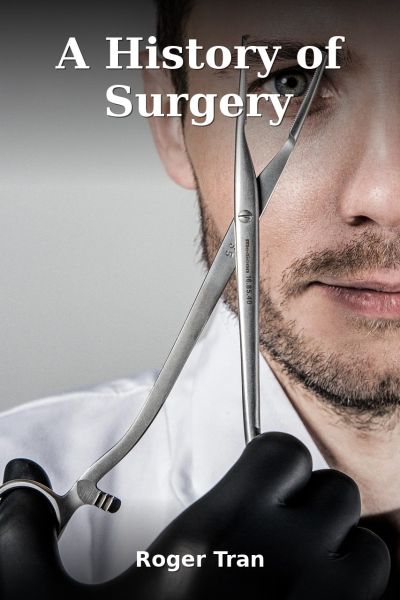
Surgery's history is not a tidy march of progress but a messy, often horrifying saga of trial and error, where breakthroughs arrived decades after the science was ready and patients paid the price. Roger Tran's A History of Surgery refuses to sanitize this story, instead laying bare the centuries when speed mattered more than precision, when "laudable pus" was celebrated as healing, and when the surgeon's knife was as likely to kill as cure. The result is a comprehensive, unflinching account that respects the science without romanticizing the suffering.
What the Book Is About
The book spans 25 chapters, moving chronologically from prehistoric trepanation to speculative futures of AI-guided microsurgery. Tran structures the narrative around the field's three enduring obstacles — pain, infection, and bleeding — and the breakthroughs that gradually overcame them: anesthesia (Chapter 8), antisepsis (Chapter 9), and hemostasis with transfusion (Chapter 10). Alongside these technical threads, he weaves in the social history: the barber-surgeon guilds (Chapter 6), the exclusion and eventual entry of women (Chapter 12), the transformation of operating theaters from public spectacles into sterile suites (Chapter 11), and the persistent global disparity in surgical access (Chapter 22). The prose is accessible but dense with detail, aimed at readers who want the full arc — not just the highlight reel — of how cutting into bodies became a science.
The Ancient Toolkit Was Smarter Than We Assume
Tran's opening chapters dismantle the notion that ancient surgery was purely superstitious butchery. The Edwin Smith Papyrus (c. 1600 BCE) reveals a trauma manual that "adopts a rational, empirical approach," with case studies following a pattern of examination, diagnosis, prognosis, and treatment — including suturing with linen thread and honey-soaked bandages. Half a world away, the Sushruta Samhita describes over 120 instruments and a cheek-flap rhinoplasty that "prefigures methods used centuries later." Even trepanation, the book's earliest documented procedure, shows healing evidence on Neolithic skulls, proving patients survived. These weren't lucky guesses; they were accumulated observational science, constrained only by anatomy's taboos and the absence of anesthesia.
The Barber-Surgeon: Craftsman, Outsider, Ancestor
Chapter 6 gives the barber-surgeon his due as the workhorse of pre-modern medicine. The striped pole — red for blood, white for bandages, the pole itself a grip for vein prominence — advertised a trade blending shaves, bloodletting, tooth-pulling, and fracture-setting. Guilds like London's United Company of Barber-Surgeons (1540) regulated apprenticeships but also enforced hierarchy: surgeons were barred from barbering, barbers from surgery beyond tooth-drawing. Yet figures like Ambroise Paré emerged from this world, abandoning boiling oil for gunshot wounds after a battlefield shortage forced improvisation with "egg yolk, rose oil, and turpentine" — a moment Tran marks as a quiet revolution in wound management. The barber-surgeon's legacy is the persistent tension between manual skill and intellectual status that shaped surgical training for centuries.
Two Revolutions That Changed Everything
The book's structural hinge arrives in Chapters 8 and 9: anesthesia and antisepsis. Tran details how Crawford Long, Horace Wells, and William Morton stumbled toward ether and chloroform — Morton's 1846 Massachusetts General Hospital demonstration prompting Warren's famous declaration, "Gentlemen, this is no humbug!" — while Joseph Lister, inspired by Pasteur's germ theory, introduced carbolic acid spray and dressings. The pairing is crucial: anesthesia gave surgeons time; antisepsis gave patients survival. Tran notes the irony that "the quietude brought by anesthesia ironically made the subsequent waves of sepsis even more conspicuous." Together, they turned surgery from a last-ditch gamble into a deliberate, repeatable intervention.
War as the Relentless Engine of Innovation
From Paré's ligatures to Gillies's tube pedicle flaps, conflict repeatedly forced surgical leaps. Chapter 17 traces how World War I's "industrialized carnage" birthed organized evacuation chains — Regimental Aid Post to Casualty Clearing Station to Base Hospital — and formalized triage, "the grim calculus of sorting" the wounded by survivability. The Carrel-Dakin wound irrigation method emerged from the trenches, while the Thomas splint cut femoral fracture mortality dramatically. World War II added penicillin, blood banking at scale, and vascular repair over ligation. Tran doesn't glorify this; he presents it as "a brutal necessity born of overwhelming numbers," where each advance was "paid for in an ocean of pain and blood."
The Modern Frontier: Access, Ethics, and the Algorithm
The final chapters confront surgery's unfinished business. Chapter 22's Lancet Commission data reveals that five billion people lack safe surgical access, with "catastrophic health expenditure" pushing families into poverty. Chapter 23 revisits lobotomy's "dark stain" — Freeman's ice-pick transorbital procedure performed on non-consenting institutionalized patients — as a warning about innovation untethered from ethics. Chapter 25 looks ahead: AI overlays highlighting nerves in real time, 3D-bioprinted organs from a patient's own cells, telesurgery bridging expertise gaps. Tran's closing note is measured: "The human element — compassion, communication with the patient, the ethical responsibility — will remain central, perhaps even more so as technology takes over some of the technical execution."
Who Should Read This
This book rewards readers who want the full, unvarnished trajectory — medical students seeking context for their training, history buffs comfortable with technical detail, and clinicians curious about their specialty's roots. It's less suited for those wanting a personality-driven narrative or a light popular-science overview; Tran prioritizes comprehensiveness over anecdote, and the density of names, dates, and procedures can feel textbook-like. But for anyone willing to follow the scalpel's path from flint to fiber optics, A History of Surgery delivers exactly what its title promises: a rigorous, sobering, and ultimately awe-inspiring account of humanity's longest fight against its own fragility.
Read “A History of Surgery” on MixCache.com →
Please log in or create an account to leave a comment.
No comments yet. Be the first to say something.