
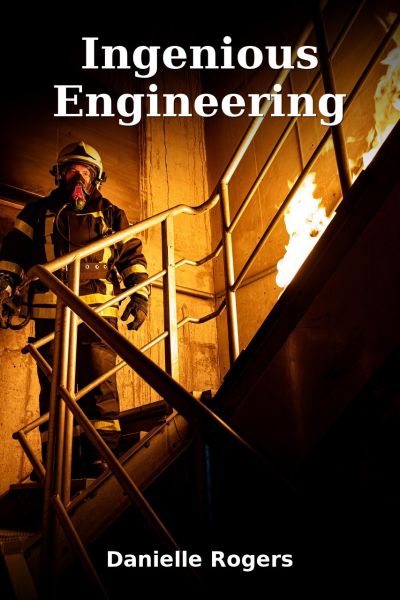
The history of engineering is often told as a parade of lone geniuses and sudden epiphanies. Danielle Rogers tells it differently. Ingenious Engineering moves chronologically through 25 chapters, but its real argument is structural: every invention rests on the shoulders of earlier ones, and the most transformative changes come from the interaction of multiple breakthroughs — materials, energy, communication, and computation — rather than any single device.
What the book is about
Ingenious Engineering: Revolutionary Inventions that Transformed the World spans roughly 5,500 years of human innovation, from the potter's wheel in 3500 BCE Mesopotamia to the large language models reshaping the 2020s. The book's 25 chapters each focus on a specific invention or field — bronze and iron metallurgy, hydraulic engineering, the steam engine, railroads, electricity, the telegraph and telephone, radio, computing, microchips, skyscrapers, bridges and tunnels, dams and power grids, smart cities, renewable energy, biomedical engineering, robotics, aerospace, and artificial intelligence. Rogers writes for a general audience with curiosity about how things work; she assumes no technical background but doesn't oversimplify. The through-line is the "how, why, and who" behind each development, with attention to the social and economic ripples that followed.
Invention as a cascade, not a moment
One of the book's clearest insights is that major inventions rarely arrive fully formed. The wheel appears first as a potter's tool around 3500 BCE; the transport wheel emerges later, and the spoked wheel — lighter and faster — doesn't arrive until roughly 2000 BCE. Rogers writes, "This continuous refinement, driven by the desire for improved performance and efficiency, is a hallmark of engineering progress throughout history. It's a testament to the fact that even the most revolutionary invention can always be improved upon." The same pattern repeats with the steam engine: Savery's 1698 vacuum pump, Newcomen's 1712 atmospheric engine, and Watt's separate condenser (1769) each solved a specific flaw in its predecessor. The book treats engineering as an iterative conversation across generations, not a series of isolated lightning strikes.
Materials mastery as the hidden foundation
Several chapters make the case that advances in materials science quietly enable every other domain. Chapter 3 traces the move from copper to bronze (an alloy requiring long-distance tin trade) to iron (abundant but demanding higher smelting temperatures and forging skill). Chapter 15 picks up the thread with silicon: the planar process developed by Jean Hoerni at Fairchild Semiconductor, combined with Robert Noyce's insight to deposit aluminum interconnects directly on the wafer, made the monolithic integrated circuit manufacturable at scale. Rogers notes that "Noyce's vision of patterning interconnections directly onto the chip that laid the groundwork for modern microchip manufacturing." Without that materials breakthrough, the computing revolution — and by extension modern AI — would have stalled at the discrete-transistor stage.
Energy transitions reshape society as much as technology
The book structures much of its middle section around successive energy regimes. Chapter 4 covers hydraulic engineering — canals, aqueducts, and water wheels — that "freed humans from laborious manual tasks" and powered early industry. Chapter 6 details how the steam engine "freed industry from its dependence on geographically constrained natural forces" and enabled factories to locate near labor and markets rather than rivers. Chapter 8 shows the internal combustion engine doing the same for personal mobility. Chapter 11 follows electricity's path from Volta's pile through Faraday's generator to the "War of the Currents" that settled on AC distribution. Chapter 21 brings the story to renewables, where "Swanson's Law" (a 20% price drop per doubling of solar PV volume) has made solar "the cheapest form of new electricity generation" in many regions. Each transition rearranges geography, labor, and geopolitics as thoroughly as it rewires machines.
Communication technologies compress time and space
Chapters 12 through 15 form a mini-arc on information engineering. The telegraph (Chapter 12) required "a single wire and a unique code" — Morse's dot-dash system — and the first transatlantic cable (1866) turned week-long message delays into minutes. The telephone (same chapter) added voice, but still needed wires. Radio (Chapter 13) cut the cord: Marconi's 1901 transatlantic "S" signal proved waves could follow Earth's curvature via the ionosphere. Computing (Chapter 14) automated calculation, culminating in ENIAC's 5,000 additions per second. The microchip (Chapter 15) shrank that power onto a fingernail: the Intel 4004 (1971) matched ENIAC's throughput with 2,300 transistors. Rogers draws a direct line from Jacquard's punched-card loom to Babbage's Analytical Engine to modern LLMs, noting that "the Jacquard loom was a precursor to modern computing, as it demonstrated how a sequence of instructions could be stored and executed mechanically."
Engineering as collective, cross-generational work
The introduction sets the tone: "Engineering is not the story of lone genius alone. It is equally the chronicle of teams, cultures, and communities harnessing collective insight to conquer formidable challenges." This theme resurfaces in the transcontinental railroad (Chapter 7), built by Irish and Chinese immigrants; the Apollo program (Chapter 24), coordinating "millions of components and thousands of people"; and the International Space Station (same chapter), "assembled in orbit over many years" from modules built by multiple nations. Even the smartphone (Chapter 15) is described as "a testament to the power of integrated circuits" where "its processing unit, memory, wireless communication chips, and myriad other specialized chips work in concert, each containing billions of transistors." The book consistently refuses the great-man narrative in favor of supply chains, standards bodies, and the slow accumulation of craft knowledge.
Who should read this
Readers who enjoy sweeping histories like The Ascent of Man or Connections will appreciate the breadth and the connective tissue Rogers provides. Aspiring engineers get a readable map of their field's lineage. Generalists curious about how specific technologies — say, the water wheel or the transistor — actually work will find clear explanations without jargon overload. Readers wanting deep technical detail on any single invention should look elsewhere; the book sacrifices depth for scope. But for anyone who wants to see the invisible scaffolding behind the modern world — and how each layer made the next possible — this is a coherent, well-paced guide.
Read “Ingenious Engineering” on MixCache.com →
Please log in or create an account to leave a comment.
No comments yet. Be the first to say something.